

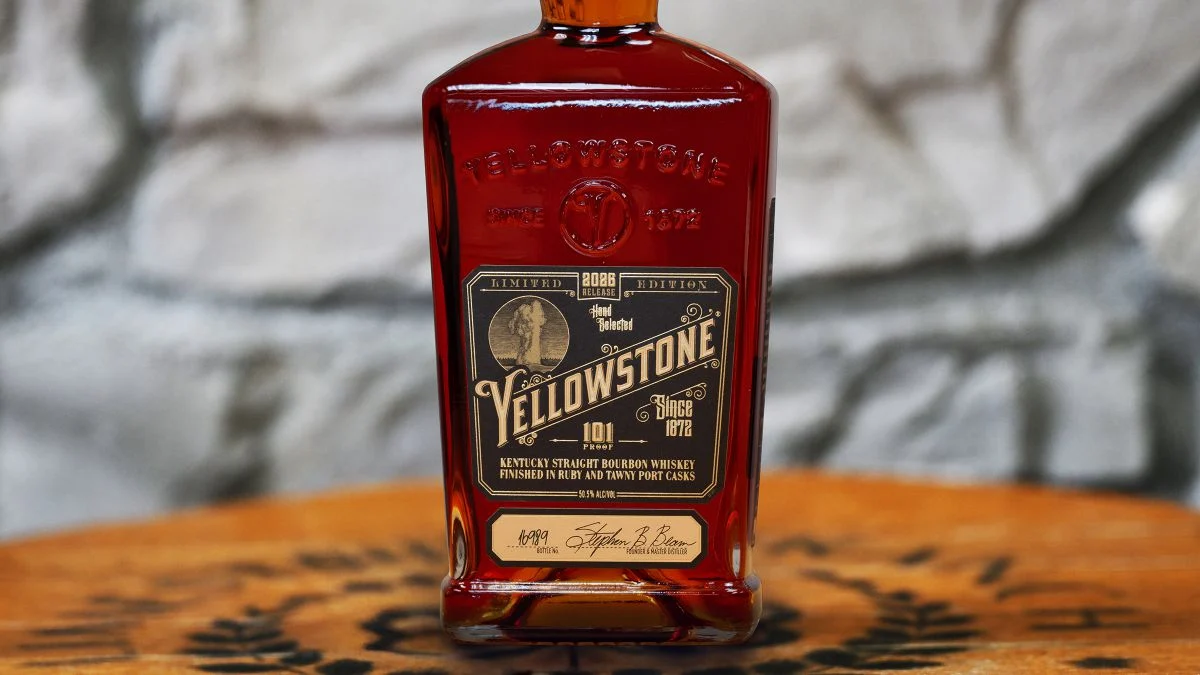
The American whiskey landscape is currently defined by a paradox: while the industry faces a cooling period characterized by excess inventory and production pauses, the market for ultra-premium, experimental, and cask-finished bourbons remains as white-hot as ever. This week, the storied Yellowstone brand—produced at the Limestone Branch Distillery in Lebanon, Kentucky—added a new chapter to its storied legacy with the announcement of the Yellowstone Limited Edition 2026.
This annual release, a cornerstone of the brand’s identity under the stewardship of seventh-generation master distiller Stephen Beam, offers a sophisticated departure from standard bourbon profiles. By marrying two distinct port-cask finishes, Beam has attempted to bottle the shifting light of the American West.
Main Facts: A Study in Contrast
The Yellowstone Limited Edition 2026 is not merely a single-cask experiment; it is a meticulously constructed blend designed to evoke the dramatic topography of the Grand Canyon of the Yellowstone National Park. The release features a base of 7- and 14-year-old bourbons, split into two distinct finishing paths.
The first portion was finished in ruby port barrels, chosen specifically for their ability to impart a vibrant, fruit-forward sweetness that mimics the “brilliant flare” of a canyon sunset. The second portion underwent maturation in tawny port casks, selected for their oxidative, nutty, and deeper profile to represent the “deep shadows of the valley floor.” The resulting blend is bottled at 101 proof (50.5% ABV), a testament to the balance required when working with such high-character fortified wine barrels.
With an SRP of $100, the whiskey is currently available exclusively at the Limestone Branch Distillery Visitor’s Center, with a nationwide rollout to select retailers scheduled for the coming month.
A Chronological Legacy: From Dant to Beam
To understand the significance of the 2026 Limited Edition, one must look back at the historical tapestry of the brand. Yellowstone was founded in the late 19th century by distiller Joseph Bernard Dant, a man whose name remains synonymous with the early days of Kentucky bourbon. However, the modern iteration of the brand owes its life to a 2011 resurrection by Stephen Beam.
Beam’s pedigree is perhaps the most impressive in the industry; he is a descendant of both the Dant and Beam families—two of the most influential bloodlines in American distilling history. Since taking the helm, Beam has navigated the brand through a series of corporate transitions, most notably the 2021 acquisition by Luxco, which was subsequently absorbed by MGP Ingredients (MGP).
The trajectory of the brand has been one of calculated expansion. Under MGP’s ownership, Yellowstone joined a robust portfolio including Blood Oath, Ezra Brooks, and Daviess County. This consolidation solidified Yellowstone’s position in the premium category, allowing it to leverage the production scale of its parent company while maintaining the artisanal spirit of the Limestone Branch facility.
The State of the Industry: Production Pauses and Excess Capacity
The announcement of this new release arrives against a complex economic backdrop. Earlier this year, MGP made headlines by announcing a strategic pause in production at its Kentucky facilities, including the Limestone Branch Distillery.

In a public statement issued in May, MGP president and CEO Julie Francis attributed this decision to the "excess capacity and inventory" that has begun to plague the broader American whiskey industry. After years of record-breaking growth and frantic expansion, the market is experiencing a correction. Demand for mid-tier, high-volume products has softened, leaving distilleries with warehouses brimming with aging spirit.
However, the industry’s "hiatus" is nuanced. While the physical act of distillation may be paused, the work of the blender and the master distiller continues unabated. The Yellowstone Limited Edition 2026 serves as a reminder that the industry’s value lies not just in the volume of alcohol produced, but in the curation of existing stocks. By focusing on blending older, pre-existing inventories—like the 14-year-old components in this year’s release—brands can continue to provide innovation and excitement to the consumer, regardless of the current status of their mash tuns.
Official Perspectives: The Philosophy of the Canyon
Stephen Beam’s approach to this year’s release is rooted in a desire to bridge the gap between landscape and liquid.
"Every Yellowstone bottle is inspired by the park, and this year I kept coming back to the Grand Canyon of the Yellowstone National Park," Beam said in a recent press statement. "The way the sunlight moves across the canyon transforms what you see from moment to moment. Using ruby and tawny port casks allowed me to capture that contrast and translate it into a bourbon that feels dynamic and complete."
While the terminology may lean into the poetic, the tasting notes provided by the distillery suggest a profile that lives up to the description. Enthusiasts can expect an aromatic profile dominated by charred oak, blackberry, and piloncillo—a Mexican raw cane sugar that adds an earthy, molasses-like depth. On the palate, the influence of the port barrels is expected to manifest through notes of dark fruit, caramelized sugar, and a lingering dark chocolate finish, providing a complex counterpoint to the traditional bourbon spice.
The Implications of the "Cask-Finished" Trend
The rise of the Yellowstone Limited Edition 2026 is part of a larger trend of "cask-finished" bourbons that are currently dominating the premium retail shelf. Whether it is the wood-finished experiments seen in the Whiskey JYPSI series or the elaborate trilogy releases of Blood Oath, the industry has clearly pivoted toward customization.
Why Cask Finishing Matters Now
- Differentiation: In a crowded market, a standard "bourbon" label is often not enough to justify a $100 price point. Finishing adds a layer of exclusivity and complexity that signals "limited edition" status.
- Age Statement Management: By blending 7-year and 14-year-old stocks, distillers can maintain the maturity of older whiskies while utilizing the vigor and grain-forward sweetness of younger barrels.
- Consumer Sophistication: The modern whiskey drinker is increasingly interested in the science of maturation. Terms like "ruby port" and "tawny port" invite the consumer to learn about the interaction between oxygen, wood, and wine, elevating the act of drinking to an educational experience.
Looking Ahead
The decision by MGP to pause production is a sobering reminder that the "whiskey boom" is entering a period of maturity. For consumers, this likely means a shift toward higher-quality, lower-volume releases rather than the "all-hands-on-deck" growth strategy of the previous decade.
The Yellowstone Limited Edition 2026 is a microcosm of this new era. It is a product that relies on the patient maturation of legacy stock, combined with the creative intervention of a master blender who understands that, in the world of high-end spirits, the "what" is just as important as the "how."
As the bottle hits shelves nationwide, it will be closely scrutinized by critics and collectors alike. If it succeeds in capturing the contrast of the Grand Canyon—the interplay of light and dark, fruit and oak—it will stand as a successful case study for how legacy brands can remain relevant during periods of economic volatility. For now, the gates of the Limestone Branch Distillery remain open, and the tradition of the Yellowstone brand continues, proving that even when the stills are silent, the art of the whiskey maker remains in constant motion.
 Evan Lee Salim
 Asep Darmawan
 Laily UPN
