

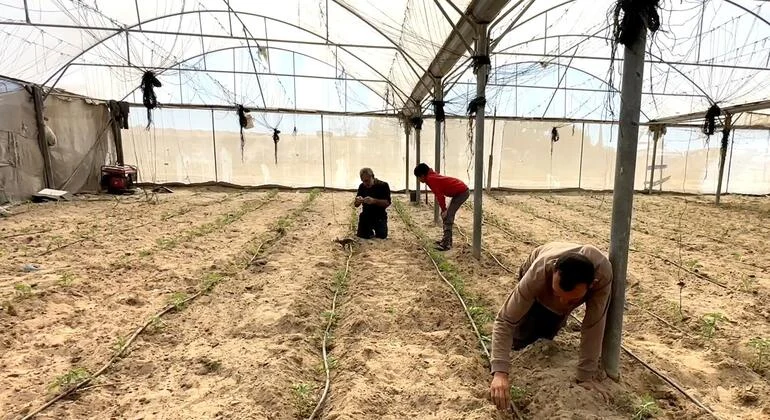
In the fractured landscape of the Gaza Strip, where the dust of conflict has yet to fully settle, a quiet, desperate battle for survival is taking place. Palestinian farmers, stripped of their livelihoods by the devastation of the war that erupted on October 7, 2023, are attempting to coax life from scorched earth. Simultaneously, in the West Bank, a surge in settler violence and the continued expansion of illegal outposts have created a dual crisis that humanitarian agencies warn is reaching a breaking point.
The Human Cost of Agricultural Collapse
For Taysir Dahdouh, a farmer in the Zeytun neighborhood of Gaza City, the geography of his life has been reduced to a plot of land slightly smaller than a football pitch. Before the conflict, his greenhouses were a testament to productivity, yielding a steady supply of cucumbers and tomatoes that sustained his family and fed his community. Today, the infrastructure that once supported his work—the irrigation systems, the plastic sheeting, and the tools—lies in ruins.
Dahdouh’s story is a microcosm of a broader agricultural catastrophe. The destruction of Gaza’s farming sector has not only shattered individual livelihoods but has also compromised the enclave’s food sovereignty. As the rebuilding process begins, farmers like Dahdouh find themselves in a race against time and scarcity, desperately needing basic inputs—seeds, fertilizer, and, most crucially, water—to restart their production.
Chronology: From Conflict to Conditional Recovery
The path to agricultural rehabilitation has been arduous and marked by repeated displacement. Since the cessation of major hostilities, the UN Development Programme (UNDP) has been working to provide a foothold for returning families.
- October 7, 2023: Large-scale conflict erupts, leading to the immediate suspension of agricultural production and the destruction of critical farming infrastructure.
- Post-Ceasefire 2024-2025: Displaced families begin the slow, dangerous process of returning to their ancestral lands, often finding their homes and fields reduced to rubble.
- Early 2026: UNDP initiates the distribution of 200 relief housing units in heavily bombed areas. These units serve as a base for families to reclaim their land.
- April 2026: The Food and Agriculture Organization (FAO) announces a scale-up of its cash-for-farmers project, aimed at assisting 1,500 farmers in time for the 2026 planting season.
- Mid-2026: Humanitarian partners, including the World Food Programme (WFP), ramp up efforts to deliver food and educational supplies to displaced populations, despite significant operational hurdles.
Supporting Data: The Scale of the Crisis
The data provided by international observers paints a stark picture of the challenges ahead. The FAO’s initiative to support 1,500 farmers is projected to provide enough fresh vegetables to feed 100,000 people over the next year—a significant achievement, yet one that barely scratches the surface of the total need in a territory where the majority of the population remains food insecure.
The constraints are physical and systemic. The FAO warns that farmers are being "squeezed into a rapidly shrinking space," hampered by ongoing military activity and restricted access to vital production inputs. Fishing gear, irrigation equipment, and basic seeds remain in short supply due to the complexities of cross-border logistics.
Meanwhile, the humanitarian footprint remains broad but stretched thin. In the first 12 days of the current month alone, the WFP and its partners reached more than a quarter of a million people across 36 distribution sites. In a parallel effort to address the psychological and developmental needs of the youth, humanitarian partners distributed over 5,440 educational kits to support approximately 217,600 children, providing a semblance of normalcy during the summer months.
A Two-Front Crisis: The Situation in the West Bank
While Gaza focuses on the restoration of physical life, the West Bank is grappling with an escalation in state-sanctioned and civilian-led violence. A high-level delegation from the UN Office for the Coordination of Humanitarian Affairs (OCHA) recently visited Deir Nidham, a village in the Ramallah governorate, to witness firsthand the impact of rising settler activity.
The statistics are harrowing: settler attacks have accounted for approximately 55 percent of all Palestinian injuries in the West Bank so far in 2026. This violence is deeply intertwined with the expansion of settlement outposts, which continue to displace families and fracture the contiguity of Palestinian lands.
Official Responses and International Law
The international community has responded with a mix of financial commitments and stern diplomatic warnings. Deputy Special Coordinator for the Middle East Peace Process, Ramiz Alakbarov, recently welcomed a $58 million commitment from eight member states to the UN Horizon Fund, intended to support stabilization and recovery efforts.
However, diplomatic tensions remain high regarding the legal status of the territories. UN Spokesperson Stéphane Dujarric stated that Secretary-General António Guterres is "deeply alarmed" by the Israeli authorities’ decision to grant city status to Givat Ze’ev, a settlement northwest of Jerusalem.
The UN has been unequivocal in its stance: the designation of a settlement as a "city" does not alter its legal status under international law. Recalling the landmark advisory opinion of the International Court of Justice (ICJ) in July 2024, the UN reiterated that all Israeli settlements in the occupied West Bank, including East Jerusalem, are illegal. The Secretary-General has repeatedly called for a total halt to all settlement expansion, viewing it as a primary obstacle to the realization of a two-State solution.
Implications for the Future
The implications of this dual crisis are profound. In Gaza, the ability of farmers to return to their fields is the difference between a society that can eventually sustain itself and one that will remain permanently dependent on international aid. Yet, as long as farmers are restricted from accessing their land, the sea, and necessary production tools, their recovery will remain fragile.
In the West Bank, the encroachment of settlements and the associated violence represent an existential threat to the peace process. If the trend of displacement and physical harm against Palestinians continues, the prospects for a negotiated, sovereign future diminish.
The humanitarian community faces a daunting task: balancing immediate life-saving relief with the long-term work of reconstruction and advocacy for rights. Alessandro Mrakic, head of the UNDP Gaza office, captured the spirit of this effort while observing a field of eggplants and tomatoes emerging from the ruins: "We have provided… the means for these families to return and start producing again."
Whether these small, green shoots of recovery in Gaza can survive the surrounding geopolitical and security volatility remains the defining question for the region. As the UN continues to call for safe access and the cessation of illegal settlement expansion, the farmers of Gaza and the families of the West Bank remain the primary victims—and the primary evidence—of a conflict that continues to shape the lives of millions.
For now, the focus remains on the basics: a bag of seeds, a secure home, and the right to live without the fear of displacement. Without these fundamental protections, the rebuilding of Gaza and the stabilization of the West Bank will remain a distant, elusive goal.
 Azzam Bilal Chamdy
 Pevita Pearce
 Iffa Jayyana
