

By Editorial Staff
As the intensity of hostilities along the Blue Line—the volatile frontier separating Lebanon and Israel—shows signs of a welcome, albeit fragile, decline, the United Nations Interim Force in Lebanon (UNIFIL) has shifted its operational focus toward intensive humanitarian support. For thousands of Lebanese families, the current lull in fighting has provided a narrow window to return to their ancestral villages, only to be met with the grim reality of widespread destruction, compromised infrastructure, and the lethal legacy of unexploded ordnance.
"The welcome reduction in violence allows our peacekeepers to do more of what we are here to do," UNIFIL spokesperson Kandice Ardiel stated in a press briefing on Thursday. This transition from a posture of strictly monitoring combat to one of active stabilization is critical as the region attempts to pivot from the brink of total collapse toward the slow, arduous process of recovery.
The Mandate: Security Council Resolution 1701
The UN mission in southern Lebanon is governed by Security Council Resolution 1701, a landmark document adopted in 2006 to terminate the devastating war between Israel and Hezbollah. The resolution established the terms for a cessation of hostilities, demanding the disarmament of non-state armed groups and the empowerment of the Lebanese Armed Forces (LAF) to act as the sole security authority in the south.
UNIFIL’s mandate is complex: it must monitor violations of the Blue Line, provide a buffer against further escalation, and facilitate humanitarian access for vulnerable populations. However, the mission has operated under extreme duress. Since October 8, 2023, UN Secretary-General António Guterres has repeatedly signaled that the mechanisms of 1701 are being undermined, accusing both Israeli forces and Hezbollah of systematic violations that have eroded the security architecture meant to keep the peace.
A Chronology of Escalation and Uncertainty
To understand the current state of southern Lebanon, one must look at the timeline of the most recent volatility.
- October 2023: Following the outbreak of conflict in Gaza, cross-border fire between Israel and Hezbollah intensified, marking the most significant breach of the post-2006 status quo.
- March 2026: The conflict underwent a tectonic shift as regional tensions spilled over. Following reports of escalated military action involving Iran, Israel, and Hezbollah, the landscape of southern Lebanon was transformed into a theater of heavy bombardment.
- June 2026: In the wake of intense destruction, tentative peace talks between the Lebanese government in Beirut and Israeli officials commenced. While these diplomatic channels have not yielded a formal ceasefire, they have fostered an environment where the frequency of projectile fire has decreased.
- Present Day: UNIFIL continues to record sporadic incidents—dozens of projectiles have been logged in recent days—but the decrease in total kinetic activity has allowed for the first organized movement of displaced civilians back to their homes.
The Human Cost: Returning to Ruin
For the displaced, the "return" is rarely a homecoming in the traditional sense. Many villages near the Blue Line have been reduced to skeletal structures. The humanitarian crisis is twofold: the lack of physical shelter and the total collapse of essential services.
UNIFIL has become the backbone of the recovery effort. By securing safe passage for humanitarian convoys, the mission is enabling the restoration of life-sustaining services. Peacekeepers are not merely observers; they are currently acting as logistical facilitators for technical teams tasked with repairing water networks, electrical grids, and telecommunications arrays that were shredded by months of shelling.
Strengthening Healthcare Infrastructure
The health sector in southern Lebanon, already strained by years of national economic crisis, faced near-total failure during the 2026 escalation. UNIFIL has stepped in to bridge the gap. In recent weeks, the mission delivered critical medical equipment and emergency room supplies to the Tibnin Governmental Hospital. This support is not just a gesture of goodwill; it is a tactical necessity to ensure that as the population density increases with returning families, the local healthcare system can handle the inevitable surge in demand and the continued risk of injury.
The Hidden Danger: Unexploded Ordnance (UXO)
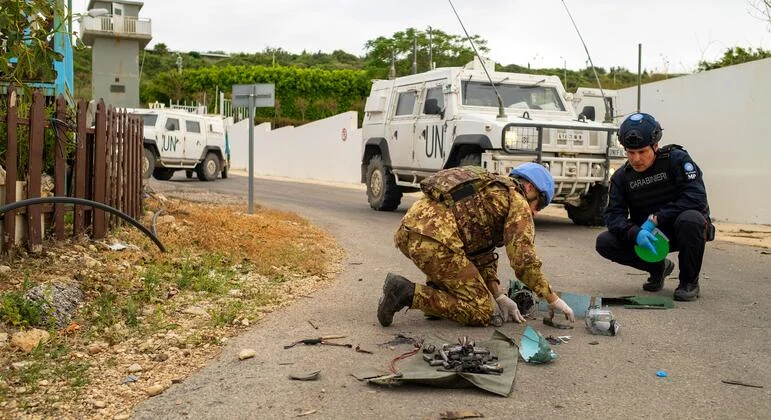
Perhaps the most insidious threat to long-term stability is the proliferation of unexploded ordnance (UXO). The landscape is currently littered with remnants of war—improvised explosive devices (IEDs), crashed drones, and unspent munitions that pose a lethal threat to civilians, particularly children and farmers returning to their fields.
UNIFIL’s demining units are working in tandem with the Lebanese Armed Forces to neutralize these threats. According to UN spokesperson Stéphane Dujarric, recent operations have seen success, with the LAF and UNIFIL teams working in coordination to identify and safely dispose of dangerous caches.
"Explosive hazards remain one of the most serious challenges facing returning communities," the mission noted in a recent bulletin. Each piece of neutralized ordnance is a life potentially saved, yet the scale of the contamination means that these clearing operations will likely need to continue for months, if not years, after a formal peace is established.
Official Responses and Diplomatic Implications
The international community remains divided on the long-term solution for southern Lebanon. While UNIFIL continues to advocate for strict adherence to Resolution 1701, the political reality is that the mission is operating in a state of "broken peace."
The Israeli government maintains that the presence of Hezbollah militants in the border region represents an existential threat that the UN mandate has failed to neutralize. Conversely, the Lebanese government argues that constant aerial incursions and the scale of Israeli retaliation violate the nation’s sovereignty.
Despite these geopolitical frictions, the presence of UNIFIL provides a critical "de-confliction" channel. By maintaining a constant, neutral presence on the ground, the mission prevents small skirmishes from spiraling into full-scale regional wars. The recent dialogue between Beirut and Israel, though fragile, suggests a desire among local stakeholders to transition away from total war, a sentiment that UNIFIL is actively nurturing through its civilian-focused initiatives.
Looking Ahead: Stability or Stagnation?
The current phase of UNIFIL’s work is characterized by "stabilization through service." By focusing on the restoration of infrastructure and the removal of explosive threats, the mission is attempting to create a "new normal" that is slightly more durable than the one that existed before the March 2026 escalation.
However, Ms. Ardiel’s sobering remark—"As people have begun to return to their villages, a lot of work remains to be done"—serves as a reminder that humanitarian aid is a temporary bandage on a deep-seated political wound.
The success of the coming months will depend on three factors:
- Sustained Diplomatic Engagement: The peace talks between Lebanon and Israel must move toward a binding agreement that addresses the root causes of the conflict.
- Resource Allocation: International donors must prioritize the rebuilding of Lebanon’s civilian infrastructure to ensure that returning families have a viable future.
- Adherence to Resolution 1701: Without a renewed commitment from both sides to respect the Blue Line and the mandate of the UN mission, the current stability will remain susceptible to the slightest provocation.
For now, the peacekeepers remain on the ground, walking the thin line between a fragile hope and the looming potential for renewed conflict. They continue to work alongside local authorities, not just as observers of a conflict, but as partners in the survival and recovery of a people caught in the crossfire of regional power struggles. As the dust settles in southern Lebanon, the presence of the blue helmets remains the only constant in a region that has known too much change and too little peace.
 Lina Hope
 Asro
Asro
 Layla Zulfa
