

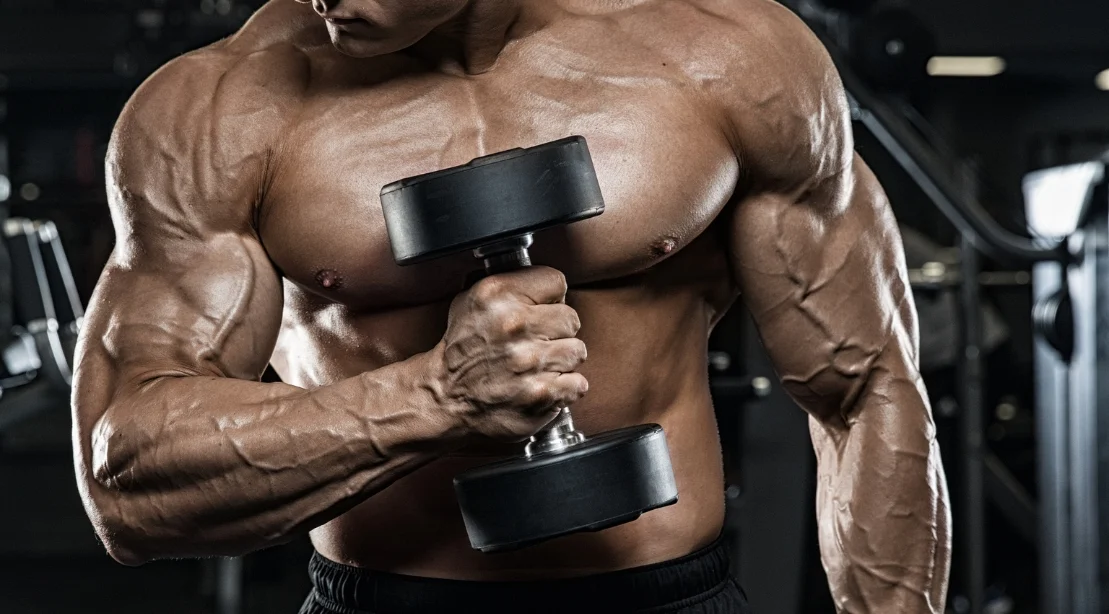
In every gym across the globe, from the elite training centers of Southern California to the most humble community weight rooms, a recurring phenomenon persists: the overwhelming obsession with biceps development. Since the dawn of the bodybuilding era—immortalized by legends like Steve Reeves and Arnold Schwarzenegger—the “peaked” bicep has served as the universal shorthand for physical strength and aesthetic dominance.
However, there is a fundamental irony in this pursuit. While the biceps occupy the center stage of the upper arm, they are not the largest muscle group in the region. That distinction belongs to the triceps, which comprise roughly two-thirds of the upper arm’s total mass. Despite this, when a lifter is asked to “flex,” the biceps remain the default target. Why? Because big biceps simply command attention. They are a visible, undeniable metric of a lifter’s dedication.
The reality of building impressive arms is a tale of two extremes: the process is not complicated, yet it is rarely easy. To achieve significant growth, one must move beyond the common pitfalls of "gym culture" and embrace the physiological realities of hypertrophy.
The Growth Equation: Debunking the Myth of Volume
For many beginners, the path to bigger arms is perceived as a simple calculation: more exercises plus more sets equals more growth. This is the primary error that stalls progress for the vast majority of gym-goers.
The human body is an adaptive machine, but it is also a conservative one. It does not want to expend the precious metabolic energy required to grow new muscle tissue unless it is absolutely forced to. I define this as the "Growth Equation." Your sole objective in the gym is to expose the biceps to a stimulus so significant, and a tension so controlled, that your body perceives its current state as inadequate for the physical demands you are placing upon it.
Once you have provided that stimulus, your work in the gym is complete. The actual physiological growth—the repair and thickening of muscle fibers—occurs later, during the windows of recovery, nutrition, and sleep. Spending three hours in the gym performing twenty different curl variations does not signal "more growth"; it often signals "more fatigue," which can actually hinder the recovery process.
Anatomical Mastery: The Secret Role of the Brachialis
To truly understand arm development, one must look beneath the surface. The front of the upper arm is governed by two primary muscles: the biceps brachii and the brachialis.
The biceps brachii is the superficial muscle, the one that catches the eye. The brachialis, however, sits deep underneath, nestled between the biceps and the triceps. It is the "forgotten" muscle of arm training, and ignoring it is a critical strategic error for anyone seeking a more muscular physique.
The Hidden Pillar of Bicep Peaks
The brachialis acts as a structural foundation. As this muscle hypertrophies, it pushes the biceps brachii outward, effectively increasing the height and fullness of the arm’s overall profile. This is the "bodybuilder’s secret" for creating a massive, peaked look without adding an extra inch to the arm’s circumference through sheer mass alone.
If your routine consists exclusively of traditional supinated (palms-up) curls, you are missing out on the primary function of the brachialis. Because the brachialis is a pure elbow flexor regardless of forearm position, it is best recruited through neutral-grip movements. This is where the Hammer Curl becomes indispensable. By shifting to a neutral grip, you distribute the mechanical load differently, allowing the brachialis to handle a greater share of the intensity. A well-rounded arm program must account for both the supinating nature of the biceps and the neutral-position strength of the brachialis.
The Chronology of Training: Managing Secondary Fatigue
A common oversight in beginner programming is failing to account for the "carry-over" effect. The biceps are not isolated islands; they are heavily recruited in virtually every major upper-body pulling movement.
When you perform heavy barbell rows, weighted pull-ups, or lat pulldowns, your biceps are already working as secondary movers. If your training week is heavy on back volume, your biceps have likely been taxed before you even begin your dedicated "arm day."
Consequently, the principle of "less is more" holds significant weight here. If you are training with high intensity, eight high-quality, strict sets for the biceps, followed by three to four sets focused on the brachialis, is often more than enough to trigger a massive adaptive response. Attempting to add volume on top of an already exhausted muscle group often leads to stagnation or, in the worst cases, tendonitis.
Supporting Data: Tension vs. Exercise Selection
In the modern fitness landscape, social media has proliferated the myth of the "magic exercise"—the idea that a specific, complex movement is the secret to unlocking bicep growth. This is fundamentally false.
Data consistently shows that the biceps respond to mechanical tension and metabolic stress, not the specific handle or bar you are holding. Whether you prefer a straight bar, an EZ-curl bar, or dumbbells is largely a matter of biomechanical comfort and injury prevention.
The Common Denominator
The best exercise is the one that allows you to:
- Isolate the muscle: Minimize the involvement of the deltoids and back.
- Maintain strict form: Eliminate momentum and "swinging" of the weight.
- Generate intensity: Reach technical failure safely.
The dumbbell does not know its own weight, and your muscles do not know what shape the iron bar takes. They only recognize the tension placed upon them. When you stop "lifting weights" and start "applying tension," you shift your focus from ego-driven movement to stimulus-driven training.
Official Perspectives: The Psychology of Intensity
Professional strength coaches and sports scientists agree: the most significant limiting factor in bicep development is not the workout routine, but the lack of true intensity. Many lifters stop their sets when they feel a "burn," confusing the accumulation of lactic acid with the actual failure of the muscle fibers.
True failure—the point at which you cannot complete another repetition with perfect form—is where the growth signal is sent. If you finish a set of twelve reps and feel like you could have done five more, you have likely failed to trigger an adaptive response.
Implications: The Path to Future Gains
As we look toward the practical application of these principles in Part Two of this series, it is vital to remember that the goal is longevity and growth. We will be moving into advanced techniques, including the legendary "21s"—a method of training that combines partial and full-range repetitions to induce maximum metabolic stress.
These finishers are not for the faint of heart. They are, by definition, a form of controlled torture. However, for the trainee who has mastered the fundamentals of tension, isolation, and anatomical balance, they serve as the final piece of the puzzle.
Building "beach-ball" biceps is not about secret supplements or revolutionary equipment. It is about the consistent, aggressive application of tension to a muscle group that, despite its relatively small size, requires a precise and disciplined approach to reveal its full potential. By prioritizing quality over quantity, integrating brachialis training, and respecting the role of recovery, you ensure that every set brings you one step closer to your physical peak.
Prepare your mindset, refine your form, and get ready to push your biceps to their absolute limit. The growth you seek is waiting on the other side of that intensity.
 Lina Hope
 rifanmuazin
 Laily UPN
