

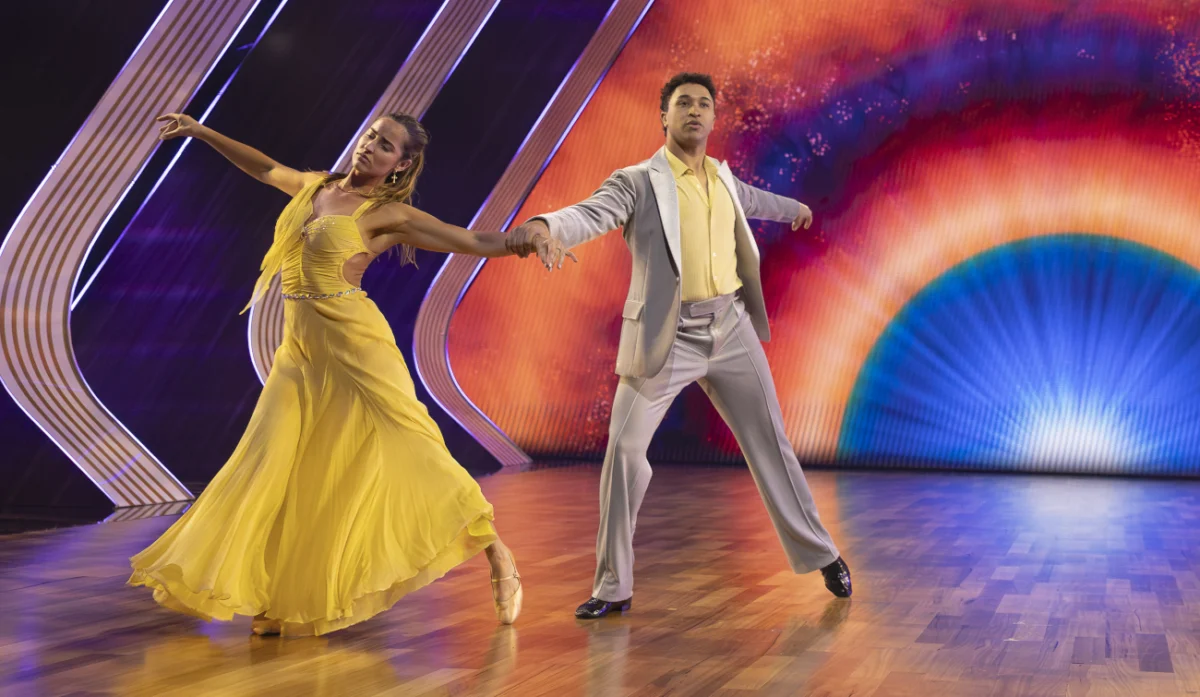
The high-stakes quest to secure a permanent spot as a professional dancer on the upcoming 35th season of Dancing With the Stars intensified this week as the remaining contestants faced a daunting shift in expectations. After a grueling premiere that saw the departure of Briar Nolet and Jake Monreal, the pressure on the remaining 10 hopefuls has reached a boiling point. If the first week was about technical precision and physical stamina under the watchful eye of six-time Mirrorball champion Derek Hough, the second episode—titled “Stories Without Words: Storytelling With Brandon Armstrong”—demanded something far more intangible: the ability to translate personal trauma and triumph into movement.
The Mandate: Storytelling as a Professional Skill
As judge Mark Ballas aptly reminded the contestants at the start of the week, “Every challenge tests a new set of skills; wipe the slate clean and attack with a vengeance.” The message was clear: technical ability is merely the baseline for a DWTS pro. The true differentiator is the ability to connect with an audience through narrative.
The episode centered on the mentorship of Brandon Armstrong, who set the tone by performing a deeply personal routine exploring his own journey as an adoptee into a white family. Armstrong’s performance was a masterclass in emotional arc, beginning with the heavy, complex weight of his upbringing and transitioning into a lighter, more hopeful conclusion that highlighted his personal growth. For the contestants, the task was to replicate this vulnerability in teams of two, crafting a routine based on their own life stories.

A Chronology of Conflict and Connection
The pairings were carefully curated, forcing dancers with varying levels of chemistry to find common ground. The teams were set as follows:
- Erik Linder and Natalie Jolley: Focusing on Natalie’s journey from a shy, reserved upbringing to finding her voice through dance.
- Benji Castro and Nina Mayster: A high-stakes exploration of Nina’s perseverance after the loss of her father.
- Tristen Sanders and Stephani Sosa: A poignant look at Stephani’s struggle for self-acceptance as a Latina in a predominantly white community.
- AJ Pritchard and Selena Hamilton: A retelling of AJ’s professional triumph at the 2013 British Open Dance Championship.
- Allen Genkin and Adele Zaikman: An emotional tribute to Allen’s mother, who fueled his dance ambition before passing away when he was just 15.
The road to the ballroom floor was not without friction. The most notable tension occurred between Benji and Nina, whose inability to communicate effectively manifested in front of the other contestants. Nina perceived Benji as passive, while Benji felt his creative contributions were being stifled. The resulting disconnect was a warning sign that Brandon Armstrong addressed early on, urging them to find a unified vision.
Simultaneously, AJ Pritchard faced criticism for his pedagogical approach to his partnership with Selena. Rather than treating her as an equal choreographic partner, his methods mirrored the Strictly Come Dancing style of teaching a celebrity, which lacked the collaborative spark required for this competition.

Emotional Stakes: The Allen Genkin Breakthrough
Perhaps the most touching moment of the pre-performance phase occurred during a heart-to-heart between contestant Allen Genkin and host Robert Irwin. As Allen struggled to process the grief associated with his routine, Irwin—who famously dedicated a moving performance to his own late father on the main stage—offered perspective on the healing power of dance.
“They say time heals all wounds, but it really doesn’t,” Allen noted during his confessional. “The only way I can really do it justice is to showcase it through art.” This raw honesty became the backbone of his performance with Adele, turning them into the frontrunners for the night.
Performance Analysis: Highs and Lows
When the music finally started, the contrast between the teams was stark.

Erik and Natalie (Viennese Waltz): The duo staged a successful comeback. Judge Shirley Ballas noted a marked increase in Natalie’s confidence compared to the previous week, while Erik’s presence was described as “Prince Charming-esque.” Their ability to frame the story through elegant, fluid movement earned them high praise from the panel.
Benji and Nina (Rumba): The cracks in their partnership were visible on the floor. The routine felt disjointed to the judges, with Brandon Armstrong pointing out the lack of narrative clarity. Shirley Ballas was particularly critical, noting that Benji’s inclusion of backflips—a flashy gymnastic maneuver—felt out of place in a rumba, further highlighting their inability to align their creative visions.
Tristen and Stephani (Rumba): While they faced minor technical hurdles, their emotional connection was undeniable. Mark Ballas praised Stephani’s physical stretch and the intensity of their bond, noting that Tristen’s unwavering eye contact effectively carried the story of her journey.

AJ and Selena (Jive): While technically proficient, the routine failed to land the emotional punch required for this specific challenge. Shirley Ballas expressed confusion over AJ’s choice to revisit the jive so soon after his previous performance, and while their partnering was strong, the lack of a relatable, high-stakes story meant it failed to resonate with the judges.
Adele and Allen (Rumba): This was, by consensus, the highlight of the evening. The routine was so powerful that it left both performers and judges in tears. Shirley Ballas described it as "one of the most beautiful things I’ve ever witnessed," while Brandon Armstrong admitted he would remember the performance for the rest of his life.
The Verdict and Implications
As the dust settled, the reality of the competition set in. Benji and Nina were the inevitable pair in jeopardy. Following a deliberation from the panel, Shirley Ballas delivered the final verdict: “Tonight was the last dance for Benji.”

In his exit interview, Benji remained gracious. “I’m most proud that I was able to represent the entire Latino community, and that I stayed genuine and true to myself,” he said. “I truly believe no matter who I was partnered with, it was my time.”
The elimination of Benji sends a clear message to the remaining nine contestants: technical skill and athleticism are no longer enough to survive. In a show that is fundamentally about the relationship between the professional and the celebrity, the ability to tell a compelling, human, and vulnerable story is the most valuable currency. As the competition moves into its third week, the dancers who have proven they can balance technique with raw emotional transparency—like Allen and Adele—have effectively separated themselves from the pack.
For the remaining contenders, the pressure is now on to prove that they are not just dancers, but storytellers capable of carrying the legacy of the Dancing With the Stars professional family. With the stakes rising, the margin for error has effectively vanished. Every step, every frame, and every expression is now being weighed against the potential to captivate a national audience. As the show continues to air on ABC and stream on Disney+ and Hulu, viewers are witnessing not just a competition, but the forging of the next generation of ballroom icons.
 Iffa Jayyana
 Dwi Wanna
