

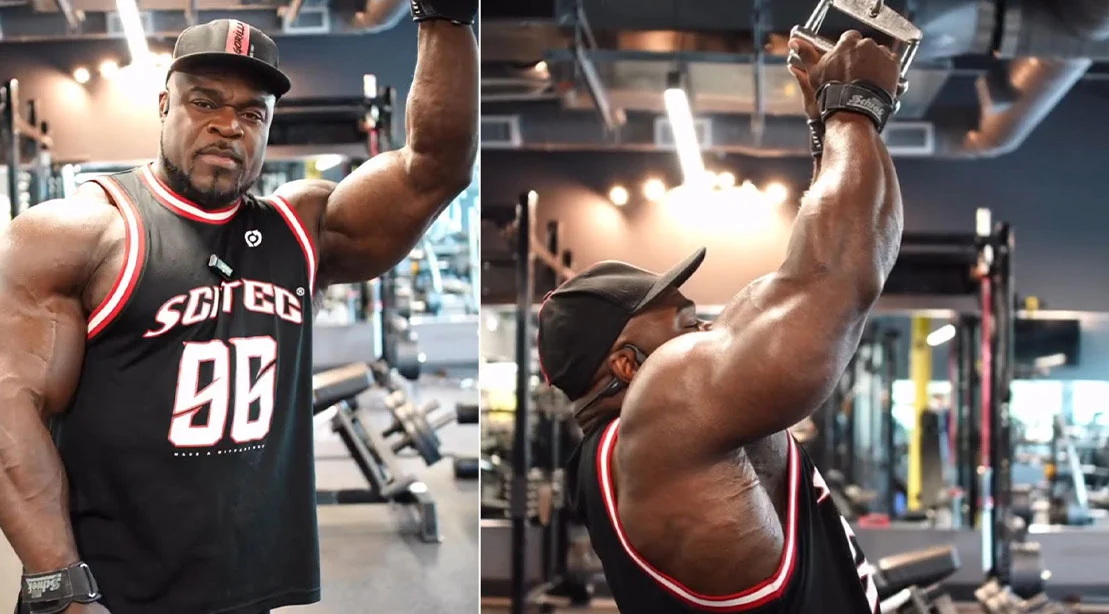
In the world of professional bodybuilding, where every millimeter of muscle mass and every degree of range of motion is scrutinized, debate often rages over the "correct" way to perform staple exercises. Recently, the fitness community found itself embroiled in a heated social media discourse regarding the narrow grip lat pulldown—a fundamental movement for building back thickness. When critics began targeting IFBB legend Victor Martinez for his unconventional form, 2019 Mr. Olympia champion Brandon Curry stepped in to silence the noise, providing a masterclass in biomechanics and intent.
The Genesis of the Controversy: A Lesson in Misinterpretation
The controversy began in the digital arena, specifically beneath a training video posted by the "Dominican Dominator," Victor Martinez. In the footage, Martinez was observed performing narrow grip lat pulldowns with a distinct, sustained bend in his elbows. While seasoned pros understood the nuance of his movement, a chorus of social media "experts" quickly descended upon the comment section, labeling his form as "incorrect" or "inefficient" because he failed to fully lock out his arms at the top of the movement.
For Brandon Curry, seeing a peer of Martinez’s caliber—a man who has graced the Olympia stage and defined an era of aesthetics—being critiqued by individuals who lacked his professional pedigree was enough to warrant a direct response. Curry, who has long been regarded as an authority on functional, results-driven hypertrophy, took to his own platform to address the misconceptions.
"I realize a lot of people look at [Martinez] and say that he’s doing it wrong," Curry noted. "Well, I think he’s doing it right."
The Anatomy of the Narrow Grip Lat Pulldown
To understand why Curry defended Martinez, one must first understand the physiological purpose of the narrow grip lat pulldown. Unlike the wide grip variation, which is primarily utilized to build the "winged" look by emphasizing the outer latissimus dorsi, the narrow grip is a specialized tool for targeting the mid-back, thoracic density, and the deep muscle fibers that create a thick, three-dimensional physique.
The exercise is traditionally performed at a cable station, allowing for constant tension. However, the common error, as Curry points out, is the obsession with "arm range of motion." By focusing on moving the hands from point A to point B—often involving a full extension of the arms—lifters inadvertently shift the stimulus from the back to the biceps and the shoulder joints.
Chronology of the Debate: From Social Media Scrutiny to Professional Validation
The timeline of this incident reflects a broader trend in modern fitness: the rise of "keyboard coaching."
- The Initial Post: Victor Martinez shares a training clip demonstrating his preferred narrow grip technique, emphasizing tension over traditional range-of-motion metrics.
- The Community Backlash: An influx of commenters points out the "lack of lockout," arguing that the exercise is performed improperly because the arms are not fully extended.
- The Intervention: Observing the critique, Brandon Curry analyzes the biomechanics of the movement. He recognizes that Martinez is utilizing a technique designed to keep constant tension on the lats, effectively isolating the muscle group by removing the bicep from the equation.
- The Educational Counter-Offensive: Curry publishes a video demonstration, walking his million-plus followers through the precise methodology of a bent-arm pulldown, essentially validating Martinez’s technique as a superior method for hypertrophy.
- The Final Word: The discourse shifts from criticizing Martinez to re-evaluating the fundamental principles of back training, with many followers acknowledging the nuance of professional-level execution.
The "Bent Elbow" Methodology: Curry’s Technical Breakdown
In his instructional video, Curry meticulously broke down why he prefers to avoid full arm extension. For the 2019 Mr. Olympia, the goal is not to move the weight with the arms; it is to facilitate a deep stretch in the lats while maintaining structural integrity.
The Start Position
Curry emphasizes beginning the movement with a slight bend in the elbow. By avoiding full extension, the lifter prevents the weight from hanging off the shoulder joint and the biceps. "One of the most effective ways, I think, is you start with a bent elbow," Curry explained. "Let the lats stretch, then pull down. But never let those arms fully extend."
Maintaining Tension
A critical component of Curry’s technique is the management of the elbows. Many lifters make the mistake of flaring their elbows outward, which engages the rear deltoids and shifts the load away from the back. Curry suggests keeping the elbows tucked slightly to ensure the line of pull is directed toward the latissimus dorsi.
The Scapular Focus
Perhaps the most important takeaway from Curry’s instruction is the shift in focus from the hands to the shoulder blades. He argues that the arms are essentially "hooks" in this exercise. "Arms are besides the point," Curry stated. "You’re trying to train your back, not your arms. So, let your back go through the range of motion, and don’t worry about the range of motion in your arms."
By focusing on the elevation and depression of the scapula, the lifter ensures that the back muscles are doing the work of initiating the pull, rather than the biceps pulling the weight down.
Implications for Modern Hypertrophy Training
The implications of this debate extend far beyond a single exercise. It highlights a recurring disconnect between "textbook form" and "professional application." In academic exercise science, range of motion is often taught as a binary—full range of motion is usually better. However, in the realm of elite bodybuilding, the goal is specific muscular hypertrophy, which often necessitates "cheating" certain biomechanical norms to maximize time under tension and peak contraction.
Why "Correct" Form is Subjective
The term "correct" in weightlifting is often misused. If the goal is powerlifting, a full range of motion is required to satisfy judges. But in bodybuilding, the objective is the development of specific tissues. If a lifter like Victor Martinez can stimulate more lat growth by keeping his arms bent, his form is technically "correct" for his specific goal.
The Danger of Internet Dogma
Curry’s intervention serves as a warning against the dangers of internet dogma. When novice lifters prioritize the appearance of an exercise—how it looks on camera—over the actual sensation of muscle engagement, they often fail to achieve the desired results. By blindly following the "full extension" rule, many individuals likely suffer from bicep fatigue before their lats are ever properly stimulated.
Expert Consensus and Future Outlook
The endorsement from a Mr. Olympia champion carries significant weight. It encourages the lifting community to look past the surface-level mechanics of an exercise and consider the "nuance." As Curry noted in his concluding remarks to his followers, "Whenever you think somebody’s doing something wrong, you may just not know the nuance to what they’re really doing right."
This incident is a reminder that the best teachers in the sport are often those who have spent decades under the iron. Both Brandon Curry and Victor Martinez have built world-class physiques through trial, error, and an intimate understanding of their own anatomy. Their techniques are not merely guesses; they are refined, experience-based strategies designed to maximize efficiency and growth.
For those looking to improve their own back development, the advice is clear: stop obsessing over the angle of your arms and start obsessing over the activation of your scapula. If you can feel the stretch in your lats and maintain the tension throughout the movement, you are doing it right—regardless of what the social media experts might say.
Conclusion: Trusting the Process and the Pros
In an era where fitness advice is disseminated at an overwhelming rate, it is refreshing to see champions step up to curate the noise. Brandon Curry’s defense of Victor Martinez was not just about protecting a friend; it was about protecting the integrity of the sport’s training principles.
By demonstrating that professional bodybuilding is as much an art form as it is a science, Curry has provided a valuable lesson for lifters of all levels. Whether you are a beginner or an advanced athlete, remember that your body is the ultimate gauge of progress. If a technique allows you to better target the intended muscle group while keeping your joints safe, it deserves a place in your program.
For those who wish to keep learning from the best, following the professional journeys of athletes like Brandon Curry is a great way to stay informed. To keep up with his training tips and future updates, you can follow him on Instagram.
Ultimately, the goal of training is not to perform a movement that satisfies a checklist of arbitrary rules, but to build a stronger, more capable, and more developed physique. As Curry and Martinez have demonstrated, sometimes the "right" way to train requires thinking outside the box—or in this case, keeping the elbows just a little bit bent.
 Lina Irawan
 Jia Lissa
 Reynand Wu
