

Warning: This article contains significant spoilers for the ninth episode of the Apple TV+ series Cape Fear.
For over three decades, Juliette Lewis has occupied a singular space in the Hollywood firmament. She is not merely an actress; she is a progenitor of a specific, visceral style of performance—a "genre actor" who elevates thrillers into high art. From the frenetic, neon-soaked chaos of Natural Born Killers to the psychological disintegration seen in Yellowjackets, Lewis has built a career on portraying characters who refuse to be contained by the traditional boundaries of a script. Her presence is a harbinger of subversion; where Lewis appears, plot expectations are invariably upended.
Now, in a move that feels both poetic and inevitable, Lewis has returned to the creative "origin" of her career. Thirty-five years after her breakout performance in Martin Scorsese’s 1991 adaptation of Cape Fear, Lewis has re-entered that world. In the ninth episode of the new Apple TV+ limited series, she makes a surprise, haunting appearance as a mysterious figure whose fleeting existence leaves a profound impact on the narrative.
The Evolution of a Classic: The 2026 Landscape
The new iteration of Cape Fear is a dense, ten-hour exploration of the source material, reimagined for an era defined by technological paranoia and shifting political morality. The central conflict remains a brutal game of cat-and-mouse between the vengeful ex-con Max Cady—played here with harrowing intensity by Javier Bardem—and the affluent, beleaguered Bowden family.
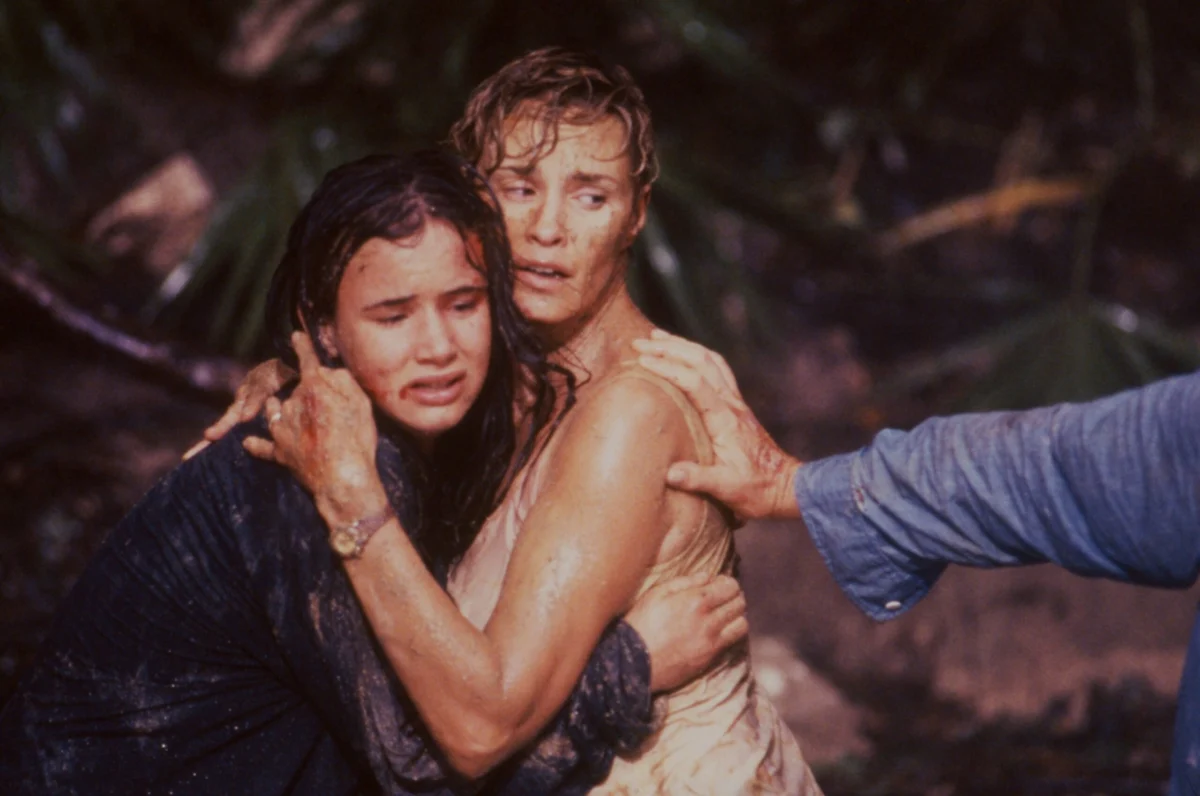
In this version, Amy Adams stars as Anna Bowden, with Patrick Wilson as her husband, Tom, and Lily Collias as their daughter, Natalie. For those familiar with the 1991 film, the character of Natalie serves as a direct mirror to the role that launched Lewis into stardom, where she played the daughter, Danielle, opposite Nick Nolte and Jessica Lange. While the name has changed, the thematic weight of the daughter figure remains the fulcrum upon which the family’s safety teeters.
However, Lewis’s role in this revival is far removed from the innocent victim she once played. She appears as Crystal, Max Cady’s estranged half-sister. Crystal is a specter from Cady’s traumatic past, a character who bridges the gap between his history and his current campaign of terror. She begins by stalking Anna Bowden, baiting her into a confrontation, and ultimately forces a violent, irreversible collision with her half-brother, orchestrated through the guidance of their father, Robert (played by Ron Perlman).

A Decade in the Making: The Creative Genesis
The journey to bring Cape Fear back to the screen was a long-gestating project, one that began with a casual conversation nearly ten years ago. Series creator Nick Antosca, the mastermind behind the true-crime anthology The Act, sought to infuse this adaptation with a distinct, modern edge.
In an exclusive interview with Gold Derby, Lewis reveals that her involvement was not an afterthought, but a seed planted years before the cameras began rolling. "Nick came to me very early when it was just a little seed in his mind," Lewis recalls. "He said: ‘What do you think about making Cape Fear a series and you being involved in it?’ At the time, I wasn’t sure. It felt like such a massive undertaking to revisit a classic."
As time passed and the project moved through the development cycle, Lewis admits there was a period of uncertainty. "I thought the ship had sailed," she says. "I saw in the industry trades that Amy Adams and Javier Bardem were attached. It wasn’t until much later that Nick came back to me and said, ‘I wrote this incredible part for you.’ It was a blessing."
The involvement of industry titans Martin Scorsese and Steven Spielberg—who both produced the 1991 film—adds a layer of legitimacy and historical reverence to the project. For Lewis, their presence as executive producers was the final, meaningful seal of approval.
Anatomy of a Villain: Morality in the Modern Age
Antosca’s approach to Cape Fear is markedly different from previous versions. By expanding the story into a ten-episode limited series, he has allowed for a deep dive into the backgrounds of the ensemble cast. The inclusion of a second Bowden child creates a "messy" family dynamic that makes the stakes feel more personal and less black-and-white.
Crucially, the portrayal of Max Cady has been recalibrated. Rather than a purely monolithic villain, Bardem’s Cady is presented through a lens of 2020s socio-political anxiety. The series asks a uncomfortable question: Is Cady a monster, or is he a mirror held up to the Bowdens, exposing the rot beneath their pristine, upper-middle-class facade?

"Because there are ten hours, it can’t be too much in one direction, or it would become stale," Lewis explains regarding the show’s murky moral compass. "That is the essential ingredient from the original: the idea that he is a man who feels wrongly accused and incarcerated. There are so many topical themes in this series—stalking, the misuse of technology, the inherent paranoia of our current era—that make it feel vital."
Passing the Torch: Mentorship and Professionalism
Lewis’s return to the Cape Fear universe has also served as a moment of reflection on her own growth as an artist. Having spent the last few decades as a mentor to younger performers—most notably her co-stars on Yellowjackets—Lewis is keenly aware of the legacy she is upholding.
"Jessica Lange, Nick Nolte, and Robert De Niro were the most exceptional examples of what greatness looks like," she says. "They were virtuosos, but they were also professionals who treated me with respect. That set a standard for me."
This philosophy was clearly on display during her work with Lily Collias. Recognizing the weight of the "daughter" role, Lewis made a concerted effort to foster a welcoming environment. "I just like to welcome people and give big hugs," she laughs. "Lily and I had a big, nice hug. It was exciting to see the exceptional work she does in this show. She’s carrying that torch beautifully."
Implications: The Road Ahead
As the series concludes its initial run, the question of a second season looms. While Cape Fear is currently billed as a limited series, the narrative, according to Lewis, has left the door ajar for further exploration.
Crystal’s demise in the ninth episode might seem like a definitive end for the character, but in the hands of a storyteller like Antosca, nothing is ever truly set in stone. When pressed on the possibility of a return or a deeper dive into the Cady family tree, Lewis remains coy.

"I have some ideas, but of course, those will be kept secret," she teases. "If everyone is lucky enough to get a second season, it will just be more of the themes that have already been established, explored in different ways. When you have this much history, you just keep going deeper and deeper into the offshoots of that history."
Looking back at the trajectory of her career, Lewis views her reunion with the Cape Fear brand as the closure of a perfect creative circle. "The 1991 film was my creative birthplace," she reflects. "I was treated as an equal and given my own voice. I was given the space to explore with the best of American cinema. I’ve never forgotten it. Sometimes, the more distance you have from an experience, the more you realize what it gave you. I am forever grateful that I had that experience, because it is really what shaped me."
Whether or not the series continues, the impact of Lewis’s cameo—and the thematic weight of the 2026 adaptation—marks a significant milestone in modern television. By bridging the gap between the classic thriller era and the digital age, Cape Fear remains as terrifying, and as relevant, as ever. The rot, it seems, is always just beneath the surface; all it takes is a character like Crystal to peel back the layers.
 Asep Darmawan
 Reynand Wu
 Layla Zulfa
