

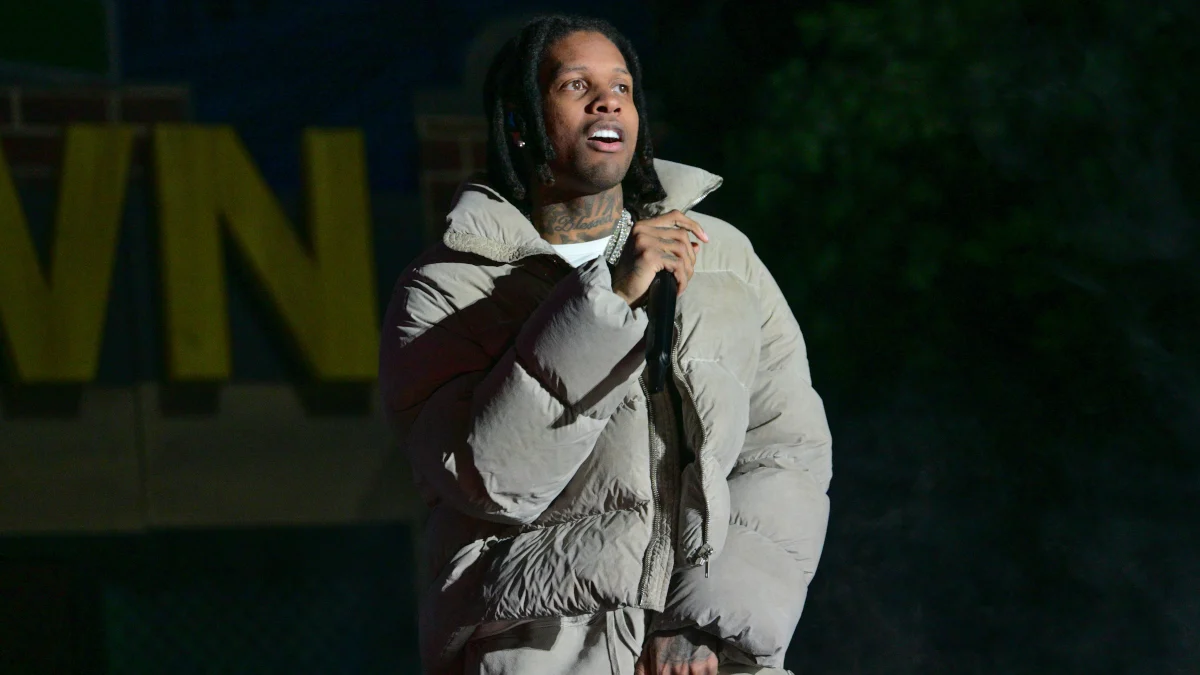
LOS ANGELES — In a dramatic conclusion to a high-profile federal proceeding that riveted the hip-hop community and mainstream media alike, a federal jury in Los Angeles has found Grammy-winning rapper Lil Durk not guilty of orchestrating a deadly murder-for-hire plot.
The verdict, delivered following a rigorous trial that commenced in August, brings an end to a labyrinthine legal ordeal stemming from a 2022 shooting in West Hollywood. The incident tragically claimed the life of Saviay’a Robinson, the cousin of rival rapper Quando Rondo.
Lil Durk, whose legal name is Durk Devontay Banks, stood accused of using his immense industry influence, financial resources, and the infrastructure of his record label, Only the Family (OTF), to execute a revenge-motivated assassination plot. Throughout the proceedings, the 33-year-old artist maintained his absolute innocence. While Thursday’s verdict delivers a monumental legal victory for Banks, his legal battles are far from finished, as he continues to confront separate civil litigation and an ongoing federal racketeering charge.
Main Facts of the Case
The federal indictment, brought against Banks in October 2024, alleged that the Chicago-born rap star served as the ultimate mastermind behind a coordinated conspiracy to eliminate rival artist Quando Rondo (born Tyquian Terrel Bowman). According to federal prosecutors, the plot was cooked up as direct retaliation for the November 2020 fatal shooting of Dayvon Daquan Bennett—globally known as rising rap star King Von—who was a cornerstone of Banks’s OTF crew and record label.
The prosecution’s theory centered on the accusation that Banks weaponized his wealth and celebrity status to orchestrate the hit. Government attorneys alleged that Banks offered lucrative financial rewards and coveted music industry opportunities to anyone who successfully assassinated Quando Rondo.
The centerpiece of the government’s physical evidence involved financial trails. Prosecutors presented airline records indicating that a credit card linked directly to Banks and Only the Family Records was used to purchase commercial plane tickets. These tickets allegedly transported four co-defendants from the Midwest to Southern California to track down, locate, and execute Quando Rondo.
On the day of the fatal encounter in August 2022, the targeted team allegedly ambushed Quando Rondo at a Los Angeles-area gas station, opening fire on his vehicle. While Quando Rondo emerged physically unharmed from the barrage of bullets, his 24-year-old cousin, Saviay’a Robinson, was struck by gunfire and succumbed to her injuries.
Despite the gravity of the accusations, Banks’s defense team—headed by high-profile defense attorneys Brian Steel and Drew Findling—successfully dismantled the prosecution’s narrative. They argued that the government’s case relied heavily on compromised, self-interested co-defendants seeking lighter sentences through cooperation, effectively lacking the direct, unassailable proof required to convict Banks beyond a reasonable doubt.
Chronology of Events: From Atlanta to Los Angeles
To fully understand the gravity of the federal trial, legal analysts and investigators looked back at a multi-year timeline defined by an escalating cycle of rap industry feuds, tragic violence, and meticulous federal surveillance.
November 2020: The Atlanta Tragedy
The foundational roots of the federal case trace back to an Atlanta, Georgia, nightclub altercation in the early morning hours of November 6, 2020. An explosive physical confrontation erupted between associates of King Von and affiliates of Quando Rondo. The ensuing shootout left two men dead, including the 26-year-old King Von, whose death sent shockwaves through the global hip-hop community and devastated the OTF camp. Local investigators ultimately declined to charge Quando Rondo, while charges against an associate were later dropped after authorities determined the shooting fell under self-defense. However, federal prosecutors claimed the street feud did not die in Atlanta; instead, it simmered and morphed into a coordinated cross-country conspiracy.
August 2022: The Los Angeles Shooting
Nearly two years after King Von’s death, the violence spilled over to the West Coast. Federal indictments alleged that members of Banks’s inner circle tracked Quando Rondo to a Los Angeles gas station. The targeted shooting resulted in the tragic death of Saviay’a Robinson. Los Angeles law enforcement and federal agencies launched an intensive, multi-jurisdictional investigation into the logistics of the hit.
October 2024: The Arrests and Federal Indictments
The multi-year investigation culminated in a sweeping wave of law enforcement actions. In late October 2024, federal authorities arrested five men—Kavon London Grant, Deandre Dontrell Wilson, Keith Jones, David Brian Lindsey, and Asa Houston—charging them with conspiracy and weapons offenses related to the planned assassination. Just one day after the sweep that rounded up his alleged associates, Lil Durk was taken into federal custody, formally transforming a localized murder investigation into a high-stakes federal racketeering and murder-for-hire prosecution.
August – September 2026: The Federal Trial
Following nearly two years of pre-trial detainment, motion practice, and legal maneuvering, the trial officially commenced in August 2026 before a federal jury in Los Angeles. Over the course of several weeks, the courtroom heard riveting testimony from federal agents, forensic experts, and cooperating witnesses, culminating in closing arguments and the ultimate not-guilty verdict delivered in September 2026.
Supporting Data and Evidence Presented at Trial
The trial featured a mountain of digital evidence, financial audits, and witness testimonies that laid bare the inner workings of modern rap label logistics and federal conspiracy investigations.
- Financial and Travel Trails: Federal prosecutors heavily emphasized credit card records, digital communication logs, and travel itineraries. They presented data showing that a card tied to Banks and OTF financed the travel of multiple co-defendants to California. The defense, however, countered that the financial transactions did not inherently prove criminal intent or knowledge of an impending homicide, suggesting standard business or personal travel expenses were being mischaracterized by investigators.
- Cooperating Witnesses: The prosecution’s case relied significantly on testimony from insiders who agreed to cooperate with the federal government in exchange for potential sentence reductions. Co-defendants Kavon London Grant, Keith Jones, and rapper OTF Jam (born Kacey Hester) took the stand to testify against Banks.
- The Defense’s Rebuttal of Witnesses: Defense attorneys Brian Steel and Drew Findling mounted a fierce cross-examination of the cooperating witnesses. They portrayed figures like Hester and Grant as desperate, unreliable actors who fabricated narratives and pointed fingers at Banks solely to curry favor with federal prosecutors and secure lighter prison sentences for themselves.
Official Responses and Courtroom Arguments
The starkly contrasting approaches of the prosecution and defense defined the courtroom drama leading up to the jury’s historic deliberation.
During closing arguments, Assistant U.S. Attorney Ian Yanniello forcefully argued that Lil Durk operated with impunity, leveraging his massive financial success and cultural power to exact street justice. Yanniello told the jury that Banks acted as the undeniable mastermind of the operation, utilizing his network to direct, finance, and oversee the violent retribution against Quando Rondo.
"Power and money do not place someone above the accountability of the law," federal prosecutors argued, painting a picture of an executive using corporate and personal assets to facilitate a targeted hit.
Conversely, the defense team delivered a masterclass in dismantling circumstantial conspiracy charges. Brian Steel and Drew Findling emphasized the complete absence of any direct communication, recording, or written directive from Banks ordering a murder. They argued that the government was attempting to criminalize association, guilt by association, and the general hardships of the music industry.
"Mr. Banks is an artist, a father, and a community leader who has worked tirelessly to pull himself out of the tragedies of his past," the defense stated during the proceedings. "The government has built a house of cards out of the self-serving lies of criminals trying to save their own skin."
Upon hearing the "not guilty" verdict read aloud in the courtroom, visible relief washed over Banks and his legal team, bringing an emotional close to months of uncertainty.
Broader Implications for the Music Industry and Ongoing Legal Battles
While Thursday’s verdict removes the most severe shadow hanging over Lil Durk’s head—the federal murder-for-hire charge that carried the potential of a life sentence—the rapper’s legal battles are far from resolved.
Lingering Legal Exposure
Even with the federal murder-for-hire acquittal, Banks still faces significant legal jeopardy. He remains the target of a civil lawsuit connected to another separate death, and he continues to face an outstanding criminal charge related to racketeering allegations. Legal experts note that while beating a murder-for-hire charge is a massive hurdle cleared, defending against federal racketeering statutes requires an equally rigorous legal strategy.
Industry and Cultural Impact
The case serves as a cautionary tale regarding the intersection of street culture, corporate rap music labels, and federal law enforcement. Over the past decade, federal prosecutors have increasingly utilized racketeering (RICO) and conspiracy statutes to target prominent rap artists and their respective crews, arguing that musical labels often function as criminal enterprises.
For the hip-hop community, the trial reignited long-standing conversations about the tragic cost of systemic feuds, the pressures placed on artists transitioning from distressed neighborhoods to global stardom, and the heavy hand of federal surveillance on urban music culture.
For now, Lil Durk walks out of the federal courthouse a free man regarding the 2022 shooting, but as he prepares to address his remaining civil and racketeering challenges, the hip-hop world will continue to watch closely as the next chapter of his life and career unfolds.
 Nana Wu
 Siti Muinah
