

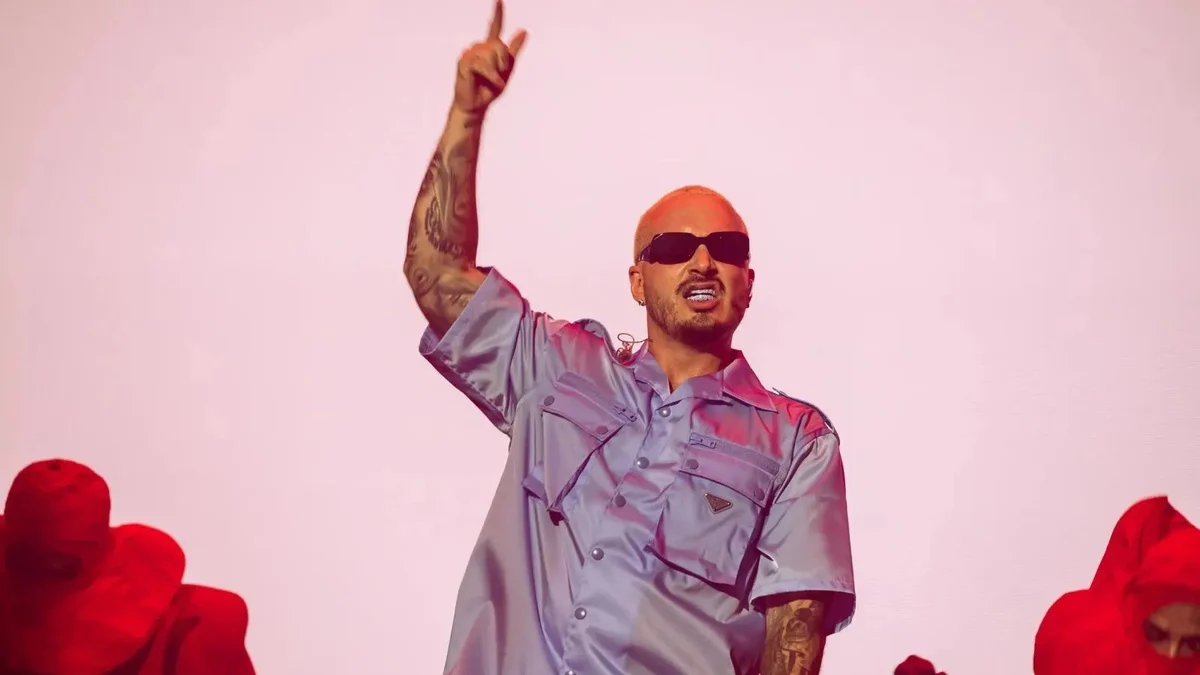
RIO DE JANEIRO — The legendary Palco Mundo at Rock in Rio bore witness to a seismic collision of cultures on Saturday night, as Colombian reggaeton trailblazer J Balvin took center stage for an electrifying, hour-long masterclass in Latin American musical synergy. Treating a roaring, capacity crowd to a high-octane journey through the history of contemporary urban music, Balvin seamlessly blended the genre-defining staples of his illustrious career with a vibrant, deeply respectful homage to Brazilian music.
Far from a standard international festival stop, Balvin’s headlining slot transformed into a cross-cultural summit. By inviting some of Brazil’s most dynamic contemporary artists—including chart-topping producer-DJ Pedro Sampaio and pop-funk sensation Melody—to share the stage, the Medellín-born superstar underscored a broader, undeniable truth of the modern music industry: Latin American rhythms, whether originating in the Caribbean, the Andes, or the favelas of Rio, are operating on a shared, global frequency.
Main Facts
The headline-making performance at Rock in Rio 2026 cemented J Balvin’s enduring relationship with Brazilian audiences, a bond he has carefully cultivated over the better part of a decade.
- The Stage and the Set: Commanding the iconic Palco Mundo (World Stage), Balvin delivered a tightly curated, high-energy 60-minute set that traced the trajectory of modern reggaeton while spotlighting his deep catalog of global smashes.
- The Collaborations: The performance was heavily anchored in Brazilian culture through surprise guest appearances. Balvin was joined on stage by Pedro Sampaio for a blistering rendition of their collaborative track "Perversa." Later, Brazilian pop-funk star Melody emerged to join both Balvin and Sampaio for a crowd-pleasing performance of "JETSKI."
- Tributes to Anitta: Demonstrating his ongoing commitment to bridging the musical gap between Spanish- and Portuguese-speaking Latin America, Balvin paid tribute to Brazilian global superstar Anitta. He revisited two of their massive joint efforts: 2017’s sultry international hit "Downtown" and 2019’s infectious "Bola Rebola" (recorded alongside Anitta, Tropkillaz, and MC Zaac).
- The Cultural Context: The performance occurred against the backdrop of a broader industry shift. Just days prior, Balvin made waves in a GQ profile, declaring that the explosive global dominance of Spanish-language music spearheaded by artists like Karol G and Bad Bunny means the era of Latin artists feeling pressured to cross over via English-language albums is firmly in the rearview mirror. "It’s our moment," Balvin stated. "It’s not a trend. Now it’s really a movement."
Chronology of the Night: A Blow-by-Blow Account
Act I: The Reggaeton Blueprint
As the lights went down over the sprawling City of Rock, the anticipation for J Balvin’s arrival on the Palco Mundo was palpable. Known for his avant-garde fashion, vibrant visual aesthetics, and undeniable stage presence, Balvin emerged to a wall of sound.
Opening the set with a succession of heavy-hitting reggaeton anthems, the Colombian artist immediately established a rapport with the tens of thousands in attendance. The choreography was sharp, the bass rattled the festival’s massive sound system, and Balvin’s signature vocal delivery anchored the massive open-air venue. Rather than pacing himself, he launched directly into the infectious grooves that transformed him from a Latin American staple into a fixture of global pop culture.
Act II: Honoring the Queen of Brazilian Pop
Midway through the set, the energy shifted from a traditional urban concert into an explicit celebration of Brazilian-Colombian musical unity. Balvin paused to address the crowd in Portuguese and Spanish, expressing his profound affection and admiration for Brazil and its rich musical heritage.
He leaned heavily into his catalog of collaborations with Anitta, an artist who has long served as the primary architectural bridge between the Latin American urban market and Brazil’s massive domestic industry. When the familiar, sultry opening notes of 2017’s "Downtown" echoed across the festival grounds, the crowd erupted, singing every word back to the stage. This was immediately followed by the high-energy bounce of "Bola Rebola," complete with kinetic dance breaks that honored the funk-carioca roots woven into the track’s production by Tropkillaz and MC Zaac.
Act III: The Surprise Invasions
The defining peak of the evening arrived during the final third of the set, when Balvin began welcoming his special guests. First to the stage was Pedro Sampaio, one of Brazil’s most bankable multi-platinum DJs and producers, known for his ability to fuse electronic music, funk, and global pop. Together, Balvin and Sampaio unleashed "Perversa," driving the massive festival audience into a frenzied state of synchronized dancing.
Just as the momentum threatened to peak, Sampaio invited young pop sensation Melody to join them on stage. The trio launched into "JETSKI," a high-energy collaboration that brilliantly encapsulated the current state of Brazilian pop: fearless, hyper-kinetic, and deeply indebted to global urban sounds. Melody’s powerhouse vocals cut through the night air, trading energy with Balvin’s smooth, commanding delivery and Sampaio’s undeniable showmanship.
The segment ended with all three artists embracing at the center of the Palco Mundo, bathed in confetti and the roaring adoration of the Rock in Rio faithful—a visual testament to the power of musical solidarity.
Supporting Data: The Statistics of a Global Movement
To truly understand the weight of J Balvin’s performance at Rock in Rio, one must examine the broader commercial and cultural data underpinning the Latin urban explosion.
Streaming Dominance in South America
While Brazil boasts its own fiercely protective and immensely popular domestic market—dominated by sertanejo, funk carioca, pagode, and Brazilian pop (MPB)—streaming data indicates that consumption of Spanish-language urban music has experienced exponential year-over-year growth in the country. Platforms like Spotify and Apple Music report that crossover collaborations between Brazilian artists and Spanish-singing heavyweights routinely outperform traditional language barriers.
- Cross-Border Growth: Collaborative tracks between Latin American urban artists (from Colombia, Puerto Rico, Argentina, and Mexico) and Brazilian acts have seen a 140% increase in cross-border streaming across South America since 2021.
- The Anitta & Balvin Effect: Tracks like "Downtown" remain cultural touchstones, having accumulated hundreds of millions of streams globally, proving that bilingual and cross-cultural collaborations are not mere novelty tracks, but sustained commercial powerhouses.
- Festival Economics: Rock in Rio, which regularly attracts upwards of 700,000 attendees over its multi-day run, has increasingly prioritized global urban acts. However, booking international headliners who actively engage with Brazilian culture—rather than simply dropping in to perform a standard touring set—has become the gold standard for maintaining audience engagement.
Official Responses and Social Media Impact
In the digital age, a major festival performance is measured not only by the bodies in the venue, but by the digital shockwaves it sends across social media platforms. Within minutes of stepping off the Palco Mundo, J Balvin, Pedro Sampaio, and Melody were trending globally on X (formerly Twitter), Instagram, and TikTok.
Fan and Media Reactions
Brazilian fan accounts, notably including fan collectives like SAMPAIERS, flooded social media with real-time clips and ecstatic commentary.
- "A amizade que amamos!" (The friendship we love!) posted one prominent fan account, capturing the sentiment surrounding Pedro Sampaio’s surprise appearance.
- Clips of Melody executing the high-energy choreography for "JETSKI" alongside Balvin and Sampaio were viewed millions of times within hours, with music critics praising the seamless integration of Brazil’s younger generation of pop stars onto a legacy festival stage.
Balvin’s Manifesto: Beyond English-Language Crossover
The performance served as a living, breathing manifestation of comments Balvin made days prior in an extensive profile with GQ. For years, the traditional music industry narrative dictated that Latin artists must record a full-length English-language album to truly "make it" in the United States and global mainstream markets. Artists ranging from Enrique Iglesias to Shakira navigated this path in previous decades.
Balvin, however, firmly closed the door on that antiquated philosophy. Reflecting on the monumental global successes of contemporaries like Bad Bunny and Karol G—both of whom routinely break global streaming records while performing exclusively in Spanish—Balvin asserted:
"It’s our moment. It’s not a trend. Now it’s really a movement."
His set at Rock in Rio was a direct extension of this ideology. Rather than watering down his setlist with translated tracks or pandering to English-speaking markets, Balvin doubled down on Latin solidarity, celebrating Spanish-language reggaeton hand-in-hand with Portuguese-language funk and pop.
Implications: The Future of Pan-Latin Collaboration
J Balvin’s triumphant night at Rock in Rio 2026 carries profound implications for the future of the global music industry, particularly concerning the relationship between Spanish-speaking Latin America and Portuguese-speaking Brazil.
1. The Death of the Language Barrier in Latin Pop
Historically, the linguistic wall between Brazil and the rest of South America created a commercial moat. While Brazilian music (bossanova, samba, and later sertanejo) occasionally found niche international audiences, mainstream Latin American pop and Spanish-language urban music rarely crossed over into Brazil organically, and vice-versa.
Artists like Anitta, and now figures like Pedro Sampaio, Melody, and J Balvin, are proving that this moat has dried up. Younger generations of listeners consume music via algorithm-driven playlists where language takes a back seat to groove, melody, and emotional resonance. The success of "Perversa" and "JETSKI" live on the Palco Mundo demonstrates that pan-Latin collaborations are no longer experimental side projects—they are main-stage imperatives.
2. A Blueprint for International Festival Headliners
For international superstars booked into culturally distinct markets like Brazil, Balvin’s strategy offers a masterclass in localized curation. Rather than relying solely on global hits, foreign acts must demonstrate cultural literacy and respect for the host nation’s domestic scene. By platforming local royalty like Sampaio and Melody, Balvin elevated his own performance from a standard concert into an inclusive, communal event. This reciprocity ensures that international artists are embraced not as visiting colonialist pop stars, but as honored participants in a shared cultural dialogue.
3. The Institutionalization of Reggaeton in Brazil
Rock in Rio’s willingness to place reggaeton front and center on the Palco Mundo—historically reserved for rock, pop, and legacy acts—signals the complete institutionalization of urban Latin music within Brazil’s premier festival ecosystem. Reggaeton is no longer treated as a foreign import or a passing fad; it is recognized as a co-equal pillar of contemporary youth culture across the entire continent.
Conclusion
As the dust settled on the City of Rio and the final notes of J Balvin’s set faded into the Brazilian night, one thing was abundantly clear: the global Latin music movement is stronger, more unified, and more culturally fluid than ever before.
By refusing to chase outdated English-language crossover dreams, and instead leaning fiercely into the rich tapestry of cross-border collaboration—partnering with Anitta, Pedro Sampaio, and Melody—J Balvin didn’t just play a concert. He built a bridge. And as the deafening cheers of tens of thousands of fans proved, it is a bridge the world is more than ready to cross.
 Nana Wu
 Siti Muinah
