

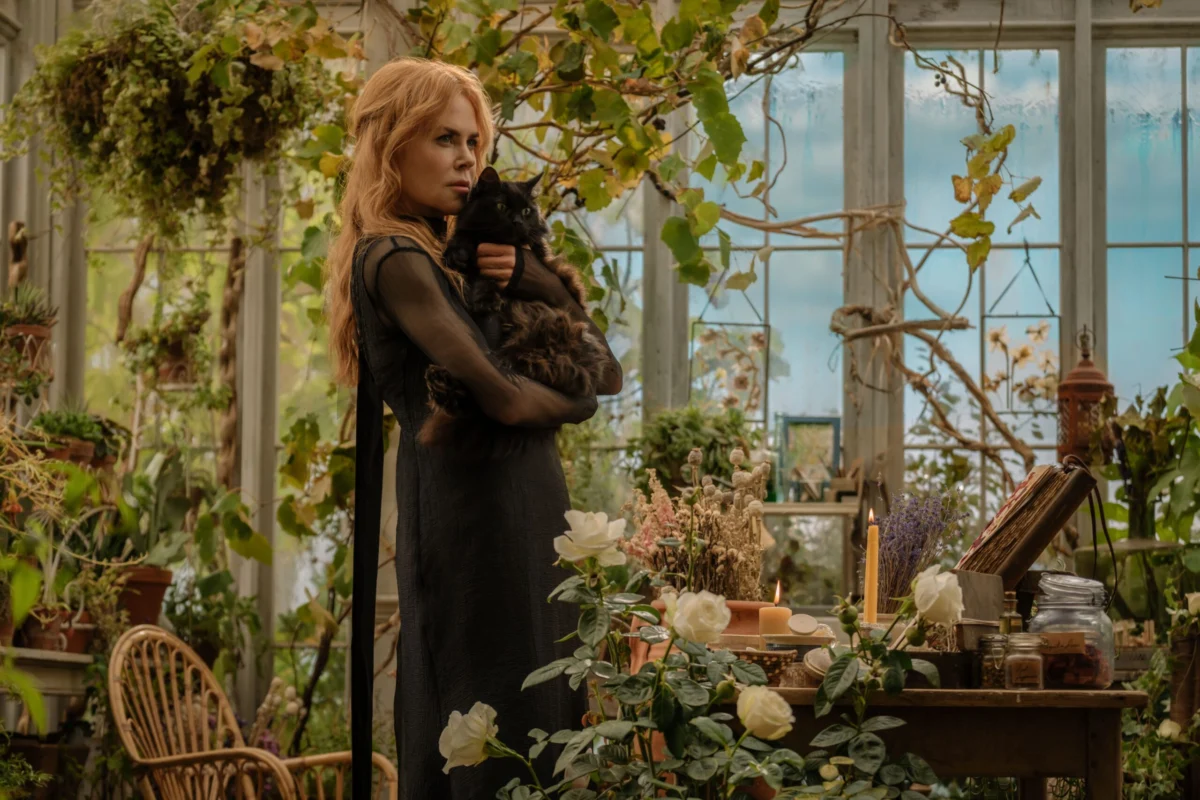
When Practical Magic premiered in 1998, it arrived as a misunderstood curiosity. Adapted from Alice Hoffman’s spellbinding novel, the film followed the Owens sisters—Gillian (Nicole Kidman) and Sally (Sandra Bullock)—as they navigated an ancestral curse that promised death to any man who fell in love with them. Critics at the time, including those at The New York Times, dismissed the film with snide remarks, famously labeling it “Barbie Joins a Coven.”
Yet, like the very magic the Owens women wield, the film refused to stay buried. Over the decades, it shed its initial tepid reception to emerge as a feminist cult classic, a cornerstone of Halloween pop culture, and a touchstone for generations of fans. Now, in an era defined by the revival of beloved intellectual properties, the Owens sisters are back. Directed by Susanne Bier, Practical Magic 2 reunites Kidman and Bullock, shifting the narrative from the misty coast of New England to the ancient, brooding landscapes of the United Kingdom.
The Evolution of the Owens Legacy: A Chronology
The journey of the Owens women is one of resilience. In the 1998 original, the story was anchored in the idyllic, witch-rich aesthetic of Massachusetts. However, the production of the sequel required a significant narrative pivot.

The plot of Practical Magic 2 picks up after a substantial time jump. Sally’s daughters, Antonia (Maisie Williams) and the free-spirited Harvard student Kylie (Joey King), are now in their early twenties. Despite their mother’s desperate attempts to shield them from their supernatural heritage, destiny has a way of asserting itself. When Kylie’s love interest, Gideon (Xolo Maridueña), falls into a mysterious, supernatural coma, the family finds themselves pulled back into their magical history. Guided by the rediscovered Book of the Raven, the narrative migrates from the United States to England, grounding the sequel in a new continent of spooky, atmospheric locales.
The Architectural Resurrection: Leavesden Studios
For the production team, one challenge loomed larger than all others: the Owens family home. In the original film, the house—a Victorian-style masterpiece of cottage-core perfection—became a character in its own right. Because the original Washington State exterior and Los Angeles interiors no longer exist, the challenge for production designer Tom Burton was to rebuild the magic from the ground up.
The choice fell to Leavesden Studios in Hertfordshire, England. Building the home from scratch allowed the team to exercise absolute control over the environment. Producer Denise De Novi noted that the house was a "phenomenon" that required meticulous recreation. The production team went to extraordinary lengths to ensure consistency, even mapping the house’s orientation relative to the sun to replicate the exact lighting and golden-hour atmosphere of the 1998 classic.

The "greens team" was tasked with populating the set with over 4,000 individual plants, recreating the overgrown, lush garden that felt essential to the Owens’ identity. This marriage of set design and horticulture ensured that while the geography of the film changed, the soul of the home remained intact.
A Tour of the United Kingdom: Key Filming Locations
While half of the shooting schedule was contained within the controlled environment of Leavesden, the production ventured into the British countryside to capture the authentic, storied landscapes required for the sequel.
The Village of Hambleden, Buckinghamshire
Serving as the fictional town of "Thornfield," the village of Hambleden offers the quintessential English aesthetic. Located just west of London, its historic brick-and-flint cottages, complete with signature dormer windows, provide a perfect, timeless backdrop for the sisters’ new life abroad.

The Royal Standard of England, Beaconsfield
No film set in England is complete without a historic pub. The production utilized The Royal Standard of England, a site that boasts a 900-year history and claims to be the oldest pub in Great Britain. Tucked away in the Chiltern Hills, this atmospheric location serves as the exterior for the "Thornfield Inn." Its ancient timber beams and history of hosting major film productions (including Hot Fuzz and The Theory of Everything) made it the ideal choice for the film’s more grounded, social sequences.
Langleybury Mansion, Hertfordshire
To stand in for the halls of Harvard University and various UK-based lodgings, the production utilized the 18th-century Langleybury Mansion. A frequent star in period dramas like Downton Abbey and The Crown, the mansion’s vacant, stately rooms provided the versatility needed to transition between the high-academic pressure of Kylie’s student life and the magical mystery of her ancestral journey.
The Wormsley Estate and Black Park
The sprawling 2,700-acre Wormsley Estate in Buckinghamshire—known for its opera pavilion and walled gardens—was transformed into the cottage of Tom Lockland (Solly McLeod). Complementing this, the production utilized Black Park Country Park to film the forest sequences surrounding Thornfield. The park’s dense conifer forests and woodland trails provided the sweeping, misty vistas necessary for the film’s more dramatic, supernatural encounters.

The Royal Hospital Chelsea
For scenes requiring grander architectural scale, the production moved to the Royal Hospital Chelsea in London. Founded in 1692 by Charles II, the hospital is a retirement home for British Army veterans. Its blend of Roman columns and historical brickwork served as a sophisticated stand-in for the exterior of Harvard, as well as a setting for an intricate flower market sequence that highlights the film’s visual flair.
Cromwell Buildings
The introduction of Professor Ian Wright (Lee Pace), a tattoo-covered scholar and romantic interest, brings a touch of modern urban charm to the sequel. His apartment scenes were filmed in the Victorian flats of the Cromwell Buildings, grounding his character in an authentic, lived-in space that contrasts sharply with the rustic atmosphere of the Owens home.
Official Perspectives and Production Implications
The decision to film in the UK was as much a creative choice as a logistical one. Susanne Bier’s direction aims to blend the "kooky hijinks" of the original with a darker, more mature exploration of the Owens lineage. By transplanting the sisters to the UK, the production benefits from a wealth of historical texture that adds an extra layer of gravitas to the "ancestral" nature of the family’s magic.

Producer Denise De Novi has emphasized that this film is designed to honor the legacy of the original while expanding the world-building. "We wanted to respect the fans who have kept this movie alive for 25 years," she said. "But we also wanted to offer something new—a different kind of atmosphere, a different kind of magic."
Implications for the Cult Classic Genre
The success of Practical Magic 2 serves as a case study in the power of modern fandom. In the late 90s, the film’s financial performance was modest. Today, it stands as a testament to the fact that cultural impact is not always measured at the opening weekend box office.
By reuniting the original stars and committing to the physical, tactile reality of sets like the Owens house, the production team is signaling a move toward "legacy sequels" that prioritize nostalgia and craft over cynical cash grabs. As Gen X and Gen Z audiences converge on this release, the film highlights a growing trend: studios are increasingly looking to properties that have "breathed" for decades, allowing the audience to grow alongside the characters.

Practical Magic 2 is not merely a film; it is an exercise in continuity. From the 4,000 plants in the garden to the 900-year-old pub in the Chilterns, every frame has been curated to bridge the gap between 1998 and today. Whether the film reaches the same heights as its predecessor remains to be seen, but one thing is certain: the Owens women are back, and this time, the world is paying much closer attention.
 Basiran
 Nana
Nana
 Nana Muazin
