

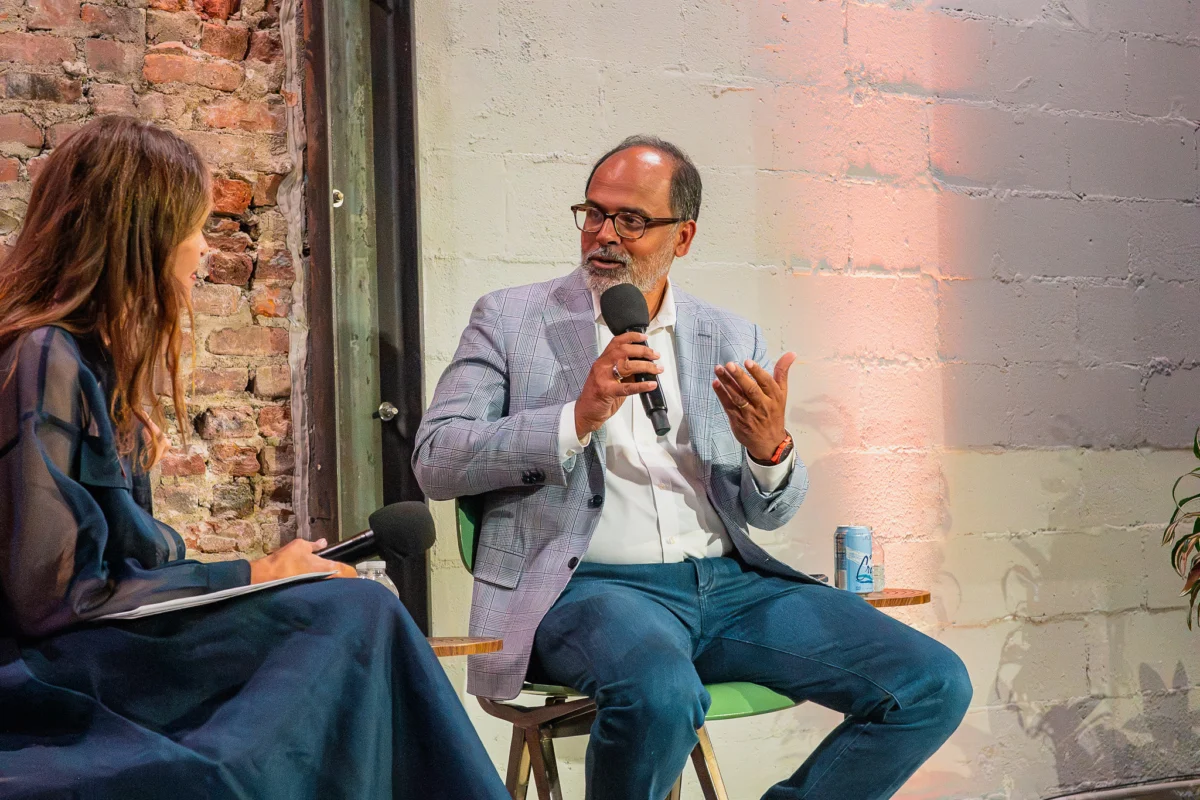
In an industry addicted to X (formerly Twitter) spats, self-aggrandizing podcast appearances, and public-facing bravado, Deven Parekh is a rare breed. Having co-run heavyweight global investment firm Insight Partners for 26 years, Parekh has quietly steered a ship managing roughly $90 billion in assets without feeling the need to broadcast his every thought to the tech ecosystem.
Unlike many contemporaries who live in the public eye, Parekh and Insight prefer to let their portfolio do the talking. However, during a candid sit-down interview with TechCrunch at the StrictlyVC event in New York City, Parekh pulled back the curtain. He offered a sharp, unvarnished look into the state of venture capital—touching upon everything from the firm’s massive wins, like Databricks and Wiz, to the deals they lost, including buzzy AI legal-tech startup Legora, and why Insight refuses to abandon a diversified strategy despite the industry’s rush toward frontier AI labs.
Below is an in-depth exploration of Parekh’s insights across main industry pillars, chronology, supporting market data, leadership perspectives, and the macro implications for the technology sector.
Main Facts
- Scale and Longevity: Deven Parekh has spent 26 years co-managing Insight Partners, which currently boasts approximately $90 billion in assets under management (AUM) and is operating out of its 13th flagship fund.
- The AI Bet: Insight maintains stakes in elite AI heavyweights OpenAI and Anthropic, managing the delicate balance of investing across competing ecosystems.
- Capital Return Metrics: Amid a broader industry liquidity crunch where many young funds have failed to return capital to Limited Partners (LPs), Insight has returned over $20 billion to its LPs over the last two years via strategic sales and IPOs.
- Missed Deals: Insight recently lost a competitive deal for Swedish AI legal-tech firm Legora to General Catalyst, an outcome Parekh attributes to General Catalyst’s superior pitch execution rather than a structural flaw in Insight’s approach.
- Macro Views on Risk: Echoing other prominent investors, Parekh dismisses extreme AI safety hysteria, arguing that the massive clinical and pharmaceutical upsides heavily outweigh the speculative existential risks.
Chronology of an Evolution: From Scale Funds to Multi-Stage Strategy
To understand Insight Partners’ current positioning, one must trace the firm’s operational evolution over more than two decades.
The Early Decades (Late 1990s – 2010s)
Founded as a software-focused growth equity investor, Insight established its reputation by backing enterprise software companies well before "software eating the world" became a ubiquitous tech cliché. Rather than betting exclusively on the earliest garage-stage startups, Insight mastered the art of growth-stage investing, scaling companies through operational playbooks and rigorous market positioning.
The 2021 Bubble and Valuation Inflation
By 2021, the venture capital landscape experienced an unprecedented influx of dry powder, driving valuations to astronomical heights. Insight, like many of its peers, participated in aggressive funding rounds. However, when the market corrected sharply through 2022 and 2023, many first- and second-time fund managers found themselves trapped with illiquid assets, unable to return capital to LPs.
The Modern Multi-Stage Approach (2024–Present)
Recognizing that late-stage growth rounds were moving too fast with minimal incremental data to justify soaring prices, Insight shifted its tactical focus. Instead of deploying $500 million tickets into overheated growth rounds, the firm leaned back into earlier-stage bets—writing $20 million to $25 million checks—while aggressively doubling down on breakout winners. A prime example is Wiz, where Insight participated in the Series A and continuously layered on capital, generating outsized returns that a single-check strategy could never match.
Supporting Data & Market Dynamics
The current venture capital ecosystem is defined by stark paradoxes: a hyper-concentration of capital in a handful of AI labs, soaring private market valuations, and a severe scarcity of liquidity for the broader market.
- The AI Capital Concentration: In the first half of the year, approximately half of all venture capital dollars deployed globally flowed into just two companies: OpenAI and Anthropic. Many new venture funds are pitching LPs on the premise that 35% to 40% of their entire fund will be funneled into a single AI giant.
- The Scale of Insight’s Returns: Insight’s multi-stage strategy has enabled it to distribute over $20 billion back to LPs over the past 24 months, with several billion more in the pipeline. This focus on DPI (Distributed to Paid-In Capital) separates seasoned institutions from speculative newcomers.
- The Mathematics of Compounding Valuations: Addressing the frothy environment where companies scale from zero to tens of billions in record time, Parekh noted the mathematical impossibility of current projections. "You can’t compound $40 billion at 50% every two months for two years without becoming the world economy. That math doesn’t work," he noted.
- Portfolio Health Checks: Insight’s rigorous asset management is underscored by its systematic portfolio reviews. The firm recently evaluated 300 portfolio companies over a three-day period to identify inflection points—deciding whether to double down, execute secondary buys, or quietly trim exposure.
Official Responses and Industry Perspectives
On AI Safety Hysteria vs. Real-World Utility
Following intense industry debate regarding catastrophic AI risks—sparked recently by high-profile researcher departures at frontier labs—Parekh addressed the hysteria head-on. Comparing notes with fellow investor Keith Rabois, Parekh adopted a pragmatic, utility-first posture:
"Sure, there’s a risk some non-state actor gets access to an open-source model and creates a biological weapon. But there’s an even higher probability we get a massive decrease in the time it takes to develop new drugs and cure diseases. I’ll take that bet."
Drawing from his experience on the board of NYU Langone, Parekh emphasized that AI is already analyzing millions of patient records to flag early health risks years before symptoms manifest. Given an aging global population and a dwindling supply of medical professionals, Parekh argues that scaling healthcare via AI is an absolute necessity.
On Competing Investments: OpenAI and Anthropic
For years, venture capital dogma dictated strict exclusivity: investing in direct competitors was considered taboo, fraught with conflicts of interest and governance nightmares. Insight shattered this unwritten rule by taking stakes in both OpenAI and Anthropic.
According to Parekh, the internal debate at Insight wasn’t about whether holding both was philosophically pure, but rather whether they could secure allocations in the earlier, more restrictive rounds. At the Series A or B stage, information-sharing restrictions are absolute, and direct competitive investments are avoided. However, at later stages—when a firm sits off the board and no longer dictates governance—investing in both market leaders is simply "buying a great stock."
"We saw OpenAI as the dominant consumer play and Anthropic as having a clear enterprise strategy… As these companies needed to raise $30 to $100 billion, they stopped being able to dictate exclusivity."
On Physical AI and Robotics
While software and large language models command the lion’s share of headlines, physical AI and humanoid robotics are attracting increased VC interest. Parekh, however, remains measured. He views physical intelligence companies largely as "science projects." While acknowledging their inevitable long-term viability, Parekh noted that investing here requires a double-layered bet: predicting whether robotics adoption will happen, and accurately timing when it will commercialize at scale. Insight is watching closely, but keeping its powder dry for now.
Implications for the Tech Ecosystem
The practices and philosophies championed by Deven Parekh and Insight Partners carry profound implications for founders, limited partners, and the broader macroeconomic climate over the next 18 to 36 months.
1. The Imperative of Liquidity and DPI
The era of paper wealth is giving way to a ruthless focus on realized liquidity. Funds that failed to prioritize secondary transactions or strategic exits face an existential threat. As Parekh bluntly noted, many first- and second-time managers who raised massive sums in 2021 will fail to raise subsequent funds because they prioritized valuation marks over cash returns. Founders are increasingly advised to de-risk by taking secondary liquidity off the table when market windows open.
2. The Coming Wave of Trillion-Dollar IPOs
With companies like Anthropic and SpaceX hurtling toward public debuts—following a trajectory where private entities achieve multi-hundred-billion-dollar valuations in mere years—the public markets are bracing for a structural shift. Parekh predicts that over the next 18 months, the market will absorb these mega-cap offerings, forcing public-market investors to recalibrate their growth expectations as formerly hyper-growth startups mature into standard corporate giants.
3. Geographic Dispersion vs. Infrastructure Concentration
While foundational AI infrastructure remains heavily concentrated in geographic hubs like San Francisco (prompting even the next generation of VCs, like Parekh’s son, to relocate to the Bay Area), vertical AI applications are far more decentralized. Talent for fintech applications clusters in New York (e.g., Ramp), while enterprise legal and software talent spans Europe and beyond. For global funds like Insight, winning deals is no longer about staying put in Silicon Valley; it requires flying to Stockholm to pitch founders directly.
4. The Enduring Value of Diversification
In a market dominated by boom-and-bust cycles where LPs dynamically chase the hottest trends, Insight’s adherence to a diversified, multi-stage model serves as a masterclass in risk mitigation. While concentrated funds like Founders Fund or Thrive Capital have achieved legendary success through high-conviction, high-concentration strategies, Parekh insists that long-term institutional survival across ten consecutive funds demands disciplined risk management.
As the tech sector navigates the white-hot intensity of the generative AI boom, Deven Parekh’s steady hand at Insight Partners serves as a reminder: true market endurance belongs to those who value disciplined execution, portfolio diversification, and real liquidity above all else.
 rifanmuazin
 Nana Muazin
