

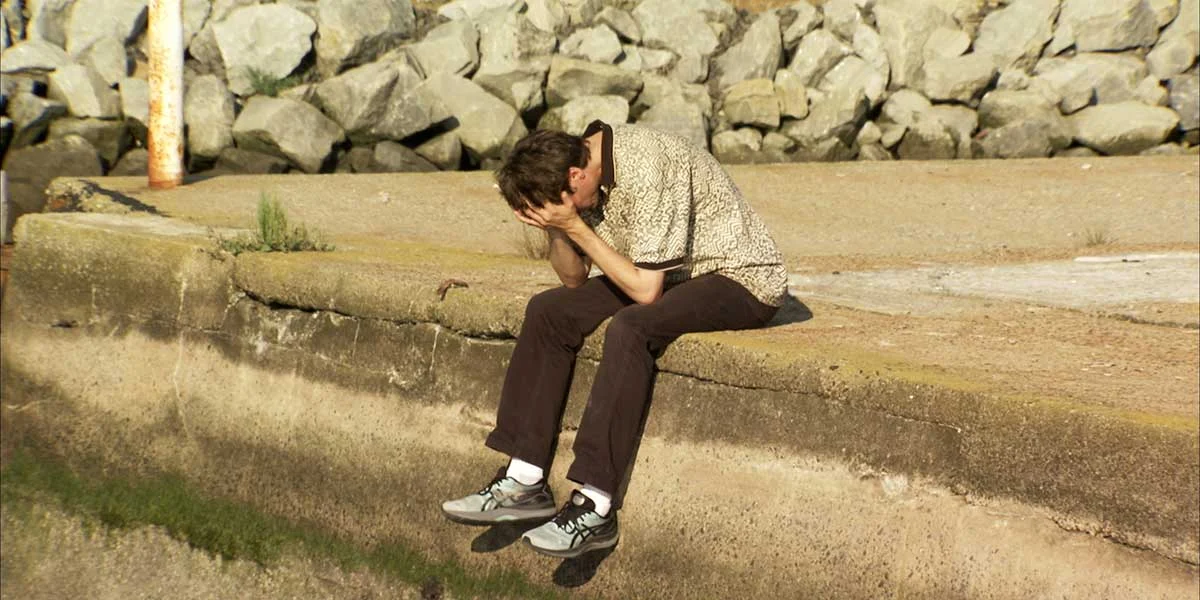
In the landscape of contemporary independent cinema, the "autobiographical documentary" has long been dominated by the ghost of Ross McElwee. His 1986 landmark, Sherman’s March, established a template for the intellectual filmmaker as a bumbling, lovelorn protagonist, navigating the complexities of history and personal failure with a handheld camera and a soft-spoken, self-deprecating wit. Decades later, that mantle has been picked up, twisted, and doused in a distinct brand of digital-age self-loathing by writer-director Matt Barats in his second feature, Anchors Aweigh.
Backed by the avant-garde comedy powerhouse Abso Lutely Productions—the same collective responsible for the cult-defying brilliance of Nathan For You and Tim and Eric Awesome Show, Great Job!—Barats delivers a micro-budget masterclass in "cringe-cinema." At a tight, claustrophobic 71 minutes, Anchors Aweigh functions as both a parody of the essay-film genre and a genuine, deeply uncomfortable exploration of the stagnation that defines the post-recession millennial creative.
The Premise: A Portrait of the Artist as a Schmuck
The film follows an unnamed, nebulously employed NYC creative—played by Barats—who finds his world collapsing after a breakup with his significantly wealthier, younger girlfriend, Megan (Serena Profaci). Following the rejection of his marriage proposal, the protagonist retreats to the cheapest, most absurd living situation he can muster: a rental sailboat, which serves as the perfect, hackneyed setting for his existential drift.
What follows is an obsessive, often humiliating excavation of the past. The protagonist spends his days alternating between watching verité DV tapes of his college years and early 20s and filming new, often rambling monologues around New York City. He describes these efforts as "a loose series of vignettes," a claim the film treats with the same skepticism as the audience does. Barats, playing a heightened, "stupider" version of himself, manages to capture the specific, itchy anxiety of being in one’s late 30s while feeling as though one’s internal clock stopped in 2007.
Chronology of a Meltdown
The narrative structure of Anchors Aweigh is cyclical, mirroring the protagonist’s inability to break free from his own historical archives.
- The Catalyst: The film opens with the dissolution of the protagonist’s relationship, establishing the inciting incident that forces him onto the sailboat. This physical displacement mirrors his emotional isolation.
- The Archive Phase: The middle act consists of the director viewing his past. These archival segments are not merely nostalgic; they are indictments. As he watches footage of his younger self, the present-day Barats interjects with brutal, unsparing commentary: "Damn, I’ve been an idiot for so long!"
- The Synthesis: The final movement of the film attempts to reconcile these two versions of the self. The protagonist tries to string his footage into a coherent feature-length narrative, hoping that by documenting his failures, he might somehow achieve the catharsis required to move forward.
Supporting Data: The Aesthetic of Nostalgia
The visual language of Anchors Aweigh is as much a character as the lead actor. With the exception of one conspicuously high-resolution camera used for modern-day segments, the film is shot on various lo-fi digital cameras. This choice is intentional; it is a "nostalgic format fetishism" that visually manifests the character’s stuck-in-time malaise.

The cultural touchstones embedded in the film serve to anchor the audience in a specific generational experience. From the inclusion of Radiohead lyrics (specifically from "Pyramid Song") to the haunting, dated trauma of reaction videos to the viral internet shock-clip "Two Girls, One Cup," Barats forces the viewer to confront the specific banality of the mid-2000s internet experience.
Perhaps most poignant is the archival footage of the George W. Bush years. In one scene, the younger Barats is seen driving a pickup truck, rambling inarticulately about his refusal to support the government system of the time. The present-day Barats deadpans, "Yup, those were the Bush years all right," effectively puncturing the veil of his own performative haplessness. This is one of the few moments where the mask slips, revealing a keen, sharp-eyed observer behind the schmuck facade.
The McElwee Connection: A Genealogy of Haplessness
To understand Anchors Aweigh, one must understand its lineage. Ross McElwee’s influence on modern non-fiction filmmaking cannot be overstated. He created the persona of the "hapless observer"—someone who pretends to be naive to draw out the truth from subjects. This persona was later adapted by documentarians like Michael Moore, who utilized it to challenge corporate power, and more recently, John Wilson, whose halting, inquisitive style has become the gold standard for contemporary "essayistic" television.
All of these filmmakers follow a principle articulated by the late novelist David Foster Wallace, who noted that in his own comic non-fiction, he often constructed a persona "that’s a little stupider and schmuckier than I am." Barats takes this concept to its logical, and arguably most extreme, conclusion. His on-camera persona is overtly dumber, more insecure, and more prone to self-sabotage than any of his predecessors. By constantly holding a large, comically oversized shotgun microphone—a direct, thumping homage to McElwee—Barats signals that he is well aware of the genre’s tropes and is actively using them to deconstruct his own identity.
Implications: The Limits of the "Loose Vignette"
While the film is a triumph of conceptual execution, it does not escape the pitfalls of its own design. The film is, by its own admission, a "loose series of vignettes." At 71 minutes, it occasionally struggles to maintain momentum, relying on repetitive gags to reach a feature-length runtime. However, in the context of a film about a man who is essentially "spinning his wheels" in life, this padding feels less like a narrative failure and more like a thematic extension.
The "airtight" conceptual framework of the film suggests that Barats is a filmmaker with total control over his own image. While his character is a mess—someone who has failed to grow or change despite years of documentation—the director behind the camera is demonstrating a surgical precision. The film forces a question upon the audience: If you document your entire life, but never learn from it, does the documentation have value? Or is it simply a high-definition record of your own static state?

Reception and Future Outlook
Anchors Aweigh premiered at the 2026 Oak Cliff International Film Festival and was later featured in the Midnight Madness section of the Toronto International Film Festival (TIFF). While the film is currently seeking U.S. distribution, the critical consensus is already leaning toward it being a defining work of the "cringe-doc" subgenre.
It is a rare film that can be simultaneously annoying and profound. By holding a mirror up to his own worst impulses—his vanity, his laziness, and his inability to let go of his past—Barats has created a work that is as difficult to look away from as it is to endure. In an era where the "personal documentary" has become oversaturated with sincerity and curated authenticity, Anchors Aweigh stands out as a necessary, jagged, and hilariously honest rejection of the status quo.
Whether it finds a wider audience or remains a cult object for those who grew up in the shadow of the Bush years and the early viral internet, one thing is certain: Matt Barats has successfully updated the McElwee tradition for a generation that no longer believes in the possibility of a "Sherman’s March." Instead, we get a sailboat with no wind, a dead battery in the camera, and a protagonist who has finally stopped lying to himself about the view.
Grade: B
 Azzam Bilal Chamdy
 Pevita Pearce
