

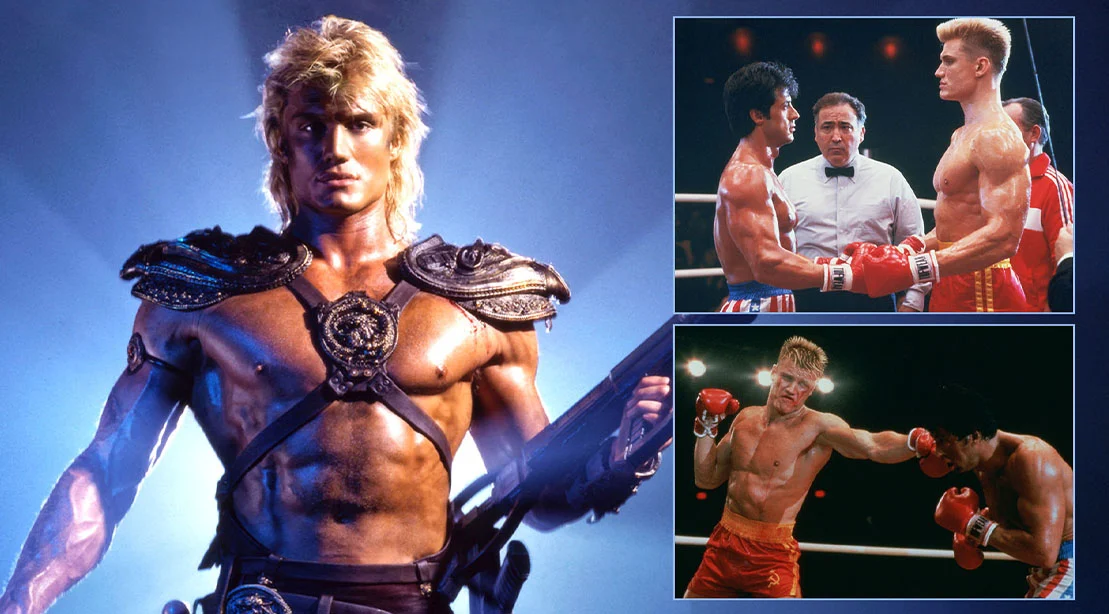
For over three decades, Dolph Lundgren has occupied a singular space in the global consciousness. To millions, he is the towering 6’5” physical manifestation of cinematic strength—the man who pushed Rocky Balboa to the brink in the snowy rings of Russia as Ivan Drago, the savior of Eternia as He-Man, and a mainstay of the Universal Soldier and Expendables franchises. Yet, behind the celluloid muscles and the imposing frame of the former karate champion lies a man of profound intellect and surprising vulnerability.
Today, at 68, Lundgren is pivoting from the silver screen to the printed page, sharing a story that is far more harrowing than any scripted action sequence. His new autobiography, Fights Worth Fighting: Finding Strength in Struggle, serves as both a memoir and a manifesto, chronicling his life-altering battle against cancer—a fight that nearly cost him everything, but ultimately redefined his understanding of strength.
The Academic Action Hero: Beyond the Punches
To categorize Dolph Lundgren merely as an action star is to ignore the depth of his background. Born in Sweden, the young Lundgren was an accomplished ice hockey player and a world-class martial artist, but his path was just as much about the mind as it was about the body. He earned a master’s degree in chemical engineering and became a prestigious Fulbright scholar at MIT before the siren call of Hollywood intervened.
With over 100 credits on his IMDb profile, his career spans the golden age of 80s action cinema through to modern blockbusters. From the cult status of 1987’s Masters of the Universe to his reprisal of the role of Gunner Jensen in The Expendables series, Lundgren has remained a relentless worker. However, his most significant challenge did not arrive on a movie set, but in a private, clinical setting a decade ago.
Chronology of a Crisis: A Decade-Long Battle
The timeline of Lundgren’s health struggle is a testament to the unpredictable nature of disease.
- 2015: The first sign of trouble appeared during a routine training session, where Lundgren discovered blood in his urine. Medical intervention revealed a cancerous tumor in his kidney. The tumor was successfully removed, and the prognosis initially seemed manageable, requiring only periodic monitoring.
- 2020: The illusion of safety was shattered when a follow-up scan revealed that the cancer had returned, this time with several tumors in the immediate vicinity of the original site.
- The Escalation: Surgeons removed the new growths, but the nightmare continued as a malignant tumor was discovered in his liver. Due to its size and location, the tumor was deemed inoperable.
- The Nadir: As he underwent intensive drug infusions, the side effects—including severe blood clots—began to take a heavy toll. By this point, the cancer had spread to his kidneys and beyond. During his lowest point, a doctor gave him a grim prognosis, suggesting he spend his final remaining months with his family.
The Breakthrough: Seeking a Second Opinion
In the face of a terminal prognosis, many might have retreated from public life. Lundgren, however, channeled the discipline of his martial arts training into a calculated, scientific inquiry. He decided to seek a second opinion, a decision he now credits with saving his life.
Lundgren reached out to UCLA Health, where his tissue samples were analyzed by Dr. Alexandra Drakaki. Through advanced genomic testing, Dr. Drakaki identified a specific mutation that linked his kidney cancer to a genetic profile often seen in lung cancer. This discovery was the "Eureka" moment: it allowed the medical team to pivot to a targeted treatment plan rather than relying on generalized protocols.
The results were nothing short of miraculous. The tumor load in his body shrank by approximately 90% within a short period. This dramatic reduction allowed the remaining cancerous tissues to be treated through ablation—the use of localized heat, cold, or lasers to destroy the residual cells. By late 2024, the actor was officially declared cancer-free.
The Philosophy of Strength: Training at 68
For Lundgren, the gym has never been about vanity; it is about longevity and mental fortitude. "It’s very important, I think, as you get older, to keep your muscle mass, keep your testosterone level up," Lundgren explains. Even during the height of his treatment, when his body was being ravaged by chemotherapy and medication, he maintained a commitment to movement.
He currently trains three times per week, blending traditional weightlifting with his lifelong passion for karate. He emphasizes that strength training provided a crucial anchor during his recovery. "Those treatments were quite tough, so the strength training really helped me," he notes. He advocates for even the simplest routines, suggesting that just 30 minutes of physical activity—disconnected from the digital noise of computers and phones—can provide transformative benefits for both the body and the psyche.
Official Reflections: The Man Behind the Legend
Reflecting on the process of writing Fights Worth Fighting, Lundgren describes the experience as a form of catharsis. "It’s a bit like doing therapy," he tells Muscle & Fitness. "You’re going back and re-examining your life. It was good for me, because it was a way for me to appreciate the young man who set out from Sweden on some sort of adventure."
He is acutely aware of his status as a pop-culture icon, but he is quick to clarify that his book is not intended as a vanity project. Instead, he views it as a service to others. "It’s for other people who have their own fights, medically or going through hardships in life," he says.
When asked if he regrets the path he chose—given that he could have easily been a chemical engineering professor or a karate instructor—Lundgren is philosophical. "I think it would have been frustrating for me," he admits. "I had the creative side of me, and a lot of energy. I think I made the right choice."
Implications: A Legacy of Resilience
Dolph Lundgren’s journey from the brink of death to a renewed life carries profound implications for how we view health, advocacy, and the aging process. His story highlights several critical points for the public:
- The Power of Second Opinions: Lundgren’s experience underscores the vital importance of self-advocacy in medical settings. Patients should never feel discouraged from seeking expert secondary opinions when faced with a life-altering diagnosis.
- Genomic Medicine: The role of precision medicine in identifying specific mutations, as seen in Dr. Drakaki’s intervention, represents the future of oncology. It moves the conversation from "one-size-fits-all" treatment to individualized care.
- The Vitality of Movement: Lundgren’s insistence on staying active—even through the most painful stages of his illness—serves as a powerful anecdote for the medical community regarding the role of exercise in recovery and patient morale.
As Lundgren embarks on his book tour and prepares for the 2026 release of his documentary, Dolph: Unbreakable, he stands as a reminder that the most impressive battles are not fought in a boxing ring, but in the quiet, persistent struggle to reclaim one’s health and future. Whether he is playing a villain or a hero, the real-life version of Dolph Lundgren has proven to be his most compelling character yet: a man who, against all odds, refused to stay down for the count.
For more information on "Fights Worth Fighting: Finding Strength in Struggle," visit HarperCollins Focus. You can also follow Dolph Lundgren’s journey on Instagram.
 Nana
Nana
 Iffa Jayyana
 Reynand Wu
