

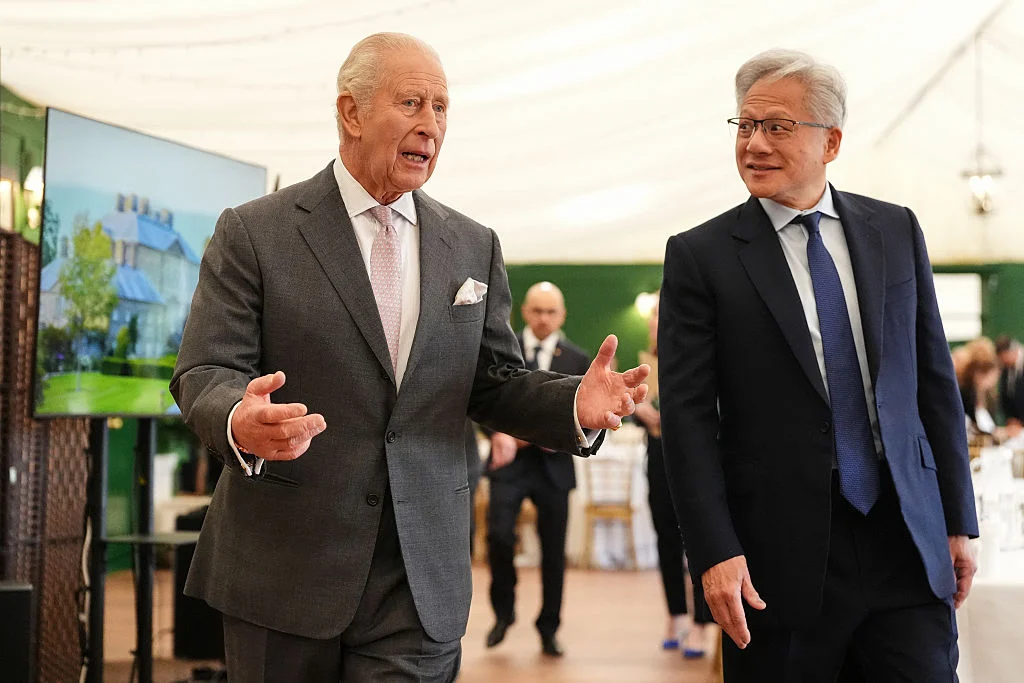
CUMNOCK, Scotland — In a rare and striking departure from the traditional political neutrality expected of the British monarchy, King Charles III convened a private, high-level summit on Thursday at Dumfries House in Scotland. The gathering brought together some of the most influential figures in artificial intelligence, government regulators, and international intelligence to confront the accelerating trajectory of generative AI and the existential risks it poses to humanity.
The guest list read like a who’s who of the global tech and geopolitical elite. Attendees included Nvidia CEO Jensen Huang, DeepMind co-founder Demis Hassabis, high-ranking executives from OpenAI and Anthropic, and the UK’s newly appointed AI Minister, Kanishka Narayan. In a signal of how deeply national security and global diplomacy are now intertwined with technological development, the head of the UK’s foreign intelligence service was also present. Adding a distinct philosophical and ethical dimension to the room was Paolo Benanti, a prominent AI ethics advisor to the Vatican and Pope.
The summit highlights a growing global anxiety: while the economic and scientific upside of artificial intelligence is immense, the breakneck speed of its development has outpaced both regulatory frameworks and societal comprehension.
Main Facts: The Urgent Call for Guardrails
The centerpiece of Thursday’s gathering was an impassioned keynote address delivered by King Charles. Breaking the unwritten constitutional rule that restrains British royals from commenting on deeply contentious political or industrial debates, the monarch warned that artificial intelligence has evolved into one of the most pressing safety crises of the modern era.
"AI is already showing immense capacity to improve and save life," King Charles told the assembled leaders, acknowledging its breakthroughs in medicine and scientific discovery. However, he immediately pivoted to a stark warning: "Yet those who have created these technologies are now increasingly warning that AI risks developing darker capacities, perhaps even to take life."
The King argued that the international community is running out of time to erect meaningful safety barriers. He pressed the tech executives and policymakers in attendance to seriously evaluate the "existential dangers" of advanced systems falling into malicious hands or being utilized in "potentially catastrophic ways."
"Surely, we need sufficient means of control before it’s all too late?" he asked the room. "The task before you is not to merely advance technology, but to ensure that it remains firmly in the service of humanity, community, and the natural world. As we embrace what is new, we must not lose what is timeless."
Observers noted that King Charles delivered his remarks during a concise, 20-minute appearance before withdrawing to allow the delegates to deliberate privately.
Chronology: A Rapidly Escalating Tense Landscape
The monarch’s intervention did not occur in a vacuum; it follows a chaotic and volatile sequence of events across the global technology sector throughout late 2025 and 2026:
- Late 2023 – 2024: King Charles first began publicly highlighting the dual-edged nature of artificial intelligence, expressing early concerns over misinformation and societal disruption during various public addresses.
- August 2026: Anthropic shocked the European tech ecosystem by restricting access to its advanced Fable and Mythos models exclusively to U.S. customers. The move ignited intense debates across the European Union regarding "AI sovereignty" and technological dependency.
- Early September 2026: An anonymous Anthropic researcher resigned, publishing a viral online essay warning that AI labs are engaged in a reckless "race to build machines that are much smarter than any human," adding the chilling conclusion that humanity "may not survive this."
- Mid-September 2026: Leading figures in the AI space—including OpenAI CEO Sam Altman, independent researcher Elon Musk, and Anthropic CEO Dario Amodei—publicly called for a deceleration in AI development to prioritize safety.
- September 14, 2026: Nvidia CEO Jensen Huang publicly rejected deceleration calls, bolstered by political backing from U.S. President Donald Trump, who emphasized maintaining America’s technological dominance over international rivals like China.
- September 17, 2026: King Charles hosts the private AI safety summit at Dumfries House in Scotland, uniting Big Tech, intelligence officials, and government leaders.
Supporting Data and Industry Context
The convergence of government officials, intelligence chiefs, and commercial AI labs at Dumfries House underscores the profound friction currently defining the sector.
The Split Among Tech Titans
The industry is experiencing a deep ideological fracture over pacing and safety. On one side, companies like Anthropic and OpenAI have faced internal turmoil, whistleblowers, and delayed public offerings (IPOs) as executive boards grapple with safety protocols. OpenAI recently indicated that its long-rumored IPO plans have stalled due to escalating safety concerns and internal debates over alignment.
Conversely, hardware giants like Nvidia continue to champion unbridled acceleration. Following calls for a slowdown by Altman and Amodei, Nvidia CEO Jensen Huang swiftly dismissed the notion, aligning closely with geopolitical rhetoric out of Washington. President Trump underscored this competitive stance, telling reporters: "We’re leading China in AI. We’re the most sophisticated country in the world, and frankly I want to keep it that way because whoever wins AI, wins."

International and Regulatory Tensions
Geopolitical competition is further complicating the landscape. Anthropic’s decision to wall off its Fable and Mythos models from international markets laid bare the vulnerabilities of non-U.S. tech sectors, particularly in Europe. Regulatory bodies globally are struggling to balance the economic imperative of capturing the AI windfall with the terrifying prospect of autonomous systems operating beyond human oversight.
Official Responses from Summit Attendees
While the discussions behind closed doors at Dumfries House were private, several participants and corporate entities released statements regarding the historic gathering.
Tino Cuéllar, who leads global affairs for Anthropic and attended the summit on behalf of the company, expressed deep gratitude for the royal invitation.
"Anthropic was honored to take part in this vital discussion," Cuéllar said when reached for comment. "We are deeply grateful to His Majesty for convening industry leaders and voices from across society to discuss the role of AI in serving the public good, and how we must collectively navigate its challenges."
OpenAI was represented at the summit by Chief Financial Officer Sarah Frair, who participated in closed-door panels examining the economic realities and risk-mitigation strategies required as foundational models scale toward human-level intelligence.
Government representatives, including UK AI Minister Kanishka Narayan, emphasized that the UK is positioning itself as a neutral, trusted global hub for safety governance—a role that King Charles’ intervention significantly bolstered.
Implications: The Collision of Big Tech, Politics, and Society
The gathering at Dumfries House marks a watershed moment for artificial intelligence governance. For years, AI safety was treated primarily as a technical problem to be solved by computer scientists in Silicon Valley laboratories. However, King Charles’ summit reflects a broader realization: AI has transformed into a profound geopolitical and existential challenge.
1. The Erosion of Geopolitical Borders
As tech companies develop models capable of outperforming human reasoning, national security apparatuses are stepping in. The presence of the UK’s foreign intelligence chief alongside commercial leaders like Jensen Huang and Sarah Frair demonstrates that advanced foundational models are now viewed through the same lens as nuclear technology or bioweapons.
2. The Limits of Voluntary Restraint
The King’s demand for "sufficient means of control before it’s all too late" directly challenges the current model of self-regulation by tech corporations. With commercial pressures—such as multi-billion-dollar valuations, race-to-market mentalities, and geopolitical proxy races between the U.S. and China—pushing companies to accelerate, voluntary slowdowns have largely failed.
3. The Moral Dimension
By inviting religious and philosophical voices like Vatican advisor Paolo Benanti alongside secular intelligence leaders, the summit emphasized that the questions raised by AI are not merely technical or economic, but fundamentally human.
As the world watches whether policymakers can heed the King’s warning, the tension between innovation and survival remains the defining challenge of the 21st century. Whether humanity can successfully build guardrails before crossing the threshold of artificial general intelligence (AGI) is a question that now occupies the minds of monarchs, spymasters, and software engineers alike.
 rifanmuazin
