

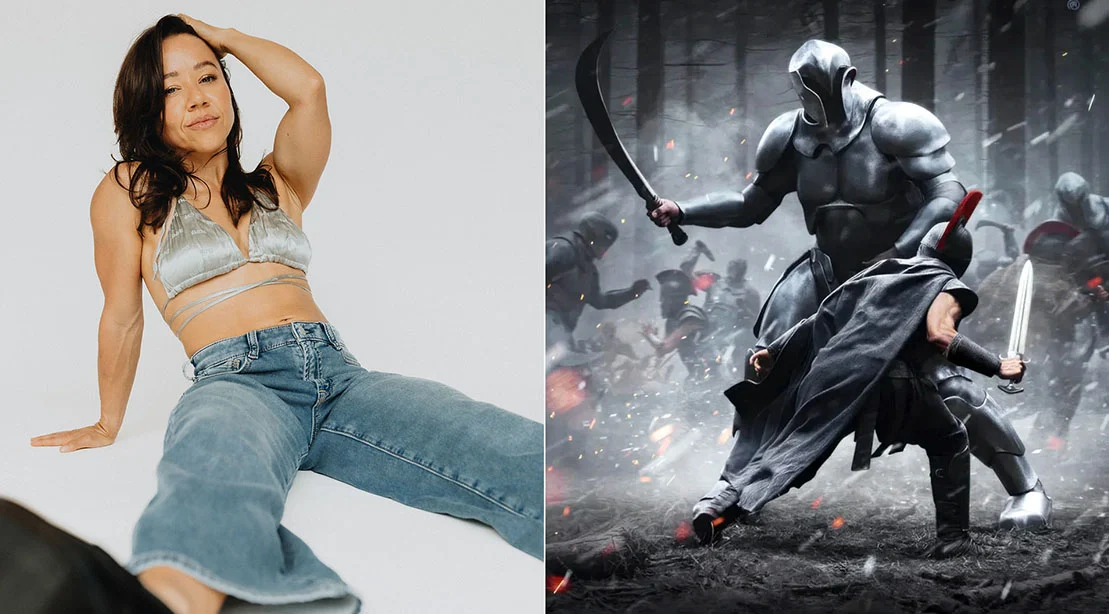
In the sprawling, high-stakes world of Hollywood blockbusters, visual effects often dominate the conversation. Yet, in the case of the global hit The Odyssey, the most talked-about physical transformation didn’t happen in a digital rendering suite—it happened in the gym. Devyn Dalton, the multi-talented Canadian performer who served as Matt Damon’s stunt double, became an unexpected focal point of the film’s marketing. Her physique, particularly her exceptionally defined and powerful arms, became so integral to the character of Odysseus that her own musculature was featured prominently on official promotional posters.
For an actor of Matt Damon’s caliber, the physical demands of playing a legendary Greek hero are immense. However, it was Damon himself who famously lauded Dalton’s conditioning, labeling her arms "the greatest" he had ever seen. This accolade has sparked a global curiosity: How does a performer of Dalton’s stature—standing at 4-foot-6—achieve a level of muscularity and functional athleticism that commands the respect of A-list stars and elite trainers alike?
The Philosophy of Performance: Redefining Strength
To understand Dalton’s approach to fitness, one must first understand the unique demands of her profession. As both a dancer and a stunt performer, Dalton’s relationship with the gym evolved from traditional aesthetic-focused training to a performance-based paradigm.
"When I started getting into stunt work and performance capture, training became less about simply ‘working out’ and more about what my body was capable of doing," Dalton reveals in an exclusive interview with M&F Hers. "I needed to be strong, explosive, mobile, and resilient. I’ve always loved challenging the assumptions people can sometimes make about what a small body is capable of."
For Dalton, the gym is not a place for vanity; it is a laboratory for human potential. Her routine is a tapestry of disciplines, ranging from the technical precision of Muay Thai and jiujitsu to the raw strength of calisthenics and traditional weightlifting. By viewing her body as a tool that must be sharpened, she has managed to build a physique that is as aesthetically striking as it is functionally superior.
Chronology of a Transformation
Dalton’s journey toward her "Odyssey" physique was not an overnight success story, but the result of years of disciplined, multi-modal training.
Early Foundations: The Dancer’s Discipline
Before she was dodging explosions on a soundstage, Dalton was a trained dancer. This background provided her with the essential pillars of athleticism: coordination, balance, and, perhaps most importantly, an intuitive understanding of body control. Dancers possess an innate ability to isolate muscle groups and maintain core tension—skills that translate seamlessly into the world of complex stunt choreography.
The Stunt Transition
As she transitioned into stunt work, Dalton recognized that her size—often perceived as a limitation—could be an asset if backed by elite strength. She began incorporating heavy resistance training, moving away from high-repetition, low-weight schemes and into the realm of compound movements. This period was characterized by the "Odyssey" protocol: a focus on pull-ups, dips, and explosive movements that build dense, functional muscle.
The "Odyssey" Peak
During the pre-production and filming phases of The Odyssey, Dalton’s training reached its zenith. To match the heroic proportions required of the character, she implemented the rigorous upper-body routine that eventually caught the eye of her lead actor. The combination of bodyweight calisthenics, cable-based resistance, and high-intensity conditioning created a look that was both lean and powerful, perfectly suited for the demands of the camera.
Supporting Data: The Science Behind the Physique
Dalton’s workout is grounded in exercise physiology. By utilizing a mix of pull-ups, dips, and explosive push-ups, she targets the upper body through multiple planes of motion.
- Mechanical Tension: By utilizing pull-ups and chin-ups, Dalton leverages bodyweight to create maximum mechanical tension on the latissimus dorsi, rhomboids, and biceps.
- Progressive Overload: Dalton’s emphasis on "building up slowly" rather than sacrificing form mirrors the gold standard of hypertrophy training.
- Constant Tension: Her use of cable machines—particularly for finishers—ensures that the muscle is under load throughout the entire range of motion, a critical factor for achieving high-definition muscle tone.
- Neuromuscular Explosiveness: The inclusion of clapping push-ups trains the fast-twitch muscle fibers, which are essential for the quick, reactive movements required in stunt work.
Official Guidance: The Odyssey Arm and Upper-Body Routine
For those looking to emulate Dalton’s results, consistency and proper form are the primary variables. Dalton recommends a two-day-per-week frequency for this specific upper-body routine to allow for adequate recovery.
The Core Protocol
- Pull-ups: The gold standard for back and bicep development. Dalton emphasizes a strong hanging position and driving the elbows down.
- Chin-ups: These shift the focus toward the biceps. The key here is to control the descent, maximizing the eccentric portion of the lift.
- Dips: The ultimate developer of the triceps and chest. Dalton advises against forcing depth until the shoulder joints are fully conditioned.
- Explosive Clapping Push-Ups: A high-level movement for power. If you are a beginner, start with standard explosive push-ups to build the necessary stabilization.
- Arnold Press: This exercise, popularized by Arnold Schwarzenegger, maximizes time under tension by combining shoulder rotation with vertical pressing.
The Finishing Touches
To maximize muscle fatigue and metabolic conditioning, Dalton employs a "finisher" strategy:
- Battle Ropes: High-intensity intervals of alternating waves or slams. This builds cardiovascular endurance while keeping the shoulders under constant load.
- Boxing: The ultimate functional finisher. Whether shadowboxing or hitting a heavy bag, this builds coordination, shoulder endurance, and core strength, while offering a psychological boost in confidence.
Implications for the Fitness Industry
The success of Dalton’s training regimen sends a powerful message to the fitness industry: the most effective training is the kind that prioritizes what a body can do rather than what it looks like. By breaking down the barriers between "stunt work" and "bodybuilding," Dalton has provided a blueprint for functional aesthetics.
Her advice to aspiring athletes is refreshingly grounded: "Stop comparing your body or your numbers to anyone else’s. Start where you are, learn good technique, get a little stronger over time, and find a way of training that you genuinely enjoy."
In a world where fitness marketing is often cluttered with superficial trends and impossible standards, Devyn Dalton’s journey stands as a testament to the power of deliberate, athletic-based training. Her arms are not just a product of a rigorous routine; they are the physical manifestation of a career built on hard work, technical mastery, and a refusal to let physical labels define her capabilities.
As The Odyssey continues to resonate with audiences, the legacy of its stunt work—and the woman behind the action—serves as an enduring inspiration for anyone looking to push their physical boundaries. Whether you are a stunt performer in training or someone simply looking to improve their functional strength, Dalton’s message remains the same: find your discipline, respect the process, and above all, enjoy the journey of seeing what your body is truly capable of achieving.
 Nana
Nana
 Iffa Jayyana
 Reynand Wu
