

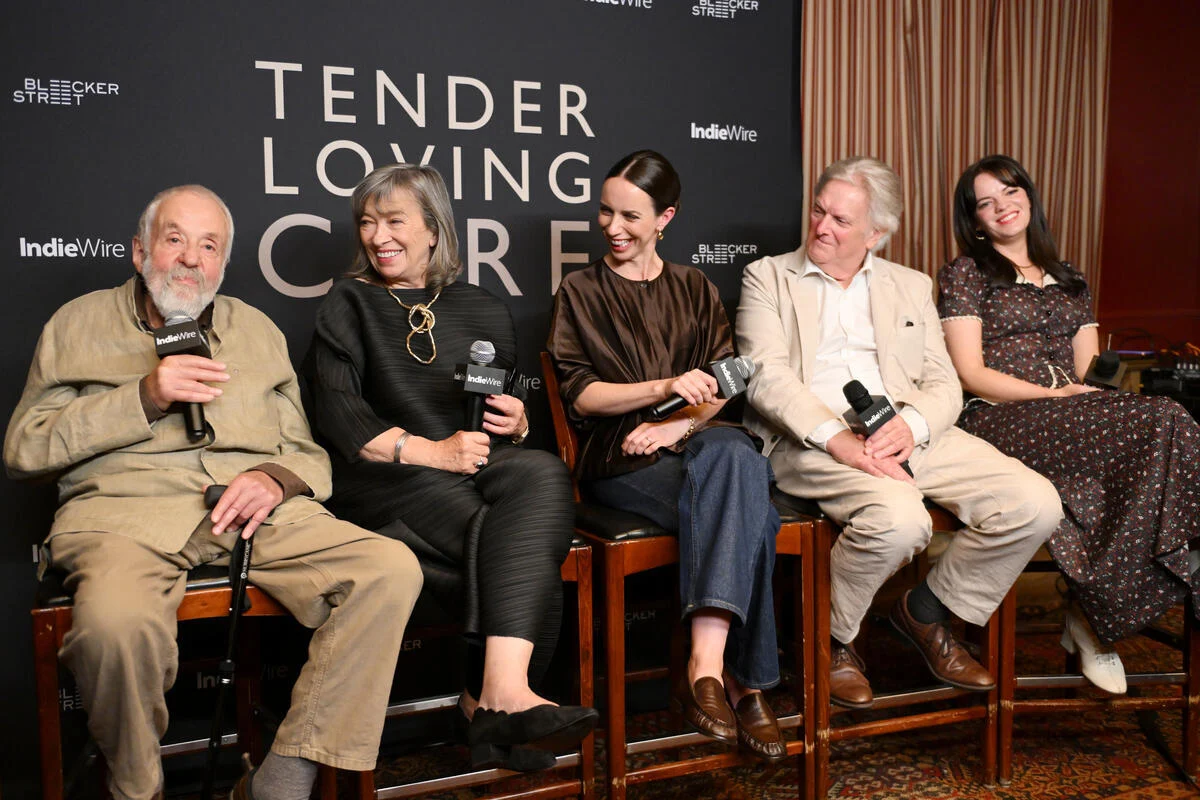
In the landscape of contemporary cinema, few filmmakers possess a signature as indelible—or as methodologically distinct—as British auteur Mike Leigh. Renowned for a filmography that captures the raw, unvarnished pulse of human existence in classics such as Secrets & Lies and Topsy-Turvy, Leigh has built a career upon a radical rejection of the traditional screenplay. Instead, he invites his actors into an extended, months-long laboratory of rehearsal and discovery, a process where characters are not written, but unearthed.
This year, Leigh brings that same spirit of organic storytelling to his latest project, Tender Loving Care. Following a buzz-worthy screening at the Toronto International Film Festival (TIFF), the film has solidified its place as a standout entry in his storied career. To celebrate the release, IndieWire and Bleecker Street hosted an exclusive dinner in Toronto, bringing together Leigh and his longtime collaborators—actors Marion Bailey, Kate O’Flynn, Paul Jesson, and Alice Bailey Johnson—to peel back the curtain on one of the most enigmatic creative processes in the industry.
The Architecture of the Unknown: A Chronology of Discovery
For the uninitiated, the "Mike Leigh Process" sounds less like film production and more like an anthropological expedition. It begins not with a bound script or a rigid storyboard, but with a faint, ephemeral spark.
"It’s a little bit hard to define," Leigh reflected during the TIFF panel, moderated by IndieWire Editor-in-Chief Brent Lang. "It’s an idea or a feeling. In the case of this film, it was the spirit of the thing. The feeling about positivity."
The chronology of a Leigh production follows a rhythmic, non-linear path:
- The Incubation: Leigh identifies a thematic resonance or a societal "spirit" he wishes to explore.
- The Casting/Development: Actors are brought on board early. They begin in isolation, working with Leigh to build their characters from the ground up—developing histories, mannerisms, and internal psychologies without knowing how they will eventually intersect with other characters.
- The Collision: Only after the characters are fully realized do the actors meet in rehearsals. The story begins to emerge through the friction and flow of these interactions.
- The Refinement: As the narrative takes shape, the "script" is essentially the culmination of these rehearsals, transcribed and polished, yet remaining fluid enough to capture the spontaneity of the moment.
This methodology forces the film to evolve rather than be imposed upon, a distinction that Leigh views as essential to the vitality of the final product.

The Collaborative Canvas: Beyond the Solo Auteur
While many directors are viewed as "soloists"—the primary authors of their vision—Leigh views filmmaking as a collective, symphonic endeavor. He draws a direct parallel between his work and the arts of painting, poetry, and music.
"We make these films in the same way that painters paint pictures and novelists write novels," Leigh explained. "You discover what the piece is by embarking on the journey of making it. But here, it’s not the solo artist in the studio; it’s about the work that we share. For me, it’s about having a feeling of the spirit and the sense of possibilities. I don’t know where we’re going to wind up, but I then invite different actors to take part."
This approach fundamentally shifts the power dynamic on set. Actors are not mere vessels for dialogue; they are architects of their own characters’ realities. This shared ownership is perhaps why so many performers—such as Marion Bailey, who has appeared in six of Leigh’s films and two of his stage productions—return to his sets with such fervor.
Voices from the Ensemble: Why They Keep Coming Back
The panel provided a rare look into the actor’s experience within the Leigh universe. For those accustomed to the "page-to-screen" orthodoxy of the film industry, the transition to Leigh’s method is often transformative.
Marion Bailey: The Revelatory Experience
"To me, it wasn’t alien; it was absolutely revelatory," Bailey noted. "I suddenly thought, ‘Oh, that’s how you do it. Now I get how to act.’ I just want to do this all the time." For Bailey, the process stripped away the artifice of traditional acting, replacing it with a form of existence that felt profoundly authentic.
Kate O’Flynn: The Rarity of Trust
Having collaborated on four films, O’Flynn admitted to an initial naivety. "I initially thought every great director worked this way," she said. "I realized how rare it was in the years after it, and how brilliant it was." Her observation highlights a systemic issue in modern filmmaking: the pressure for efficiency often overrides the necessity of artistic exploration.

Paul Jesson: The Joy of the Unmapped
A veteran of five Leigh projects, Jesson described the appeal of the unknown. "I absolutely love the sense of adventure of setting off on a project about which you really don’t know anything." For Jesson, the lack of a script is not a hurdle; it is the primary engine of excitement.
Alice Bailey Johnson: The Freedom of Agency
As a relative newcomer to the ensemble, Johnson spoke to the emotional impact of the method. "It’s so freeing for an actor," she observed. "You just feel really trusted, and that’s so important for us." By trusting his actors to inhabit their roles completely, Leigh fosters an environment where the stakes feel genuinely personal.
Implications for the Future of Filmmaking
The sustained success of Tender Loving Care, along with the critical acclaim recently bestowed upon Hard Truths, suggests that Leigh’s unconventional process is not merely a quirk—it is a sustainable, viable model for high-caliber drama.
However, the implications of this model are broader than one filmmaker’s success. It serves as a critique of the "content factory" approach that currently dominates much of the entertainment landscape. In an era where scripts are often vetted by algorithms and focus groups, Leigh’s commitment to the "spirit of the thing" offers a counter-narrative: that the most profound stories are those that are allowed to breathe, grow, and surprise their creators.
The Sustainability of Risk
The logistical and financial risks of the Leigh process are obvious. Without a script, there is no pre-production greenlight based on a page count. There is only the investment in time—the most precious resource in modern cinema. Yet, the longevity of his career suggests that this risk pays off in the form of emotional resonance that is difficult to manufacture via traditional, rigid production timelines.
The Legacy of the Ensemble
Leigh has cultivated a "repertory company" feel, where the shorthand between director and actor creates a level of nuance that would be impossible to achieve with a revolving door of talent. This loyalty creates a safe space for vulnerability. When actors know their director has spent months in the trenches with them, they are willing to push their boundaries further, resulting in performances that are consistently cited as career-bests.

Conclusion: A Living, Breathing Art Form
As Tender Loving Care continues its journey through the festival circuit and toward general release, it stands as a testament to the enduring power of process. In an industry increasingly obsessed with franchise branding and intellectual property, Mike Leigh remains a stubborn, brilliant outlier.
His work reminds us that cinema is at its most powerful when it stops trying to fulfill a blueprint and starts trying to document a human moment. By inviting his actors into the uncertainty, by valuing the "feeling" over the "fact," and by treating the camera as a witness to an unfolding truth rather than a recording device for a script, Leigh continues to redefine what is possible in film.
As the panel in Toronto made clear, the magic of a Mike Leigh film isn’t found in a hidden twist or a high-concept hook. It is found in the rehearsal room—in the quiet, messy, collaborative labor that precedes the first frame of film. It is a reminder that in the right hands, the greatest stories aren’t written; they are lived.
 Lina Hope
 Azzam Bilal Chamdy
 Pevita Pearce
