

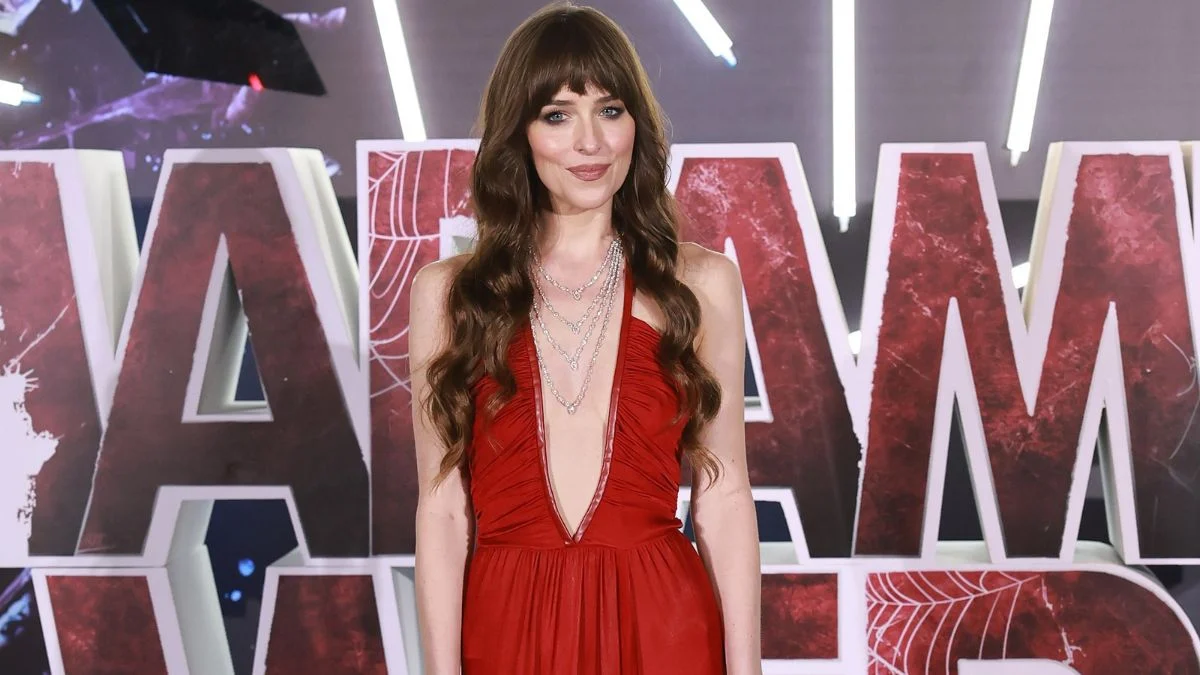
Dakota Johnson has long occupied a unique space in Hollywood’s constellation—a performer whose effortless, often understated grace masks a razor-sharp business acumen and a profound commitment to the craft of storytelling. As the face of Vogue’s October 2026 issue, Johnson returns to the spotlight not merely as a muse, but as a mogul. Captured by the lens of photographer Larissa Hofmann, Johnson’s latest editorial feature serves as a visual manifesto for her current chapter: bold, grounded, and unapologetically intentional.
The centerpiece of this feature is a striking, fiery red Valentino gown that has already ignited the fashion world. However, beneath the layers of silk and the dramatic silhouettes lies a deeper narrative about a woman who is successfully navigating the transition from leading lady to industry power player.
The Aesthetic of Power: An Analysis of the Valentino Look
The fashion world is no stranger to the “red dress effect,” but in Vogue’s October 2026 issue, Dakota Johnson elevates the trope into something architectural. The garment in question—Valentino’s Cady Couture Long Dress, retailing at a staggering $12,800—is a masterclass in minimalist construction.
Technical Craftsmanship
Crafted entirely from premium silk, the gown’s front profile offers a deceptive sense of modesty. It features a high, elegantly draped neckline that suggests a classic, column-style silhouette. Yet, the true genius of the design reveals itself as Johnson turns. A massive V-shaped cutout plunges nearly to the waist, exposing the back with a surgical precision that balances sensuality with structural integrity. The padded shoulders provide a sharp, authoritative frame, ensuring the fluid silk does not overwhelm the wearer’s natural posture.
The Editorial Vision
Styled by the legendary fashion editor Tonne Goodman, the look is an exercise in restraint. The vivid scarlet of the dress is set against a saturated, electric blue backdrop—a color-blocking choice that creates a high-contrast visual tension. Johnson’s styling—her signature curtain bangs and loose, softly layered dark hair—grounds the high-fashion aesthetic in the relaxed, bohemian sensibility for which she is known. The makeup, defined by a satin-finish pink lip and luminous, dewy skin, reflects a modern approach to glamour: one that enhances rather than masks the subject’s natural features.
Chronology: From Screen Star to Creative Producer
Dakota Johnson’s career trajectory has been defined by a deliberate pivot toward creative control. Her path from the commercial heights of Fifty Shades of Grey to the complex, auteur-driven projects she favors today is a testament to her long-term strategic vision.
- The Breakthrough (2015): Johnson achieved global recognition, which provided the platform necessary to begin selecting projects with greater selectivity.
- The Formation of TeaTime (2019): Recognizing the limitations of being purely a talent-for-hire, Johnson partnered with former Netflix executive Ro Donnelly to establish TeaTime Pictures.
- Building the Slate (2020–2025): Through TeaTime, Johnson began developing projects that leaned into literary adaptations and character-driven narratives, moving away from the conventional blockbuster model.
- The October 2026 Vogue Feature: Serving as both an interview and a fashion retrospective, this cover marks the crystallization of her status as an independent producer who commands respect both in front of and behind the camera.
Supporting Data: The Business of TeaTime Pictures
At the heart of Johnson’s recent Vogue interview is the philosophy driving TeaTime Pictures. While many actors have launched production banners in recent years, TeaTime has distinguished itself by fostering a “womb-like” environment for creators.
Creating a Protective Space
Johnson’s description of her production house as a protective, nurturing environment is not mere PR rhetoric. In an industry notoriously prone to burnout and creative interference, TeaTime emphasizes the mental and artistic well-being of its collaborators. By prioritizing the “womb-like” quality of the workspace, Johnson and Donnelly have sought to insulate their projects from the chaotic, high-pressure machinery of typical studio development.
The Project Slate: Three Incestuous Sisters
A focal point of the current discussion is her work on the upcoming film Three Incestuous Sisters. Based on the illustrated novel by Audrey Niffenegger, the project represents the kind of gothic, emotionally dense material that has become the hallmark of the TeaTime aesthetic. Producing and starring in this film marks a synthesis of her two professional worlds: the need to anchor a story with her presence and the need to steward that story from the initial script phase through to final edit.
Official Responses and Industry Context
The fashion and film communities have responded to the Vogue spread with widespread acclaim, noting that the images reflect a shift in Johnson’s personal brand.
“Dakota has moved into a space where she is no longer asking for permission,” says industry analyst Marcus Thorne. “The Valentino look is a visual shorthand for this newfound confidence. You don’t wear a $12,000 gown with that level of nonchalance unless you are fully comfortable in your own skin.”
Johnson herself, in her conversation with the magazine, addressed the necessity of grounding her life amidst the frenzy of production. “It is about finding the quiet,” she noted. “When you are producing, you are constantly solving problems. If you don’t have a grounded space to return to—a home, a routine, a sense of self—the work eventually consumes the person.”
Implications: The Future of the "Actor-Producer"
The success of the October 2026 issue suggests a significant trend in Hollywood: the rise of the “Auteur-Actor.” Johnson’s career path indicates that the modern star is no longer satisfied with being a mere face on a poster.
Shaping the Narrative
By taking on the role of producer, Johnson ensures that the stories being told are aligned with her specific artistic sensibilities. This has profound implications for the industry. When a star of her magnitude exerts creative control, it changes the power dynamics on set, potentially leading to more collaborative environments and, hopefully, more nuanced storytelling.
A Template for Success
For younger actors, Johnson’s trajectory serves as a blueprint. The transition from the “it girl” phase to the “creative leader” phase is notoriously difficult. By leveraging her influence to secure funding for niche, high-quality projects like Three Incestuous Sisters, Johnson proves that commercial appeal can be successfully reinvested into artistic integrity.
The Vogue World: Milan Connection
The Vogue feature serves as the perfect prologue to her upcoming appearance at Vogue World: Milan. This event, which bridges the worlds of high fashion and performance, is the ideal venue for a star who treats fashion as an extension of her identity. Her participation in Milan will likely continue the conversation sparked by the October cover, further cementing her as a bridge between the old guard of Hollywood glamour and the new, independent-minded wave of female producers.
Conclusion: A New Era of Grounded Glamour
As the October 2026 Vogue issue hits newsstands, it is clear that Dakota Johnson has successfully navigated the most challenging pivot of her career. She has shed the expectations of being merely an actress to become a architect of her own creative destiny.
The Valentino dress is more than a piece of silk; it is a symbol of the strength required to command a room, whether that room is a film set, a boardroom, or the pages of a global fashion magazine. By embracing a life that is as grounded as her professional ambitions are soaring, Johnson has positioned herself to remain a vital, influential force in cinema for decades to come.
As we look toward the release of her upcoming projects, one thing is certain: Dakota Johnson is no longer playing a part. She is writing the script.
 Dwi Wanna
