

By Thomas Hindmarch
Published September 19, 2026
Main Facts
At the bustling, digital-heavy expanse of PAX West 2026 in Seattle, one of the most breakout, discussed phenomena wasn’t a high-powered ray-traced video game, a multi-million-dollar virtual reality simulator, or a sprawling new campaign expansion for an industry-giant tabletop RPG. Instead, it was crokinole—a century-old, tactile Canadian wooden board game that combines the kinetic thrill of billiards, the precision of darts, and the nostalgic charm of pub-style tabletop gaming.
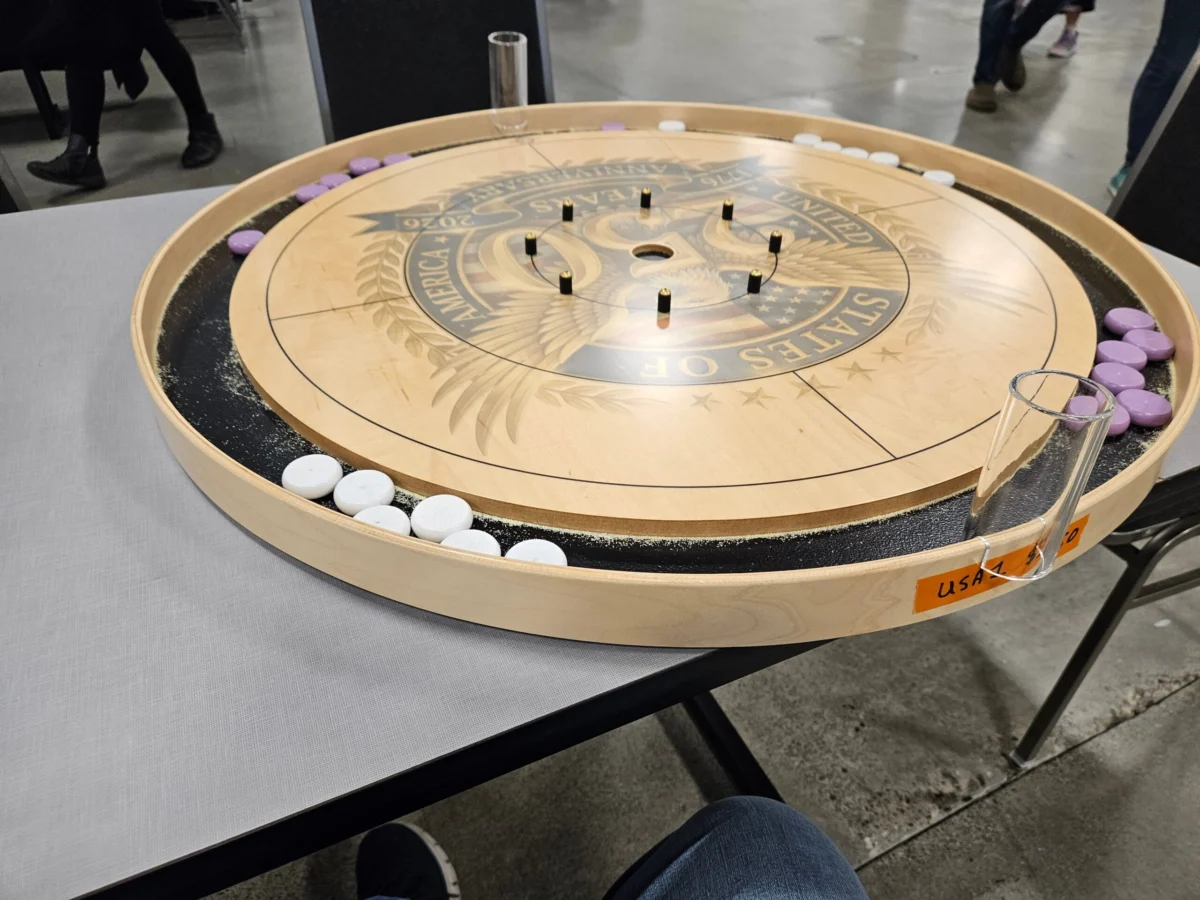
Tucked away in the basement-level demo hall of the Washington State Convention Center, a dedicated installation hosted by the renowned Canadian board manufacturer Tracey Boards drew continuous crowds. Featuring a dozen tables surrounded by enthusiastic players flicking wooden discs across waxed surfaces, the exhibit served as an introduction for hundreds of uninitiated convention-goers.
For the uninitiated, crokinole is a head-to-head game of pure finger dexterity. Players take turns flicking small wooden pucks from the perimeter of a circular, polished wooden board, attempting to land them in the highest-scoring concentric circles or directly into the coveted center hole. While the rules can be explained in less than two minutes, mastering the geometry, force management, and strategic defensive play takes years. Despite its roots stretching back to mid-19th-century Ontario, crokinole has experienced a massive resurgence in contemporary board-gaming circles, culminating in its triumphant, albeit surprising, spotlight at PAX West 2026.
Chronology: From 19th-Century Canada to Modern Conventions
To understand the sudden omnipresence of crokinole in modern gaming spaces, one must trace its journey through time—a history as smooth and polished as the paraffin wax dusting its playing surfaces.
Origins in Victorian-Era Canada
Historians generally agree that crokinole was invented in rural Canada during the early-to-mid 1860s. The earliest documented physical board dates back to 1876, crafted by a Perth County, Ontario farmer named Eckhardt. While folklore often attributes the game’s creation to German-Canadian immigrant communities in southwestern Ontario—drawing inspiration from European games like Novuss and various carrom-adjacent pastimes—it quickly evolved into a staple of Victorian parlor entertainment.
The name itself is widely believed to be a linguistic corruption of the French word croquignole, which translates to a sharp flick of the finger or a type of small pastry. By the turn of the 20th century, mass-produced boards manufactured by companies like the Canada Games Company began appearing in households across North America, often built as dual-sided combination tables featuring checkerboards or backgammon on the reverse.
The Mid-Century Lull and DIY Revival
Despite its early popularity, crokinole faded from mainstream commercial visibility during the latter half of the 20th century, overshadowed by mass-market cardboard board games and electronic video gaming. However, a dedicated subculture kept the flame alive. Enthusiasts formed regional clubs, particularly in rural Canada and the Upper Midwest of the United States, trading handmade blueprints and preserving the competitive tournament scene.
The 2020s Renaissance and PAX West 2026
Over the past five years, crokinole has enjoyed a digital-age renaissance, fueled by board game content creators, Reddit communities, and specialty manufacturers like Tracey Boards standardizing high-competition equipment. This momentum culminated at PAX West 2026. What began as a niche historical curiosity exploded into a convention-floor sensation, proving that modern gamers—increasingly fatigued by screen fatigue—are hungrier than ever for tactile, analog experiences that reward physical skill.
Supporting Data & Mechanics: How the Game is Played
For those looking to step up to a crokinole board for the first time, understanding the core mechanics reveals why the game strikes such a compelling balance between accessibility and deep mastery.
Equipment and Setup
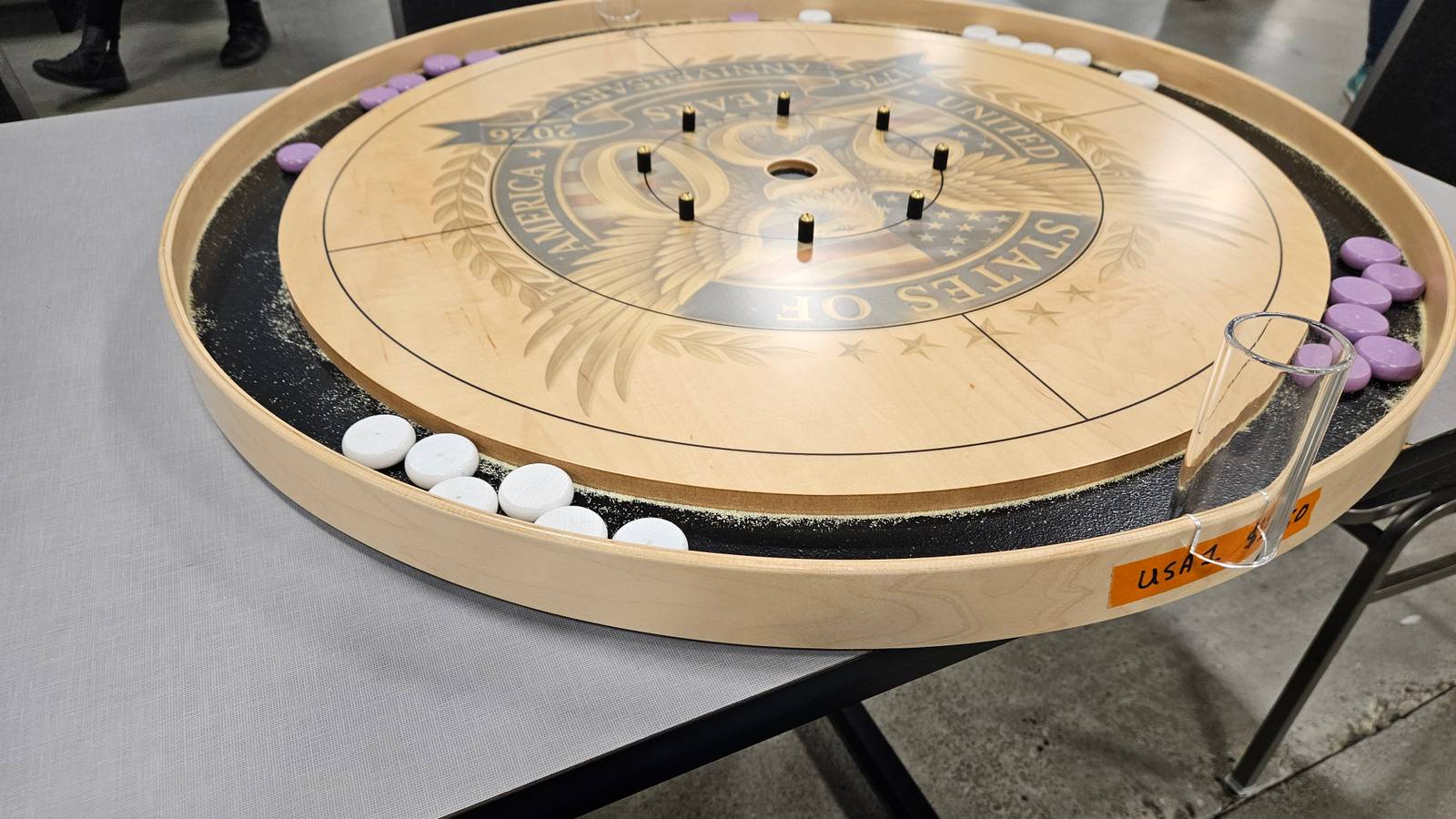
A standard tournament-grade crokinole board measures roughly 26 inches in diameter of play surface (enclosed in a larger octagonal or circular wooden frame) and sits flat on a table. The board features:
- The Outer Ditch: A recessed gutter framing the board where errant or knocked-out pucks land.
- The Quadrants: Four scoring zones divided by lines, worth 15, 10, and 5 points moving inward.
- The 20-Hole: A recessed hole precisely in the center of the board worth 20 points.
- The Pucks: Typically 24 wooden discs (12 per player/team), slightly concave on their rims to facilitate smooth sliding.
To ensure frictionless gameplay, the surface is sprinkled with a microscopic dusting of fast-acting powder—most commonly paraffin wax or specialized board speed powder—allowing pucks to glide with minimal resistance.

Step-by-Step Gameplay Rules
- The Lead-Off: Players take turns flicking their assigned pucks from the outer boundary line (the 20-line) into the scoring zones.
- The Interaction Rule (The "Peg" Clause): If there are any opposing player’s pucks already on the board, a player must make contact with an opponent’s piece during their shot. Failure to hit an opponent’s puck results in a foul, and the shooter’s puck is immediately removed and placed into the ditch (along with any friendly puck it may have inadvertently displaced).
- Clearing and Scoring: If a player successfully strikes an opponent’s piece (or if the board is completely empty of enemy pieces), their puck remains on the board. Pucks that successfully make it into the central 20-hole are immediately removed, sequestered, and counted as a guaranteed 20 points at the end of the round.
- Round and Match Conclusion: Once all 24 pucks have been played, the remaining pieces on the board are scored based on the concentric ring they occupy. The score is calculated as a differential (e.g., if Player A scores 65 and Player B scores 40, Player A wins the round with 25 points). Play continues across multiple rounds until a player reaches a predetermined target score, usually 100 points.
Official Responses and Industry Perspectives
The sudden commercial visibility of crokinole at a major digital and tabletop expo like PAX West 2026 prompted reflections from both seasoned veterans and industry insiders.
Jeremy Tracey, founder of Tracey Boards—the Canadian artisanal manufacturing company that spearheaded the PAX West play area—noted that the cultural shift toward analog socialization has dramatically altered the demographic of buyers over the past several years.
"Ten years ago, we were shipping mostly to dedicated tournament players in Ontario and hardcore board-gaming hobbyists who knew our name through word-of-mouth," Tracey remarked during the convention. "Today, we are seeing younger demographics—people in their twenties and thirties who grew up exclusively on video games—discovering crokinole because it offers that exact same competitive, high-skill rush, but with the added warmth and physical satisfaction of natural woodcraft."
Board game critics and convention organizers have similarly praised the game’s inclusivity. Unlike complex modern eurogames that require reading a 30-page rulebook, crokinole’s barrier to entry is virtually non-existent. A seven-year-old child and a seventy-year-old veteran can play a competitive match on equal footing, provided the veteran’s finger-flick accuracy isn’t significantly sharper.
Implications: The Future of Tactile Gaming in a Digital Age
The breakout success of crokinole at PAX West 2026 carries broader implications for the broader gaming and entertainment landscape.
The Counter-Trend to Screen Saturation
As augmented reality, virtual reality, and increasingly complex digital ecosystems dominate the entertainment sector, a counter-movement is quietly gaining power. Consumers are seeking "low-tech digital detox" options that still deliver intense competitive stimulation. Crokinole fits squarely into this niche, alongside the resurgence of competitive darts, pickleball, and artisanal tabletop publishing.

The Economic Hurdle: Cost vs. Craftsmanship
One of the primary challenges facing the widespread adoption of crokinole is its price point. Premium, tournament-legal boards crafted from rich hardwoods like maple, walnut, or mahogany—such as those produced by Tracey Boards or Muzzies—frequently retail between $250 and $350. Even budget-tier online alternatives rarely dip below $70.
However, this economic barrier has inadvertently fostered a vibrant DIY maker subculture. Because the fundamental design requires only a smoothly sanded wooden disc, painted concentric circles, and a central peg, woodworking enthusiasts frequently build their own boards as custom passion projects. This hands-on ethos mirrors the open-source spirit found in many tabletop gaming communities.
Final Verdict
Whether you view it as a thrilling test of micro-ballistics or simply a gorgeous piece of functional furniture for your living room, crokinole has firmly cemented its place in the modern gaming lexicon. For those willing to look past its antique aesthetic and invest in the learning curve—or the price tag—it offers a timeless, highly addictive social experience that proves some of the best games ever made were perfected a century and a half ago.
 Lina Irawan
 Azzam Bilal Chamdy
 Basiran
