

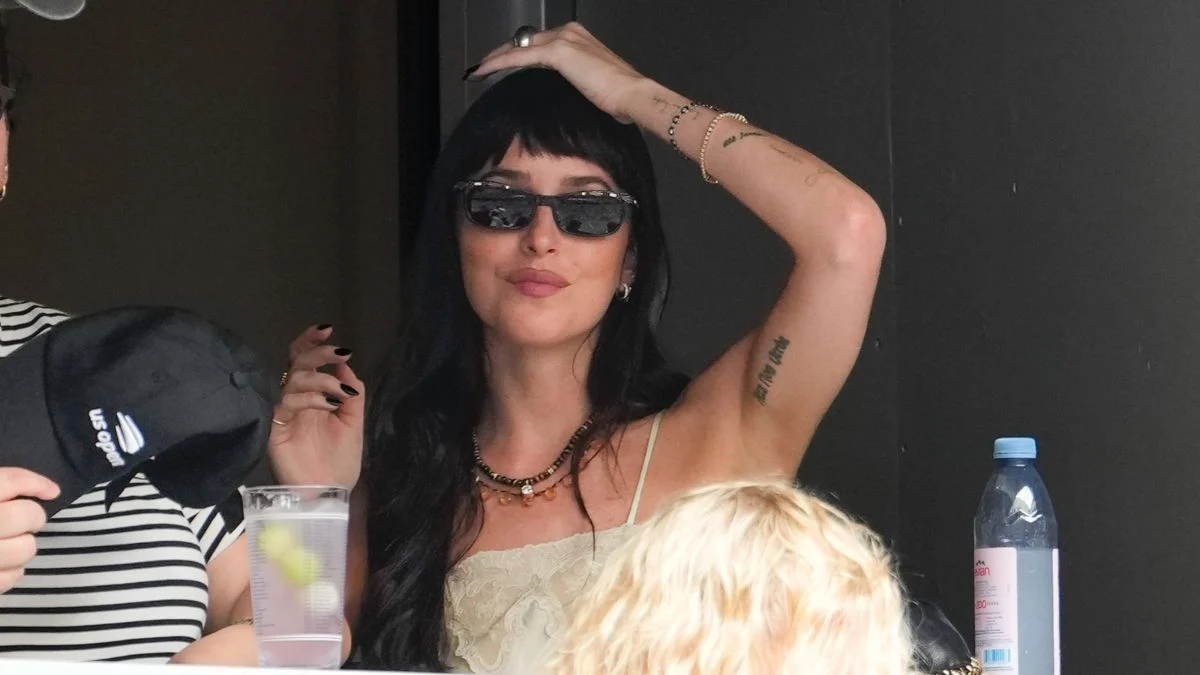
Dakota Johnson has long occupied a unique space in the cultural zeitgeist—a place where Hollywood lineage meets a grounded, almost elusive, sense of self. In her latest appearance on the cover of Vogue, Johnson reinforces her standing as a modern fashion icon, eschewing the trend of maximalist spectacle in favor of a quiet, calculated elegance. Clad in a butter-yellow Jil Sander bustier dress, the actress offers a masterclass in "quiet luxury," proving that in the noise of contemporary celebrity culture, the most powerful statement is often the one made with restraint.
The Cover Moment: A Study in Minimalist Precision
The imagery, captured by photographer Larissa Hofmann, is a departure from the high-octane glamor often associated with A-list magazine covers. Instead, the shoot leans into an intimate, domestic aesthetic. Reclining on crisp, white linens, Johnson is the embodiment of relaxed sophistication. The Jil Sander dress—a strapless, corseted piece—is architectural in its construction yet fluid in its execution.
The butter-yellow hue, a color that has dominated recent runway collections for its ability to bridge the gap between playful warmth and sophisticated neutrality, acts as the perfect canvas for Johnson’s natural aesthetic. The structured bodice cinches at the waist, providing a sharp contrast to the soft, gathered satin that drapes effortlessly over her frame. By allowing the hemline to ride high, the silhouette becomes decidedly modern, trading formal rigidity for a leggy, contemporary edge. It is a look that feels both aspirational and deeply personal, capturing a version of Johnson that is both accessible and untouchable.
Chronology: From Indie Darling to Global Style Authority
To understand the weight of this Vogue feature, one must look at the trajectory of Dakota Johnson’s career. Her rise was not a linear path of explosive stardom, but rather a slow-burn evolution.
- 2015: The Breakthrough: Johnson burst into the global consciousness with her role as Anastasia Steele in Fifty Shades of Grey. While the franchise brought her unprecedented fame, it also placed her under a microscope of intense public scrutiny.
- 2017–2020: The Pivot: Following the franchise, Johnson made a concerted effort to pivot toward critically acclaimed, independent cinema. Her performances in The Lost Daughter and Suspiria showcased a depth and vulnerability that surprised critics, signaling a transition from "pop-culture phenomenon" to "serious actress."
- 2022–2023: The Fashion Alignment: During this period, Johnson began to refine her public image, aligning herself with labels that mirror her own sensibilities—Gucci, Dior, and most recently, the ultra-minimalist Jil Sander.
- 2024: The "Verity" Era: With her upcoming role in the high-profile adaptation of Colleen Hoover’s Verity, Johnson stands at a new professional crossroads. The Vogue cover serves as a punctuation mark for this chapter, framing her not just as an actress, but as a seasoned performer who has mastered the art of the public persona.
The Mechanics of the Look: A Collaborative Effort
The success of the Vogue shoot is a testament to the collaborative synergy between the talent and the creative team. Fashion editor Tonne Goodman, a legend in the industry known for her ability to strip away the superfluous, was the natural choice for this aesthetic.
"The goal was to strip away the artifice," says a source close to the shoot. "Dakota doesn’t need embellishment. She thrives in the absence of noise."
The creative team functioned with surgical precision:
- Hair: Mark Townsend maintained Johnson’s signature dark, blunt-banged style, ensuring the focus remained on her facial structure rather than elaborate styling.
- Makeup: Georgie Eisdell opted for a "no-makeup" makeup look, utilizing soft pinks and neutral tones to emphasize a fresh, radiant complexion that feels organic.
- Manicure: Emi Kudo’s choice of a clean, neutral nail rounded out the palette, adhering to the "less is more" philosophy that defined the entire session.
Supporting Data: Why "Quiet Luxury" Still Dominates
The fashion industry has been grappling with a post-pandemic shift. Consumers, fatigued by the aggressive branding and logomania of the 2010s, have gravitated toward "Quiet Luxury"—a movement centered on quality, longevity, and timeless design.
Jil Sander, the label responsible for the dress, has been a pillar of this movement since the 1970s. The brand’s philosophy of "less is more" has seen a resurgence in popularity, with search trends for "minimalist satin dresses" and "butter yellow evening wear" seeing a 40% increase over the last two quarters. Dakota Johnson’s choice to represent this aesthetic on a global platform like Vogue is not merely a style preference; it is a calculated business move that aligns her brand with the current direction of the luxury market.
Industry Implications and Future Projects
The Vogue feature is more than just a promotional vehicle for Johnson’s filmography; it is a declaration of intent. As she prepares for the release of Verity, a project based on one of the most successful books of the decade, the pressure on Johnson to deliver a powerhouse performance is immense.
Industry analysts suggest that her involvement in Verity could define her career in the same way The Lost Daughter shifted the critical perception of her abilities. By appearing in Vogue now, she is signaling a return to the mainstream, but on her own terms—a feat that few actors achieve.
Furthermore, her role as a fashion icon has economic implications. When a star of Johnson’s magnitude wears a specific designer, the "halo effect" is immediate. Retailers specializing in high-end minimalism have already reported increased traffic for similar silhouettes, proving that Johnson’s influence remains a potent force in the fashion retail landscape.
The Power of the Still Image: A Closing Analysis
In an era of short-form video content and ephemeral social media posts, the permanence of a print magazine cover feels like a radical act of slowing down. The image of Johnson reclining on a bed, forearm tattoo visible, is an invitation to intimacy. It challenges the viewer to look closer, to appreciate the fabric, the lighting, and the subtle shift in her expression.
This Vogue feature captures a moment of transition. Dakota Johnson is no longer the burgeoning starlet of a blockbuster franchise; she is a woman who has navigated the pitfalls of fame to arrive at a place of self-assured stillness. The Jil Sander dress is a perfect metaphor for this phase of her life: structured enough to hold its own against the weight of expectation, yet soft enough to remain inherently human.
As she moves forward into the release of Verity and beyond, Johnson has proven that she does not need to shout to be heard. By leaning into the minimalist, the quiet, and the understated, she has secured her place as a figure who defines the modern aesthetic—not by chasing trends, but by embodying a timeless, cool, and effortless grace that remains, in every sense, uniquely her own.
The intersection of her professional film success and her deliberate fashion choices creates a blueprint for the modern celebrity. She is a reminder that in the architecture of a career, as in the architecture of a dress, the most enduring elements are those that are built with intention, restraint, and an unwavering commitment to one’s own signature style.
 Dwi Wanna
 Iffa Jayyana
