

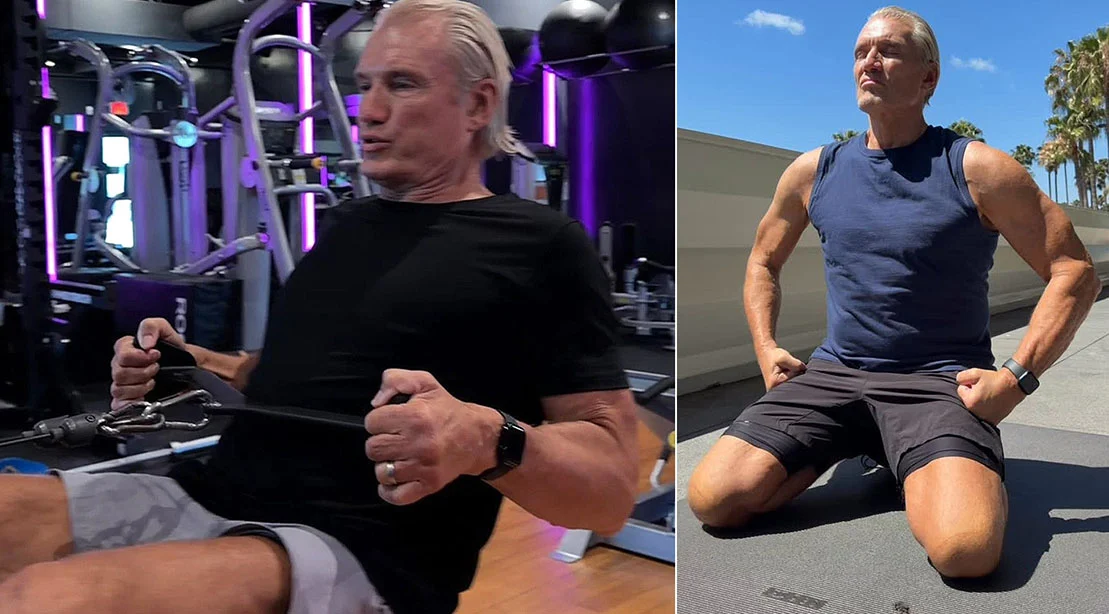
For generations of cinema-goers, Dolph Lundgren has been the embodiment of physical perfection. From his chilling, iron-willed portrayal of Ivan Drago in 1985’s Rocky IV to his gritty tenure as The Punisher and the tactical prowess displayed in The Expendables, Lundgren has occupied a unique space in the pantheon of action legends. However, the most compelling battle of his life did not take place on a film set or in a boxing ring. For the past decade, the 68-year-old star has navigated a grueling, private war with cancer—a fight he has not only survived but emerged from with a renewed, uncompromising philosophy on health, aging, and the power of the human spirit.
Today, as he balances a busy production schedule, a literary career, and a commitment to his four million Instagram followers, Lundgren stands as a testament to the idea that strength is not merely an aesthetic choice, but a requirement for longevity.
A Legacy Forged in Steel: The Chronology of an Icon
Dolph Lundgren’s journey into the public consciousness began long before he stepped into the ring to face Sylvester Stallone. A former two-time European Karate champion, Lundgren brought a level of technical athleticism to the silver screen that few of his contemporaries could match.
From the Dojo to the Silver Screen
Lundgren’s rise to fame in the 1980s was defined by his imposing frame and stoic, calculated performance as Drago. This role set a precedent for his career, casting him as the ultimate antagonist and, eventually, the quintessential action hero. Throughout the 90s and 2000s, he remained a fixture of the industry, consistently maintaining his physique through rigorous resistance training and martial arts practice.
The Silent Battle
Behind the curtain of Hollywood glamour, the last ten years have been marked by a profound medical struggle. In a recent disclosure, Lundgren revealed that he has been battling cancer, a diagnosis that tested his legendary fortitude. True to his character, he refused to succumb to despair. When initial medical advice offered a path he wasn’t satisfied with, he sought a second opinion—a decision he credits with saving his life. This breakthrough in treatment allowed him to regain his health, proving that the same persistence he used to build his muscles was essential in navigating the complexities of his oncology journey.
The Science of Aging: Why Muscle Mass Matters
Lundgren’s approach to fitness has evolved from the hypertrophy-focused goals of his younger years to a nuanced, longevity-based strategy. Speaking with Muscle & Fitness, the star emphasized that as one enters their late 60s, the objectives of training must shift to prioritize hormonal health and metabolic efficiency.
Maintaining Testosterone and Metabolic Health
"It’s very important, I think, as you get older, to keep your muscle mass and keep your testosterone level up," Lundgren explains. Science supports this stance; resistance training in older adults is widely recognized as a critical intervention against sarcopenia (the age-related loss of muscle mass) and metabolic decline. By maintaining a robust musculature, Lundgren is not just preserving his "action star" look; he is actively protecting his bone density, joint integrity, and metabolic rate.
The Three-Day Split
To achieve this, Lundgren adheres to a disciplined, three-day training split:
- Chest and Back
- Arms and Shoulders
- Legs
This rotation allows for sufficient recovery time, which is essential for older athletes. By incorporating cardiovascular work—specifically his foundational karate training—before hitting the weights, he ensures his heart health remains as strong as his muscular skeletal system.
The Blueprint: Breaking Down the Lundgren Workout
For those looking to emulate the "Universal Soldier’s" routine, the focus is not on ego-lifting, but on deliberate, controlled movement. Lundgren’s training style is rooted in time-under-tension (TUT) principles, which maximize muscle fiber recruitment while minimizing the risk of connective tissue injury.
1. Seated Cable Rows (Wide Grip)
Lundgren begins by targeting the posterior chain. Using a wide grip on the cable row, he emphasizes the engagement of the rear deltoids, trapezius, and latissimus dorsi. This movement is essential for posture, a critical factor in healthy aging.
2. Cable Seated Wide-Grip Pulldowns
Following the rows, he moves to wide-grip pulldowns. This exercise provides a deep stretch to the lats, fostering back width and upper body structural support. The controlled eccentric (lowering) phase is where Lundgren finds the most benefit, as it builds the stability required for a powerful upper torso.
3. Incline Dumbbell Rows
By utilizing an inclined bench, Lundgren isolates the upper and mid-back. Rowing from this position removes the ability to use momentum, forcing the traps and rhomboids to carry the load. This is a staple for building the "thick" back look associated with his iconic film roles.
4. Smith Machine Incline Bench Press
The inclusion of the Smith machine is a strategic choice. As a seasoned lifter, Lundgren understands the value of mitigating injury risk. The Smith machine provides a fixed path of motion, allowing him to push his pectorals and anterior deltoids to failure without the instability inherent in free-weight bench pressing.
5. Machine Pec Fly
The workout concludes with the pec fly, designed to isolate the chest muscles and reach the serratus anterior—a muscle often neglected in standard routines.
The Prescription: For those attempting this regimen, Lundgren suggests 2 to 3 sets of 8 to 12 repetitions. His secret for consistency? "I realized, as you get older, it’s so much better if you know you’re only in it for 30 minutes. It’s so much easier."
Official Perspectives and Literary Reflections
Lundgren’s philosophy on health is an extension of his broader worldview. In his book, Fights Worth Fighting: Finding Strength in Struggle, he provides an intimate look at his life, detailing how the challenges of his upbringing, his career, and his cancer diagnosis helped him forge a resilient mindset.
The Message of "Fights Worth Fighting"
The book is more than a memoir; it is a manifesto for anyone facing adversity. Lundgren argues that the struggle is not something to be avoided, but something to be utilized. His success in beating cancer serves as the ultimate case study for this belief. "Keep fighting and believe in yourself as much as you can," he urges his readers. His narrative shift from "action hero" to "survivor" has resonated deeply with his fanbase, humanizing a figure previously known only for his larger-than-life roles.
The "Unbreakable" Documentary
Looking toward the future, the upcoming documentary Dolph: Unbreakable, slated for release on October 6, 2026, promises to provide an even deeper look into the man behind the myth. The title itself is a poignant reflection of his current state—not that he is immune to pain or illness, but that his spirit has proven to be, in his own words, unbreakable.
The Implications: A New Era for the Aging Athlete
Dolph Lundgren’s ongoing commitment to his training and his transparency regarding his health offer significant implications for the aging population. In a culture that often views aging as a period of inevitable decline, Lundgren represents the "active aging" movement.
The Shift in Fitness Culture
The trend of fitness influencers and celebrities focusing on longevity—rather than just aesthetics—is gaining momentum. Lundgren’s emphasis on the "30-minute window" of high-intensity, low-risk training is a practical solution for busy professionals who fear that aging necessitates a sedentary lifestyle. By showing that one can remain fit, strong, and active well into their late 60s, he is redefining the standard for health in the second half of life.
Conclusion: The Man, The Mission, The Motivation
Whether he is preparing for a new film role or simply maintaining the machine that has carried him through decades of intense activity, Dolph Lundgren remains a powerful example of what is possible when discipline meets resilience. He is no longer just the man who played Drago; he is a survivor who has turned his personal battles into a roadmap for others.
As he continues to share his workouts and wisdom, his message remains clear: the fight for health is the most important fight of all. Whether you are 20 or 80, the weights are there, the path is clear, and as Lundgren proves, it is always worth the struggle to keep moving forward.
 Iffa Jayyana
 Reynand Wu
