

Main Facts: A Champion’s Strategic Pivot
In the hyper-competitive world of IFBB Pro League Classic Physique, Terrence "Ruff Diesel" Ruffin stands as a paragon of aesthetic precision. His recent victory at the 2025 EVLS Prague Pro was more than just another trophy for the mantle; it served as a definitive statement of intent, securing his qualification for the 2026 Olympia final. Yet, beneath the accolades and the symmetrical conditioning that has defined his career, Ruffin has grappled with a challenge that plagues many high-level bodybuilders: stubborn muscle growth in the arms.
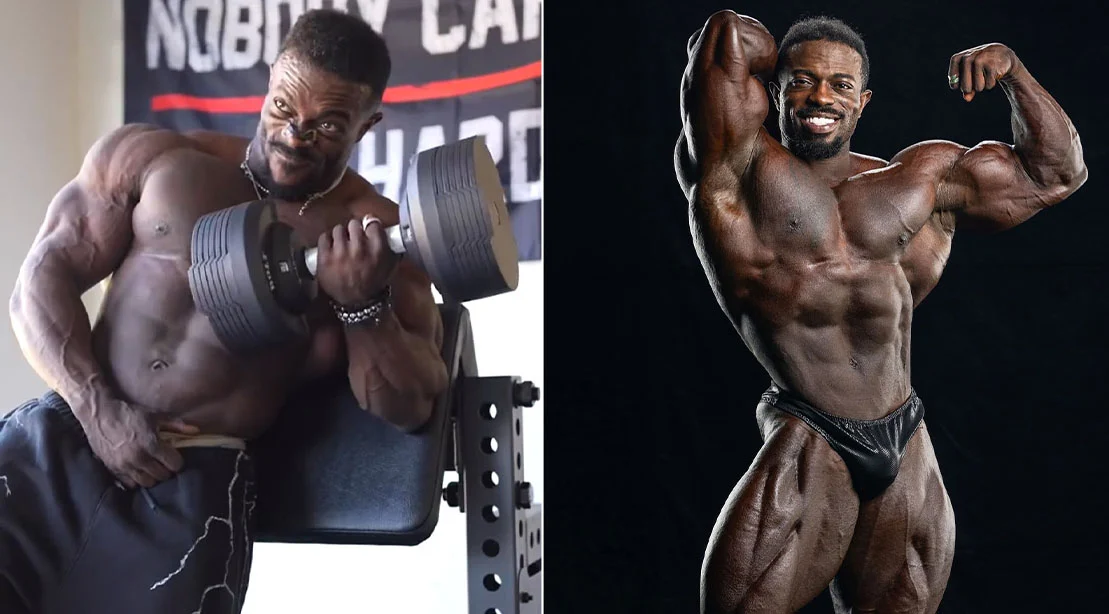
Despite possessing an upper body that many spectators consider world-class, Ruffin recently revealed that his biceps were once his most significant developmental bottleneck. For a man who has competed at the highest levels of the sport since earning his Pro Card at just 21 years old, admitting a weakness is a testament to his commitment to improvement. Ruffin has effectively overhauled his approach, moving away from high-volume, generic training toward a highly calculated, unilateral, and intensity-driven methodology. By integrating specific anatomical focus on the biceps brachii and the brachialis, Ruffin has finally unlocked the potential of his arms, proving that even a two-time Arnold Classic champion can evolve.
Chronology: From Air Force Discipline to Global Dominance
To understand Ruffin’s current training philosophy, one must look at the foundation of his discipline. Before he was a household name in the fitness industry, Ruffin served as a Senior Airman in the United States Air Force. The military provided a structural bedrock for his life, instilling a level of punctuality and attention to detail that he would eventually transplant into his bodybuilding career.
- 2014: Ruffin earns his IFBB Pro Card at the age of 21, marking the beginning of his professional journey.
- The Early Years: Throughout his formative professional years, Ruffin focused heavily on overall structural balance, but noted that while his back and shoulders responded readily to stimulus, his arms remained stagnant.
- 2021-2022: A breakthrough period where Ruffin secures back-to-back Arnold Classic titles, cementing his status as an elite contender, even while continuing to experiment with different arm-training protocols.
- 2025: After a period of refinement and a strategic shift in programming, Ruffin dominates the EVLS Prague Pro.
- 2026: With his ticket punched for the Olympia, Ruffin turns his focus toward optimizing his physique for the ultimate stage in the sport.
Supporting Data: The Science of "Ruff Diesel" Training
Ruffin’s recent success is not a byproduct of chance, but a result of rigorous adherence to the principles of biomechanics and progressive overload. His methodology is centered on the concept of unilateral training—working one limb at a time. This approach mitigates the risk of dominant-side compensation, ensuring that both the left and right biceps are subjected to identical mechanical tension.
The Anatomy of the Bicep
To achieve the "sleeve-splitting" look, Ruffin targets two distinct areas:
- The Biceps Brachii: The primary "show" muscle that creates the peak.
- The Brachialis: Located beneath the bicep, this muscle is crucial for width and pushing the bicep upward, effectively increasing the perceived height of the peak.
Ruffin’s realization that his arms were lagging led him to reduce the frequency of arm sessions but increase the intensity. He now trains arms twice a week, focusing on only two to three movements per session. By limiting his exercise selection, he ensures that he can put maximum effort into each repetition without the fatigue that accompanies excessive volume.
Official Methodology: The Three Pillars of Arm Growth
Ruffin has officially endorsed a specific trio of exercises that have become the cornerstone of his arm development. He emphasizes that the execution of these moves is secondary only to the intensity applied.
1. Single-Arm Preacher Curls
The preacher bench is a staple in Ruffin’s arsenal. By isolating the bicep against the pad, he eliminates the ability to use momentum or "cheat" the weight up. This forces the biceps brachii to handle the entirety of the load during the flexion phase. Ruffin emphasizes the importance of a full range of motion, ensuring a deep stretch at the bottom of the movement and a hard contraction at the top.
2. Single-Arm Dumbbell Curls
While the preacher curl provides isolation, the single-arm standing curl allows for a natural range of motion that mimics the functional movement of the arm. Ruffin utilizes this to focus on the mind-muscle connection. By leaning against a stable surface, he creates a fixed pivot point, ensuring that his elbow stays locked in place, forcing the bicep to work in isolation.
3. Single-Arm Cable Hammer Curls
The inclusion of the hammer curl is a strategic masterclass in hypertrophy. By rotating the palm to face the torso, Ruffin shifts the emphasis away from the biceps brachii and onto the brachialis and the brachioradialis (forearm). This is the "secret weapon" for anyone looking to add thickness to the arm profile, as the brachialis acts as a shelf that pushes the bicep out.
The Double Progression Method
Perhaps the most significant revelation from Ruffin’s recent social media disclosures is his reliance on the "Double Progression" method, popularized by coach Paul Carter. This is not merely about lifting heavier; it is about a systematic approach to performance.
- Step One (Form Baseline): Ruffin starts his sets with a weight that allows for approximately 8 repetitions. This ensures that the movement pattern is perfect and that he is not sacrificing form for ego.
- Step Two (Intensity Ramp): Once he masters the baseline, he increases the weight to force the rep range down into the 4–8 rep bracket. This high-intensity, lower-rep phase is where the mechanical tension required for hypertrophy is maximized.
By cycling between these two phases, Ruffin avoids the plateaus that often derail bodybuilders who rely solely on "pyramid" sets or fixed rep ranges.
Implications: The Future of Classic Physique
The implications of Ruffin’s training shift are significant for the broader bodybuilding community. For years, the prevailing dogma in the industry was that "more is better"—higher volume, more sets, and more days in the gym. Ruffin’s success acts as a counter-narrative, proving that a refined, minimalist approach, when paired with high-intensity execution, can yield superior results.
For the aspiring bodybuilder, Ruffin’s story offers a roadmap. It highlights that even at the professional level, the "perfect" workout does not exist; only the workout that is perfectly adapted to the individual’s needs exists. His transition from a military background to the Olympia stage is a testament to the idea that success is a process of constant iteration.
As Ruffin prepares for the 2026 Olympia, the bodybuilding world will be watching his arms closely. If the results he has achieved in the last year are any indication, "Ruff Diesel" is not just aiming to participate—he is aiming to redefine what is possible in the Classic Physique division.
Expert Commentary and Industry Response
Industry analysts have noted that Ruffin’s transparency regarding his struggles is rare. In a sport often defined by smoke and mirrors, his willingness to share his "Double Progression" data and his specific focus on the brachialis provides a masterclass for amateur athletes.
"Terrence is not just training hard; he is training smart," says one industry insider. "Most guys look at a bicep and just think ‘curls.’ Terrence looks at the anatomy, identifies the gap, and applies a scientific, unilateral solution. That is the difference between a bodybuilder and a champion."
Final Thoughts
Terrence Ruffin has proven that muscle growth is not just about the weight on the bar; it is about the intention behind the movement. By prioritizing unilateral balance, controlled time-under-tension, and the scientific application of the Double Progression method, he has turned a once-weak point into a signature asset. As he moves toward the 2026 Olympia, his journey remains an inspiration for anyone looking to overcome their own physical limitations through discipline, logic, and an unwavering commitment to the process.
For those looking to replicate his results, the message is clear: strip back the volume, master the movement, and let the intensity do the heavy lifting. The sleeves of your gym shirts may soon be in as much danger as those belonging to "Ruff Diesel" himself.
 Nana
Nana
 Iffa Jayyana
 Reynand Wu
