

Warning: This story contains major spoilers for Episode 7 of Lanterns.
The penultimate episode of Lanterns has arrived, and with it, the series has peeled back the layers of its central mystery while simultaneously excavating the tragic history of its most iconic figure. By shifting focus between the formative years of Hal Jordan and the desperate, reality-bending mission of a modern-day John Stewart, the show has cemented its status as a character-driven psychological drama disguised as a cosmic thriller. As the narrative hurdles toward its season finale, the latest installment offers a profound look at trauma, legacy, and the true cost of being a hero.
The Architecture of a Hero: Unpacking the Flashbacks
The episode opens with a sharp departure from the high-stakes extraterrestrial intrigue that has dominated the season. For the first time, viewers are transported back to 1975, witnessing the childhood of a young Hal Jordan, portrayed with striking vulnerability by Henry Samiri.
The cold open is deceptively simple: a baseball diamond, a frustrated coach (Billy Griffin), and a young boy who refuses to relinquish the mound. "I thought you were a team player," the coach admonishes. It is the defining thesis of Hal’s life. The boy’s refusal to trust his teammate, Danny Bochner, to finish a no-hitter—even at the cost of the game—reveals the foundational flaw in Hal’s psyche: a self-reliance so absolute that it borders on pathology.

This early resistance to communal effort serves as a stark precursor to the adult Hal’s isolation. When the rest of the team turns on him, the arrival of his father, Martin Jordan, provides no moral correction. Instead, Martin validates the boy’s arrogance by physically confronting the coach, an act of "protection" that reinforces a dangerous cycle of volatility. The scene transitions to Martin’s funeral, where a young Hal stands in a suit that evokes the somber imagery of a grieving John F. Kennedy Jr., cementing the tone of inevitable tragedy that has followed the Jordan lineage.
Chronology of a Cosmic Investigation
In the present day, the narrative picks up the threads of John Stewart’s (Aaron Pierre) investigation. Having exhumed Hal’s remains and coerced Guy Gardner into recovering the ring, John faces a singular, technological hurdle: a lockbox that requires the vocal biometric signature of the deceased.
This leads to the centerpiece of the episode’s sci-fi premise: the "Hal-ogram." As showrunner Damon Lindelof explained in the episode’s behind-the-scenes featurette, the digital recreation of Hal (Kyle Chandler) was not an eleventh-hour plot device but a narrative seed planted in the series premiere. By choosing to resurrect a version of Hal that predates his later, more cynical years, the writers created a fascinating dynamic: a man confronted by his own younger, more idealistic, and significantly more irritated ghost.
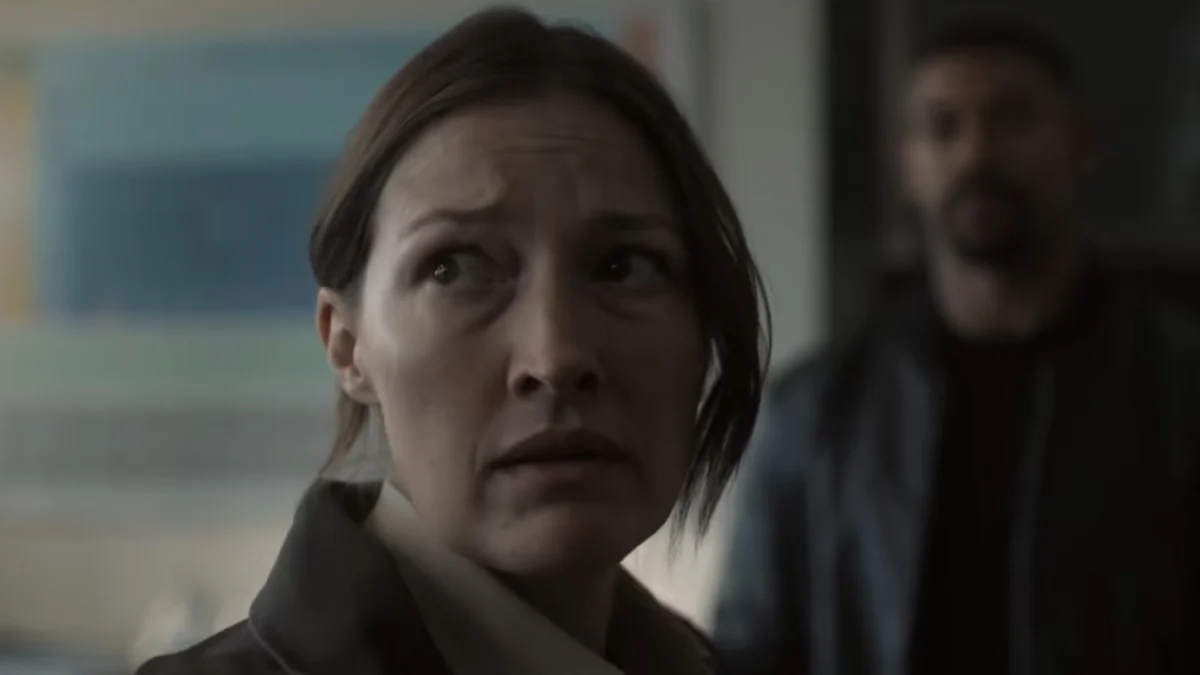
The introduction of Kerry Kane (Kelly Macdonald) adds a layer of emotional weight that grounding, humanistic writing often provides in genre television. Macdonald’s performance is a masterclass in subtlety; forced to convey the history of an intense, off-screen affair through facial expression and voice alone, she breathes life into the specter of the man John is trying to understand.

The Geography of Desolation: Filming the Alien
As the mystery deepens, the duo ventures into a dimensional portal located within the lockbox, emerging on a desolate, yellow-hued world. While the production team, led by designer John Paino, originally considered keeping the narrative confined to Earth to maintain a True Detective-esque aesthetic, they ultimately opted to expand the scope.
"The more we talked about that, the more it felt like we were imposing a rule on ourselves for no good reason," Lindelof noted regarding the shift. To ground this alien environment, the crew turned to the earthly landscape of Barstow, California. The objective was to emulate the calcified, barren aesthetic of the Salton Sea, creating a sense of a world that has been poisoned beyond recognition—the very same world where the Manhunter, Zoe, committed genocide.
The technical prowess on display is equally noteworthy. During a harrowing sequence on a boat in the middle of a storm, the production team flooded a literal parking lot to create a controlled environment for the actors. This commitment to practical production serves to elevate the performances of Pierre and Chandler, as they navigate not just the geography of a dead planet, but the interior landscape of their own damaged psyches.
The "Jordan Boys’ Legacy": A Psychological Analysis
The most significant revelation of the episode occurs on that alien lake, where the facade of the hero is stripped away. Hal reveals the truth behind his father’s death: it was not a tragic accident during a test flight, but a suicide.

This revelation recontextualizes Hal’s entire character arc. The "Jordan boys’ legacy" is revealed to be a generational struggle with depression and the crushing weight of expectation. Hal’s admission—"I’m not fearless because I’m brave, I’m fearless because I’m broken"—is perhaps the most honest line of dialogue in the series to date. It suggests that his legendary status as a Green Lantern was never about the absence of fear, but rather the presence of a void that he was desperate to fill with adrenaline and heroics.
This narrative choice mirrors real-world psychological discussions regarding the "superhero archetype." By framing fearlessness as a symptom of trauma, the writers invite the audience to view the character not as a god-like entity, but as a deeply flawed human attempting to survive his own history.
Implications and the Arrival of Sinestro
The episode concludes on a note of rising tension. As the duo continues their search, they are accosted by a mysterious, cloaked figure. When John intervenes with a well-placed punch, the figure is revealed to be none other than Sinestro (Ulrich Thomsen).
The introduction of such a pivotal figure in the final minutes of the penultimate episode carries significant implications for the finale. Is Sinestro the architect of the chaos that has defined the season? His presence on this desolate, ruined world suggests a deeper connection to the Manhunter’s genocide and the potential corruption of the Green Lantern Corps.

Furthermore, the callback to the opening scene—with Hal praising John’s "great arm"—provides a poetic symmetry to the episode. It bridges the gap between the child who couldn’t trust his team and the man who has finally found a partner worthy of his trust.
Critical Reflection
The success of Lanterns lies in its ability to balance the cosmic stakes of the DC Universe with the grounded, gritty realities of human behavior. By dedicating significant time to the internal lives of John and Hal, the show avoids the common pitfall of becoming a series of disconnected set pieces. Instead, it offers a meditation on what happens when the people we hold up as icons are revealed to be as fragile as the rest of us.
As the series heads into its final chapter, the questions that remain are less about "who did it" and more about "how will they move forward." John Stewart has been forced to carry the weight of a man he never knew, and in doing so, he has begun to understand the price of his own potential. The "Hal-ogram" serves as a bridge, a way for the past to inform the future, and if the latest episode is any indication, the finale promises to be a confrontation between the ghosts of the past and the desperate necessity of the future.
The writing, led by Lindelof and his team, has successfully transformed a high-concept comic book property into a character study that feels urgent, relevant, and hauntingly human. Whether or not John and Hal can survive the threat posed by Sinestro, they have already succeeded in navigating the most dangerous territory of all: the truth.
 Asep Darmawan
 Reynand Wu
 Layla Zulfa
