

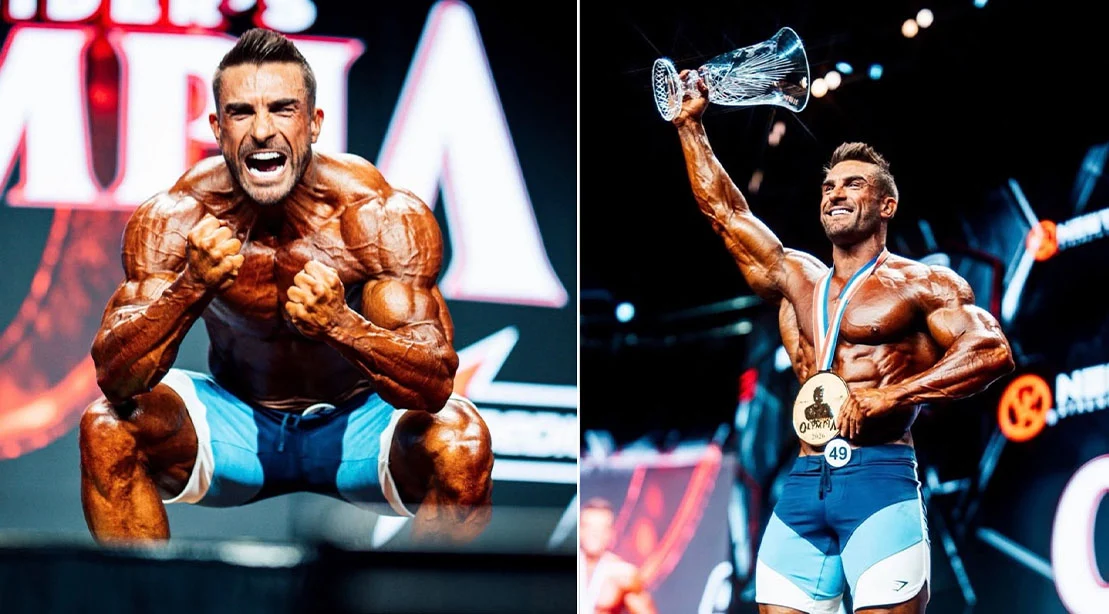
In the high-stakes world of professional bodybuilding, the margin between triumph and obscurity is often measured in millimeters of muscle symmetry and fractions of a percent in body fat. For British icon Ryan Terry, the 2026 Olympia represented the pinnacle of his career—a moment to cement his legacy by equaling Jeremy Buendia’s record of four consecutive Men’s Physique titles. However, as the dust settled in Las Vegas, the narrative shifted from simple athletic dominance to an harrowing tale of physical endurance and psychological fortitude.
Less than 24 hours after his historic victory on September 26, 2026, a vulnerable and candid Terry revealed that his path to the podium had been nearly derailed by a severe cervical spine injury that threatened to keep him off the stage entirely.
The Road to History: A Legacy Cemented
Ryan Terry’s journey to the top of the sport has been defined by persistence. After a grueling nine-year pursuit, he finally captured his maiden Olympia Men’s Physique title in 2023. Since that breakthrough, he has transformed from a top-tier competitor into a dominant force, maintaining a firm grip on the division.
Entering the 2026 Olympia, the expectation was that Terry would cruise to his fourth title. His social media presence throughout the prep—characterized by a focus on mental clarity, mindfulness, and the elimination of external stressors—suggested he was operating at peak efficiency. Yet, behind the scenes, the "RT Fit Gym" owner was battling a physiological nightmare.
Chronology of a Crisis: Seven Weeks to Disaster
The turning point in Terry’s 2026 campaign occurred exactly seven weeks before he was scheduled to step under the bright lights of the Orleans Arena. During a routine training session, Terry suffered a herniated C5 disc in his neck.
The Breaking Point
For a bodybuilder, the neck and upper back are conduits for immense physical load. A herniated C5 disc does not merely cause localized pain; it compromises the function of the shoulders, arms, and hands—the very tools required to showcase the physique.
"We can talk about it now," Terry remarked during the Olympia Winner’s Seminar held at the Palms on September 27. "This has been the hardest prep I’ve ever gone through."
The timeline of the injury was particularly cruel. With only seven weeks remaining, the window for traditional recovery had closed. The injury led to a trapped median nerve, resulting in chronic "pins and needles" sensations in his fingers that persisted even after he was crowned champion. For Terry, the mental toll was perhaps heavier than the physical. He described agonizing moments in his own kitchen, sitting with his wife in tears, convinced that the dream of a fourth title had evaporated.
The Science of Recovery: A Multi-Modal Approach
Facing the potential end of his season, Terry and his team pivoted to an aggressive, unconventional recovery protocol. Unable to rely on standard heavy lifting, he leaned into a suite of therapeutic interventions to maintain his muscle mass while allowing the nerve irritation to subside.
The Toolkit of a Champion
Terry’s successful return to the stage was facilitated by a combination of cutting-edge technology and traditional physical therapy:
- MBST (Molecular Biophysical Stimulation Therapy): Utilizing magnetic resonance technology to stimulate cellular repair, this served as the cornerstone of his recovery.
- Chiropractic and Acupuncture: These modalities were employed to manage the inflammation surrounding the C5 disc and mitigate the radiating pain caused by the nerve entrapment.
- Physical Therapy: Terry credited his best friend, a professional physical therapist, with providing the round-the-clock care required to keep his training volume sufficient to maintain his stage-ready conditioning.
"I’ve still got pins and needles in my fingers even to this day," Terry admitted, underscoring that his victory was achieved not in peak health, but in spite of ongoing neurological discomfort.
Official Responses and Peer Respect
The victory at the 2026 Olympia was not just a win for Terry; it was a moment of profound significance for the division’s history. By securing his fourth title, Terry moved into a rarefied air previously occupied only by Jeremy Buendia.
In a display of true sportsmanship, Buendia—who held the record since the inception of the Men’s Physique division—was among the first to offer his congratulations.
"Massive, massive respect to Jeremy," Terry said during the seminar. "That must have been a hard thing to watch. He’s held that record since the early days of Men’s Physique. It must have been a hard night for him, yet he took it so well. He was the first to congratulate me, and he genuinely meant it. That meant a lot to me."
This exchange highlights the evolution of the sport. While the rivalry between competitors is fierce, the shared understanding of the sacrifice required to reach the Olympia stage creates a bond that transcends the individual titles.
The Competitive Landscape
Terry’s victory was no "gimme." The 2026 lineup was arguably one of the most competitive in the history of the sport. To emerge victorious, Terry had to overcome an elite field, including:
- Ali Bilal: Known for his incredible aesthetic proportions.
- Kyron Holden: A consistent top-tier threat with immense muscle density.
- Erin Banks: A former Olympia champion who pushed Terry to his absolute limit.
The fact that Terry was able to outclass these athletes while nursing a nerve-compromising injury speaks volumes about his mastery of "posing flow" and his ability to mask physical deficits through sheer stage presence.
Implications: The Road to 2027
The fallout from the 2026 Olympia has done more than just add a trophy to Terry’s mantle; it has set a new standard for what it means to be a "champion." By disclosing his injury, Terry has shifted the conversation toward the human element of bodybuilding—the reality that behind the photoshopped perfection of Instagram, these athletes are often performing at the limits of human endurance.
The Quest for Five
During the post-Olympia event, Terry confirmed that his sights are firmly set on the 2027 Olympia. His goal is now clear: to surpass the record he worked so hard to equal and become the most decorated Men’s Physique athlete in the history of the IFBB Pro League.
The implications for his training are clear. While his 2026 prep focused on "shutting out negativity," his 2027 prep will likely focus on injury mitigation and longevity. Terry has proven that he can win when healthy, and he has now proven he can win when broken.
Conclusion: The Legend Continues
Ryan Terry’s 2026 Olympia victory will be remembered not just as a statistic, but as a masterclass in psychological resilience. He transformed a potential career-ending injury into a narrative of triumph, proving that the true strength of a champion is often found in the moments when they are closest to giving up.
As he prepares for the 2027 season, the bodybuilding world watches with bated breath. Whether he secures a fifth title or not, Ryan Terry has already secured his place in the pantheon of the sport’s greats—not just for his physique, but for the iron will that allowed him to defy the odds on the biggest stage in the world.
To follow Ryan Terry’s ongoing journey and recovery progress, you can find him on Instagram.
 Iffa Jayyana
 Reynand Wu
 rifanmuazin
