

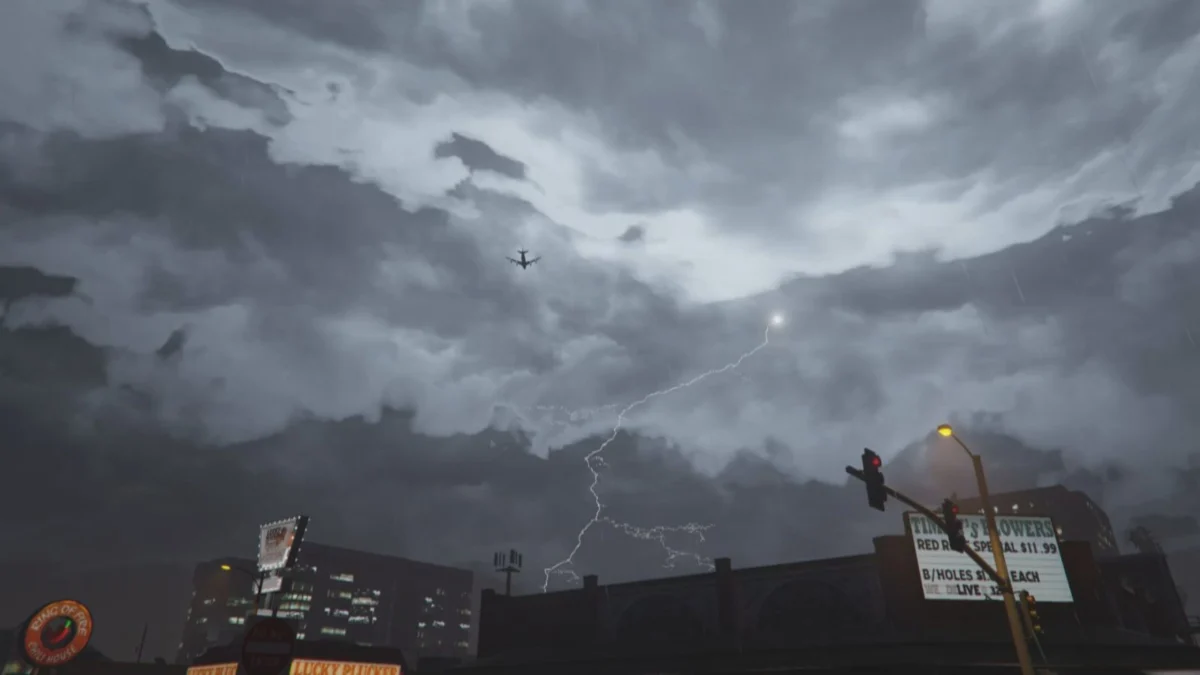
In an era where real-world weather events increasingly disrupt everything from outdoor music festivals to daily commutes, the virtual world is doubling down on atmospheric volatility. Rockstar Games, the powerhouse developer behind the world’s most lucrative entertainment franchises, has announced that Grand Theft Auto VI will feature a re-engineered, hyper-realistic weather engine capable of simulating full-scale tropical storms and hurricanes.
Set within the sun-drenched, yet tempest-prone fictional state of Leonida—Rockstar’s satirical love letter to Florida—the upcoming title promises to bring unprecedented meteorological depth to the open-world genre. According to fresh insights from the development team, players will no longer just dodge rain showers or wait out brief thunderstorm loops. Instead, they will contend with localized, persistent weather systems that mirror the unpredictable and devastating nature of real-world subtropical climates.
As anticipation reaches a fever pitch ahead of the game’s release, this deep-dive exploration examines the architecture of GTA 6‘s revolutionary weather system, its chronological development, the technical data supporting the feat, official commentary from Rockstar leadership, and the broader implications this holds for the future of interactive entertainment.
Main Facts: The Anatomy of Leonida’s Storms
The headline feature of GTA 6‘s environmental design is its dynamic, highly localized weather system. While previous iterations in the franchise treated weather as a map-wide modifier—where it was either raining across the entire game world or entirely clear—GTA 6 introduces localized atmospheric pressure zones, migrating cloud formations, and natural disasters.
Key elements of the system include:
- Full-Scale Hurricane Simulation: Players will experience multi-stage tropical storms characterized by heavy, building cloud cover, gale-force winds, and torrential downpours.
- Hyper-Detailed Visual Effects: Environmental physics have been upgraded to show water cascading off roof edges, pooling in urban gutters, gushing down lampposts, and responding dynamically to wind vectors.
- Localized Geography: Because the map of Leonida is vast—reportedly twice the physical size of Grand Theft Auto V‘s Los Santos—players can theoretically drive out of a localized downpour into blinding sunshine, mirroring coastal weather phenomena in the American Southeast.
- Dynamic Cloudscapes: Rather than repeating a static texture loop, the skies above Leonida feature fully 3D volumetric cloudscapes that roll realistically across the horizon, interacting with lighting and terrain.
Chronology: The Evolution of Weather in Grand Theft Auto
To understand the magnitude of GTA 6‘s atmospheric overhaul, it is helpful to trace how Rockstar Games has evolved its environmental simulation technology over the past two decades. Weather in the franchise has transitioned from simple cosmetic filters to complex, physics-driven systems.
The 3D Era: Aesthetic Atmosphere (GTA III, Vice City, San Andreas)
In the early 2000s, weather in the Grand Theft Auto series served primarily to set a mood. Grand Theft Auto III introduced a gloomy, perpetually overcast Liberty City punctuated by occasional gray rain showers. Vice City captured the neon-soaked, humid aesthetic of 1980s Miami with tropical downpours and dramatic sunsets, though these were largely achieved through basic particle effects and skybox swaps. By San Andreas, the palette expanded to include heavy fog, sandstorms in the desert regions, and distinct regional atmospheric hazes, but the interaction between weather and gameplay remained minimal.
The HD Era: Scripted Spectacle (GTA IV, GTA V)
The launch of Grand Theft Auto IV in 2008 marked a major leap forward, utilizing the Euphoria physics engine to make pedestrians react to rain by opening umbrellas or running for cover. The water surfaces reacted more convincingly to wind, and Liberty City felt appropriately bleak during heavy storms.
When GTA V debuted in 2013, Rockstar expanded these concepts across a massive map featuring urban environments, deserts, and deep oceans. Coastal fog rolled into Blaine County, and lightning storms battered the Vinewood Hills. However, weather events remained largely uniform across the map. If it rained in Los Santos, it was generally raining across the entire southern half of the state, constrained by the technological limitations of seventh-generation gaming hardware.
The Next-Gen Leap: GTA VI and the Leonida Engine
The development of GTA 6 represents a generational jump. Freed from the constraints of legacy hardware, Rockstar’s rendering and engineering teams began building a physics and lighting pipeline designed to handle complex fluid dynamics and atmospheric pressure models. The inclusion of hurricanes and localized micro-climates signifies a shift from scripted weather events to emergent, systemic environmental conditions that actively impact gameplay, visibility, and navigation.
Supporting Data: Technical Ambition and Scale
The decision to simulate hurricanes in GTA 6 is backed by massive technical scaling. Industry profiles and developer disclosures have revealed the sheer magnitude of the game’s architecture:
- Map Scale: Industry insiders and leaks have confirmed that the state of Leonida is approximately twice the physical landmass of Grand Theft Auto V‘s map. This expansive canvas allows for distinct regional climates—from swampy wetlands to dense urban centers and coastal beaches—each susceptible to different types of weather patterns.
- Lighting and Rendering Pipelines: According to recent coverage from Game Informer, the game relies on advanced ray-tracing and volumetric lighting techniques. During a severe storm, flashes of lightning do not merely flash a white overlay on the screen; they realistically illuminate dense, churning clouds from within, casting dynamic shadows across the sprawling landscape.
- Fluid Dynamics: Water physics have been completely overhauled. Rain is no longer a simple vertical particle generator. Wind vectors drive rain diagonally, causing it to streak across windshields, collect in puddles with realistic ripple physics, and drain off architectural structures according to surface gravity mapping.
Official Responses: Insights from Rockstar Leadership
The unveiling of GTA 6‘s weather mechanics came to light through a comprehensive cover story by Game Informer, featuring detailed commentary from key figures within Rockstar Games.
Owen Shepherd, Rockstar’s Vice President of Art for Lighting and Rendering, provided a vivid description of what players can expect when the skies open up over Leonida. Speaking on the integration of heavy atmospheric density, Shepherd noted that storm systems are designed to evoke a visceral sense of being caught in a subtropical deluge:
"Heavy clouds, strong winds, dense atmospherics, and a lot of rain combine so that everything is dripping wet, water is gushing off roof edges and lampposts, thunder rumbles and flashes of lightning light up the clouds dramatically."
Shepherd further emphasized that the system breaks away from the homogenized weather patterns of previous titles, introducing unpredictability through “much more localized and persistent” storms featuring “fully dynamic cloudscapes that roll across the map.”
While Rockstar has historically maintained a tight-lipped approach to marketing its titles—relying on carefully curated trailers and deep-dive journalistic features rather than constant developer updates—these technical disclosures underscore the studio’s obsession with environmental immersion.
Implications: What Hurricane Simulation Means for Gaming
The introduction of advanced, destructive, and persistent weather systems in Grand Theft Auto VI carries significant implications for the gaming industry at large.
1. Gameplay and Tactical Diversification
Weather in open-world games has historically been treated as a visual backdrop. By introducing systems as violent as hurricanes, Rockstar is creating tactical variables for players. High winds could affect aircraft handling, driving visibility, and projectile trajectories. Navigating a heist or a high-speed police pursuit during a blinding downpour introduces entirely new layers of challenge and strategy.
2. Setting a New Standard for World Immersion
As hardware capabilities expand with current-generation consoles (PlayStation 5 and Xbox Series X/S) and high-end PC architectures, players increasingly expect virtual worlds to feel alive. Static environments are rapidly becoming obsolete. Rockstar’s focus on micro-weather phenomena sets a high bar for competing open-world franchises, pushing developers to invest more heavily in atmospheric and physics simulation engines.
3. The Irony of Digital Disasters
There is a distinct cultural irony in simulating devastating tropical storms within a video game at a time when real-world climate volatility—ranging from festival-canceling downpours to increasingly severe hurricane seasons—disrupts daily life globally. However, digital escapism has always leaned into the extreme. Just as players enjoy the lawless freedom of a virtual criminal empire they would never partake in real life, braving a Category 4 hurricane from the safety of a living room couch offers a thrilling, risk-free confrontation with nature’s raw power.
Conclusion
As the release window for Grand Theft Auto VI draws closer, every new detail released by Rockstar Games reinforces the title’s status as a watershed moment for interactive entertainment. By transforming the skies of Leonida into a living, breathing, and occasionally terrifying meteorological canvas, the developers are not just building a bigger map—they are breathing unprecedented life into it.
Whether players will welcome the sudden downpours or find themselves cursing the skies when a hurricane derails their carefully laid plans remains to be seen. One thing, however, is certain: when GTA 6 launches, the weather forecast in Leonida will be the least predictable thing about it.
 Siti Muinah
 Reynand Wu
