

By Rhea Nayyar
Main Facts
Amid a national sociopolitical climate marked by the intensification of anti-immigrant rhetoric, political exploitation, and systemic marginalization, a pioneering public art initiative across New Jersey is actively carving out physical and cultural space to honor the profound contributions of immigrants. The New Jersey Monuments to Migration and Labor (NJMML) project has officially inaugurated a series of striking, large-scale outdoor commissions created by acclaimed artists Michelle Angela Ortiz, Chat Travieso, and Immanuel Oni.
Rather than functioning as traditional, static bronze statues of historical figures, these contemporary public art installations are living monuments. They are the direct result of extensive grassroots consultations involving over 1,000 community stakeholders, including local workers, advocacy groups, and multi-generational immigrant families. Strategically dispersed across North, Central, and South Jersey, the artworks reflect the culturally specific experiences, struggles, and triumphs of the prominent immigrant demographics that anchor each region.
The initiative serves as both a counterweight to prevailing xenophobic narratives and a permanent testament to the economic, cultural, and social vitality that newcomers bring to the Garden State. To further contextualize these installations, Rutgers University’s Zimmerli Art Museum is hosting a comprehensive academic and community symposium on Friday, October 16, bringing together artists, scholars, and activists to discuss the intersection of migration, public memory, and labor.
Chronology: From Concept to Community Landmarks
The realization of the NJMML project represents years of meticulous planning, community engagement, and artistic execution. While the monuments were formally unveiled to the public in a series of summer inaugurations, the timeline of the initiative highlights a deeply collaborative community-first methodology:
- Phase 1: Grassroots Consultation (2023–2024): Before a single sketch was drawn or material purchased, project organizers and collaborating artists engaged in months of listening sessions. Over 1,000 community stakeholders across New Jersey shared their personal narratives, challenges, and aspirations as migrants and laborers. These intimate testimonies formed the conceptual bedrock for the public commissions.
- Phase 2: Artist Selection and Site-Specific Design (2024–2025): Artists Michelle Angela Ortiz, Chat Travieso, and Immanuel Oni were selected to lead the public installations. Each artist was paired with a specific geographic region in New Jersey—North, Central, or South—to ensure that the final artworks resonated directly with local immigrant communities, architecture, and labor histories.
- Phase 3: Fabrication and Installation (Late 2025–Early 2026): Fabrication of the monumental works took place in close collaboration with local fabricators, laborers, and community members. Strategic sites were selected in high-visibility civic spaces to ensure daily engagement with the general public.
- Phase 4: Summer Inaugurations (Summer 2026): The monuments were officially unveiled to the public through a series of celebratory community gatherings, cultural performances, and civic addresses.
- Phase 5: Academic and Public Symposium (October 16, 2026): Rutgers University’s Zimmerli Art Museum hosts a statewide conference to analyze the impact of the monuments, offering a platform for broader discussions on labor rights, migration, and public art curation.
Supporting Data: Understanding New Jersey’s Immigrant Landscape
To fully grasp the cultural and sociological significance of the NJMML project, one must examine the demographic data that defines New Jersey as one of the most culturally diverse states in the United States.

- Demographic Footprint: According to data from the American Community Survey, foreign-born residents account for over 23% of New Jersey’s total population, totaling more than two million people.
- Economic Drivers: Immigrants comprise nearly one-third of New Jersey’s labor force. They hold critical leadership and frontline roles in vital industries, including healthcare, education, construction, retail, and hospitality.
- Geographic Distribution: The NJMML initiative’s regional approach mirrors the state’s distinct demographic clusters. North Jersey (including urban hubs like Paterson, Jersey City, and Newark) features vibrant Hispanic, Caribbean, South Asian, and Middle Eastern communities. Central and South Jersey host expansive agricultural, manufacturing, and suburban networks driven by Latin American, African, and Southeast Asian workforces.
- Community Outreach: The foundational phase of the project leveraged qualitative data gathered from over 1,000 direct interviews and town halls, ensuring that the resulting monuments are authentic reflections of lived experiences rather than generalized abstractions.
Official Responses and Perspectives
The unveiling of the NJMML installations has drawn widespread acclaim from community organizers, municipal leaders, and academic figures, who view the project as a vital intervention in contemporary public discourse.
Andrew Urban, Project Director of the NJMML, emphasized that the initiative treats cultural expression not as a luxury, but as an essential civic necessity during times of societal strain. In a press statement regarding the statewide launch, Urban remarked:
“I think the three monuments are distinguished by an awareness that celebration and reflection, which the pieces encourage, are not just secondary pursuits that can be sacrificed during times of crisis.”
Urban also expressed profound gratitude to the community participants who lent their voices to the project, praising the stakeholders for their “willingness to share their time, perspectives, and incredibly personal stories related to being migrants and laborers.”
Local municipal officials have similarly echoed these sentiments, noting that public art has the unique capacity to transform civic plazas into welcoming spaces of belonging. By placing monuments outside municipal buildings and community centers, the initiative asserts that the stories of immigrants are central—not peripheral—to the civic identity of New Jersey.
Implications: Redefining Public Monuments for the 21st Century
The New Jersey Monuments to Migration and Labor project arrives at a critical juncture in American art history, prompting a broader national conversation about who and what deserves to be memorialized in public spaces.
Challenging Traditional Monumentalism
For centuries, public monuments in the United States have predominantly honored political figures, military generals, and wealthy industrialists—often overlooking the foundational labor of marginalized populations. By shifting the focus to immigrant workers, everyday laborers, and community builders, the NJMML project subverts traditional hierarchies of public memory. The monuments honor endurance, familial sacrifice, and communal solidarity rather than battlefield dominance or political power.
Art as Social Infrastructure
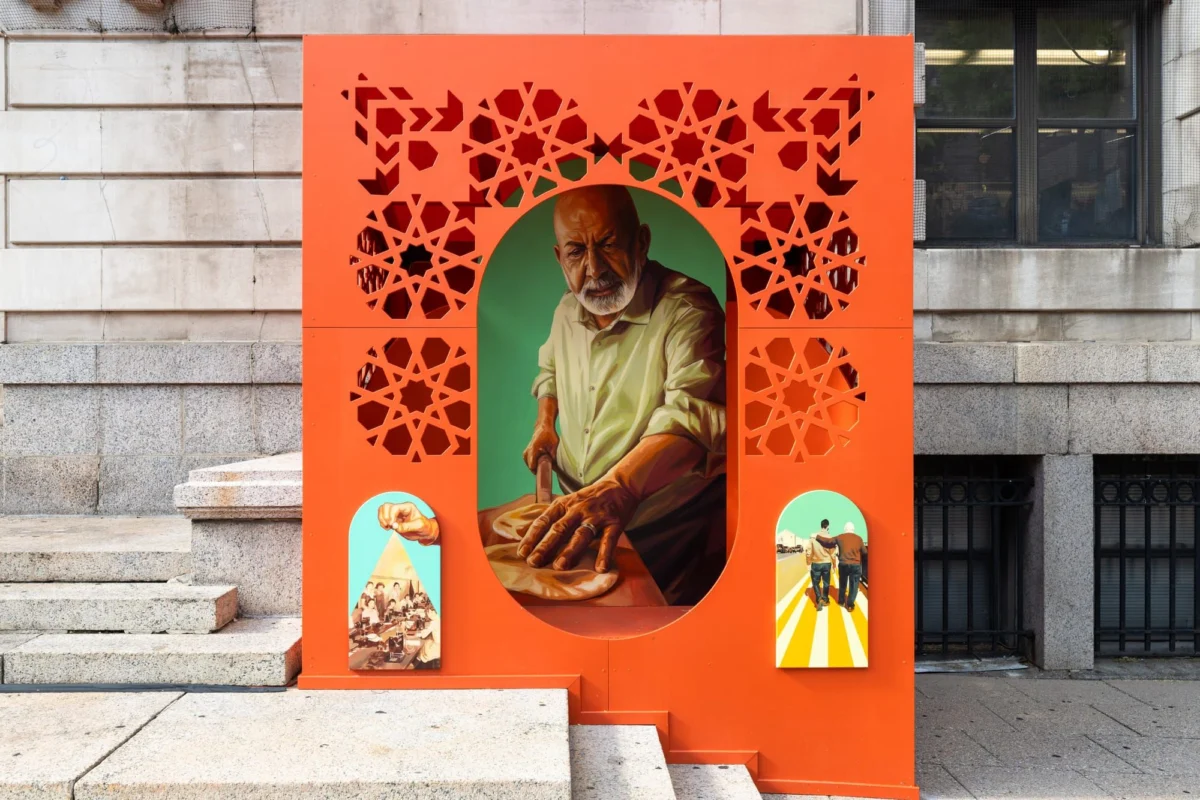
The installations by Ortiz, Travieso, and Oni are designed not merely as objects to be viewed from a distance, but as architectural pavilions and gathering spaces. For instance, Michelle Angela Ortiz’s installation outside Paterson City Hall—titled Carriers of Light and Labor—incorporates design elements that actively honor local immigrant staples, such as the Nouri brothers and the Fattal family, retail grocers who have shaped the commercial and social fabric of Paterson for decades. These spaces invite dialogue, rest, and community assembly, effectively functioning as social infrastructure.
A Blueprint for Other States
As municipalities across the United States grapple with polarized debates over public art, cultural heritage, and immigration, the NJMML initiative offers a replicable framework. By anchoring public art in rigorous, community-led oral histories and strategic regional placement, New Jersey has demonstrated how artistic interventions can heal community fractures, validate underrepresented histories, and foster enduring empathy.
As the initiative culminates in its upcoming academic symposium at the Zimmerli Art Museum, the conversation extends beyond the physical borders of the Garden State. The NJMML project stands as a bold reminder that public art can—and should—reflect the diverse, hardworking humanity of the communities that sustain it.
 Muslim
 Evan Lee Salim
 Nana Muazin
