

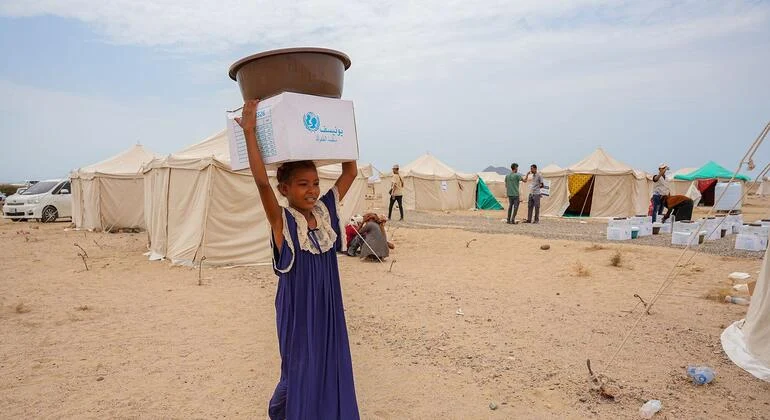
The humanitarian landscape in Yemen, already defined by years of protracted conflict and systemic instability, is plummeting into a new, darker phase. Recent escalations in fighting between government forces and Houthi rebels along the nation’s strategic southwestern coast have unleashed a fresh wave of displacement, disrupted vital supply chains, and further constricted the reach of international aid organizations.
As the conflict intensifies, the World Food Programme (WFP) has issued a sobering warning: what is currently manifesting as a localized hunger crisis in Yemen threatens to destabilize global food security far beyond the country’s borders.
The Anatomy of a Humanitarian Crisis: Main Facts
The current flare-up of violence has displaced nearly 150,000 individuals in a matter of weeks. These families, fleeing the crossfire in coastal regions, are arriving in urban centers and displacement camps often without access to water, shelter, or basic sustenance.
According to Matthew Hollingworth, WFP Assistant Executive Director for Programme Operations, the situation on the ground is deteriorating with unprecedented speed. "Nearly three out of four households in accessible areas are unable to meet their basic needs," Hollingworth noted, describing this as a record-breaking decline in living standards within just a few short weeks.
The crisis is not merely one of availability, but of affordability and access. Markets are failing; traders report dwindling stocks of wheat flour and critical shortages of vegetable oil. As supply lines are severed by the fighting, food prices have surged, rendering the most basic caloric staples inaccessible to the average Yemeni household.
A Chronology of Escalation: From Protracted War to Acute Emergency
Yemen has been entrenched in conflict for nearly a decade, consistently ranking among the world’s most severe humanitarian "hotspots." However, the timeline of the recent escalation highlights a rapid departure from the already dire status quo:
- Pre-Escalation: Yemen was already struggling with the shadow of famine. National figures indicated that over 18 million people faced acute food insecurity, with 2.2 million children under the age of five suffering from acute malnutrition.
- The Coastal Surge: Recent months saw a shift in military activity to the southwestern coast, a region critical for both trade and civilian life. This maneuver triggered a massive, forced migration of civilians away from the frontline.
- Operational Stagnation: Following the intensification of the conflict, the United Nations implemented an operational pause in specific zones under Houthi de facto authority. This move, while necessary for security, effectively walled off approximately 350,000 people from direct humanitarian assistance.
- The Regional Exodus: The crisis has now spilled across the maritime border. At least 3,700 Yemenis have crossed the Bab al-Mandab Strait to seek refuge in Djibouti, a figure that continues to rise as the fighting persists.
Supporting Data: The Scale of Desperation
The statistics surrounding the Yemeni crisis provide a harrowing snapshot of a population pushed to the brink. The WFP, which had been supporting over 1.5 million people in government-held areas prior to this surge, is now stretched to its breaking point.
Families are resorting to extreme survival mechanisms. Reports from the field indicate that households are skipping meals entirely and significantly reducing the nutritional diversity of their diet—a precursor to mass starvation. In urban areas, the influx of displaced persons has overwhelmed existing infrastructure. Many of those arriving at shelters have endured days of travel on foot, arriving in a state of severe physical depletion.
The WFP has managed to reach 70,000 people in the "displacement hotspots" of Lahaj and Taiz with hot meals and emergency provisions. However, these efforts are being executed using resources previously earmarked for long-term food security programs. As Hollingworth starkly put it, the agency is effectively "robbing Peter to feed Paul," a practice that is unsustainable in the long term.
Official Responses and Strategic Obstacles
The international humanitarian response is currently grappling with a dual challenge: a critical lack of funding and severe physical barriers to distribution. While pre-positioned stocks exist, the ability to move these goods into frontline areas has been largely neutralized by the fighting.
The Diplomatic and Operational Impasse
The United Nations remains committed to the safety of its staff and partners, which has necessitated the current operational pause in Houthi-controlled zones. This, however, leaves a massive humanitarian vacuum. The WFP and its partners are currently unable to reach hundreds of thousands of people who were previously recipients of life-saving aid.
Mr. Hollingworth’s appeal to the international community is clear: without a significant injection of funding and a cessation of hostilities in food-secure corridors, the outlook for the coming months is bleak. The agency is calling for global donors to prioritize the Yemen response, noting that the cost of inaction will far outweigh the cost of providing life-saving support today.
Global Implications: The "Choke Point" Effect
Perhaps the most alarming aspect of the current situation is the threat it poses to international maritime trade. The Bab al-Mandab Strait, where the conflict is currently concentrated, serves as one of the world’s most critical maritime corridors. It acts as a gateway for food, fuel, and commercial goods transiting between Asia, the Middle East, Africa, and Europe.
The Triple Threat to Global Supply Chains
The instability in Yemen is occurring at a moment of unique global fragility. Experts have identified three "critical maritime choke points" currently under extreme pressure:
- The Bab al-Mandab Strait: The immediate epicenter of the current conflict.
- The Black Sea: Already hampered by the ongoing conflict in Ukraine, impacting global grain exports.
- The Strait of Hormuz: A vital artery for global energy supplies.
When these corridors face simultaneous disruption, the ripple effects are felt in every corner of the world. As Hollingworth warned, "When all three of these are under pressure at the same time, you can add to that the impact of a super El Niño weather pattern. These consequences are going to ripple through food systems everywhere."
The confluence of climate change (El Niño), regional geopolitical conflict, and supply chain fragility suggests that we are moving toward a period of extreme volatility in food prices. The crisis in Yemen is not an isolated event; it is a stress test for the global food system.
Conclusion: The Cost of Indifference
The situation in Yemen serves as a grim reminder of the interconnectedness of modern global security. A humanitarian shock in a single, war-torn nation has the potential to manifest as a global food crisis. By disrupting the flow of goods through the Bab al-Mandab Strait, the war in Yemen is effectively raising the price of bread in Europe and the cost of energy in Asia.
As the international community watches the escalating numbers of displaced persons and the shrinking capacity of aid agencies, the message from the frontlines is unequivocal: today’s humanitarian shock in Yemen can, if left unaddressed, become tomorrow’s global systemic failure. Addressing the hunger crisis in Yemen is not merely an act of charity; it is a necessary intervention to preserve the stability of the global food systems upon which all nations depend. The world must act, not only for the sake of the Yemeni people but for the stability of the global order itself.
 Lina Hope
 Asro
Asro
 Layla Zulfa
