

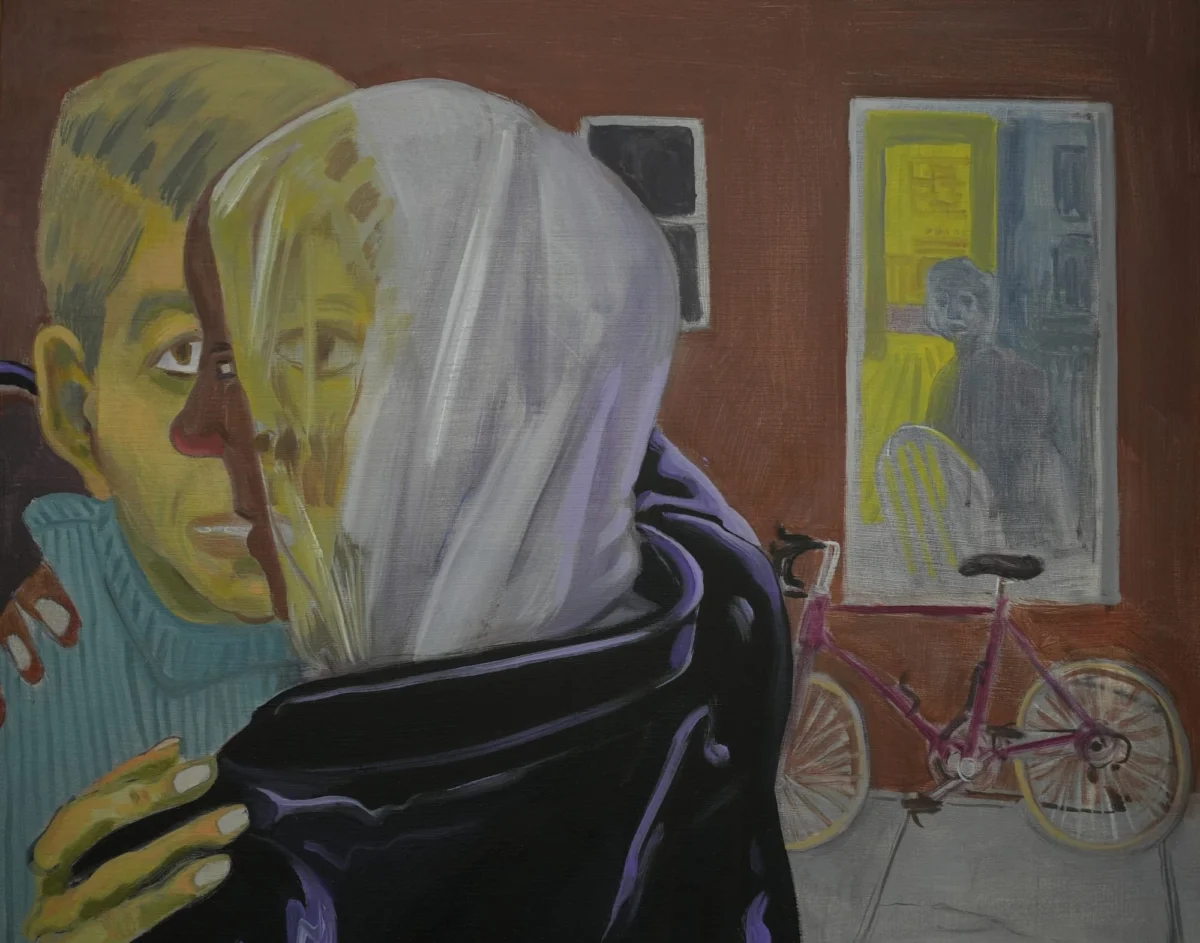
NEW YORK — In the heart of Manhattan’s Lower East Side, inside the sunlit, intimate confines of the JJ Murphy gallery, artist Mala Iqbal is exhibiting a body of work that feels at once intensely local and universally recognizable. Her newest collection of paintings examines the modern human condition through a singular lens: the metropolis as a vast, shared waiting room where millions of individuals coexist in proximity, yet remain entirely sequestered within their own thoughts, glowing screens, and urban armor.
Reviewing the exhibition, art critics and observers have noted that Iqbal’s canvases remind viewers that the world is a room shared predominantly with strangers—most of whom are looking elsewhere. Through a brilliant interplay of color, texture, and psychological tension, Iqbal manages to capture the fleeting, phantom intimacies of contemporary life, from the subterranean hum of the subway system to the neon-drenched saturation of Times Square.
Main Facts: The Exhibition and Its Core Premise
Mala Iqbal’s latest solo exhibition anchors itself around several key 2025 and 2026 works, including Subway Riders (2026), Through the Curtains (2026), Times Square (2026), and Transparent Friend (2025). Hosted at the JJ Murphy gallery, the showcase centers on how urban dwellers construct, negotiate, and consume reality in an era defined by sensory overload.
- The Artistic Focus: Figures jostle across Iqbal’s canvases with the kinetic, relentless energy of a global metropolis.
- The Palette: Many works are bathed in artificial orange and yellow glows—a visual nod to populations that live under perpetual electric light, in urban microclimates where even the sun feels secondary.
- The Thematic Core: The paintings interrogate the paradox of urban transit and public spaces: environments that offer false intimacies, fostering the illusion that we know the people sitting inches away from us, even as we retreat behind social masks and averted gazes.
Chronology and Evolution: Tracing Iqbal’s Visual Language
To understand the weight of Iqbal’s 2026 collection, one must trace the evolution of her artistic trajectory, which has long grappled with the mediation of reality.
- Pre-2025 Foundations: Iqbal’s earlier work laid a foundation in exploring abstract spaces and figurative disruption, heavily influenced by the tenets of social realism but resisting its heavier, more despairing tendencies.
- 2025 (Transparent Friend): Moving deeper into the mechanics of human connection, works like Transparent Friend (2025) began experimenting with layered transparency, questioning how much of our true selves we reveal—or conceal—from companions and casual onlookers alike.
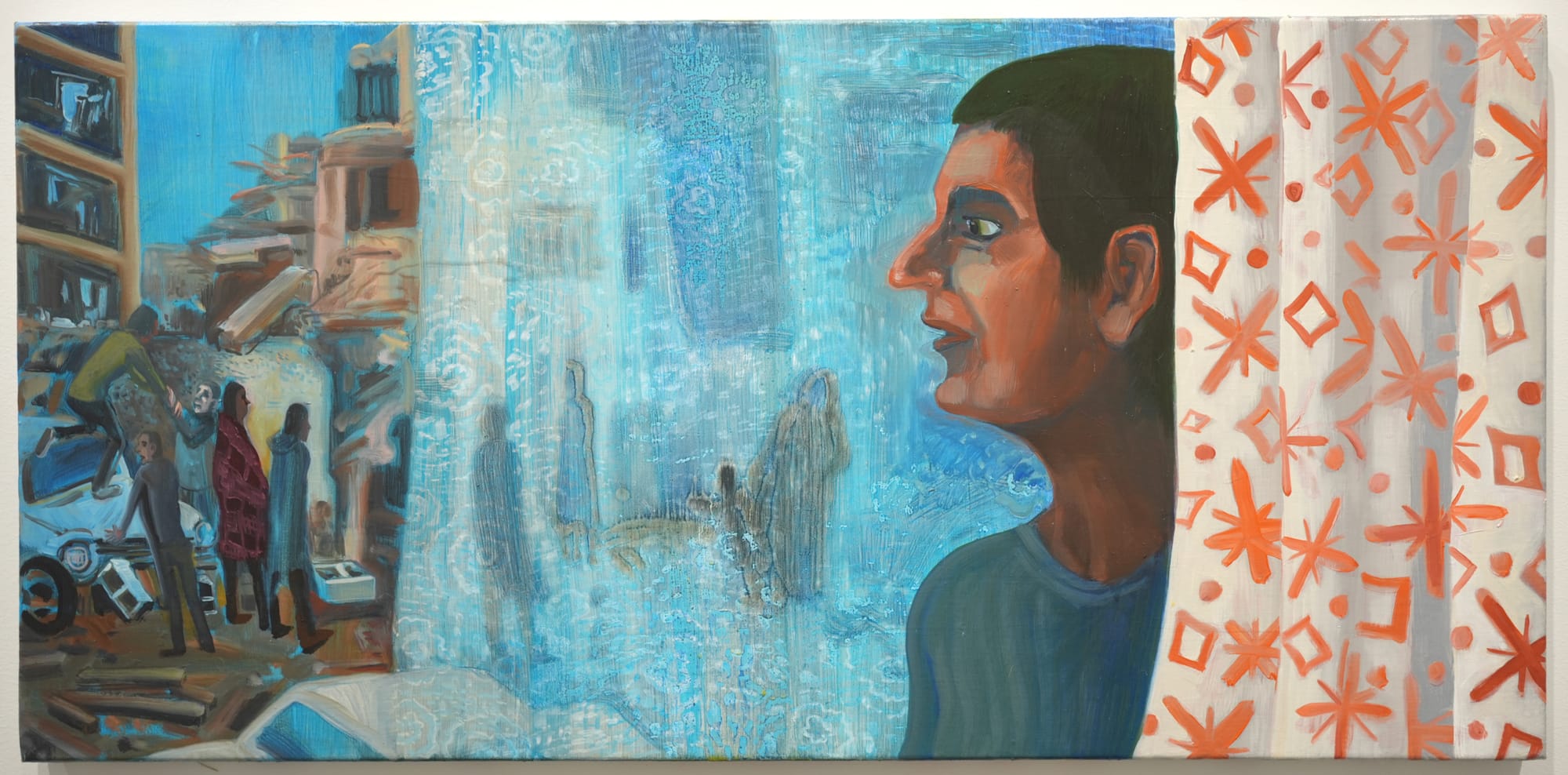
- 2026 (The Current Body of Work): In her newest pieces, the scope broadens to encompass mass media consumption and systemic anxiety. A prime example is Through the Curtains (2026), a triptych-like visual narrative. Reading from left to right, the painting depicts a scene of collapse or catastrophe, which is subsequently obscured by a sheer tulle curtain rendered like a faded negative. A middle figure reacts with a numbed, muted posture, while the final panel presents a curtain finished with a pictograph-like pattern.
Critics have interpreted Through the Curtains as a brilliant metaphor for the digital age: systemic collapse and violence are delivered to our pockets via screens faster than human psychology can process them, quickly transforming real-world tragedy into an indecipherable, aestheticized language of data and pixels.
Supporting Data and Aesthetic Analysis
Iqbal’s technique is a masterclass in balancing historical artistic traditions with hyper-modern anxieties. While social realism casts a long shadow over her compositions, her overall mood sidesteps cynicism, leaning instead into a Matisse-like ease of form and color.
The Palette of the Metropolis
In Times Square (2026), Iqbal utilizes a chalky, grounded palette reminiscent of American social realist Ben Shahn. This deliberate choice gives the image a distinct terroir—a sense of place rooted in concrete, grit, and endurance—without ever sliding into bleak despair. The figures are rendered with expressive brushwork, their faces frequently obstructed or morphing into shapely flourishes that draw the eye to the enticing, tactile quality of the canvas surface.
The Subway as a Microcosm
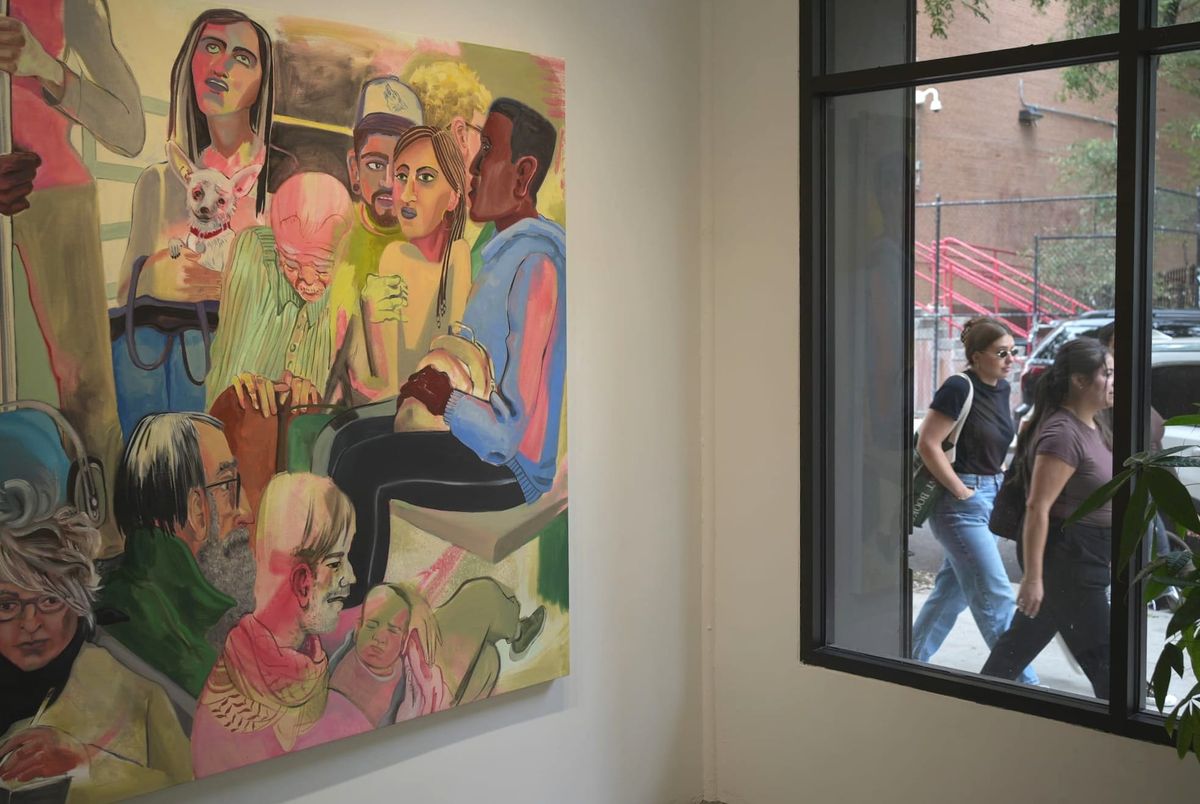
The underground transit system serves as a recurring stage in Iqbal’s work. In Subway Riders (2026), positioned prominently near the JJ Murphy gallery’s front windows, the claustrophobic yet connective nature of the New York City subway is laid bare.

Notably, the painting features a recognizable figure: artist Angela Dufresne, Iqbal’s partner. Dufresne is depicted recording her own observations, gazing outward toward the viewer but not quite at them. This meta-layering introduces a profound meditation on relationships, reminding audiences that the ways we choose to depict our loved ones are often a reflection of how those same relationships shape and depict us.
Official Responses and Critical Reception
The art world has responded to Iqbal’s latest exhibition with considerable critical acclaim, praising her ability to translate abstract psychological states into vivid, tangible tableaus.
Galleries and cultural critics have highlighted how the exhibition successfully captures the post-pandemic urban psyche—a collective mindset characterized by an intense hunger for public community coexisting alongside a deeply ingrained, protective alienation.
"Iqbal does not judge the urban mask; she celebrates its textural complexity," noted one gallery observer during the opening week on the Lower East Side. "In a world where everyone is looking elsewhere, she forces us to look at the looking—to examine the architecture of our own detachment."
Furthermore, fellow artists and curators have praised the exhibition’s layout at JJ Murphy, noting that placing works like Subway Riders near the street-facing windows creates a seamless dialogue between the art inside and the actual strangers hurrying past on the Manhattan pavement outside.
Implications: What Iqbal’s Canvas Tells Us About Modern Life
Mala Iqbal’s 2026 exhibition transcends the traditional boundaries of landscape or figurative painting, offering instead a diagnostic tool for contemporary urban sociology.
- The Screen-Mediated Reality: By equating the tulle curtains in Through the Curtains with the digital filters of modern media, Iqbal addresses the psychic numbing of the 21st century. As breaking news of global crises rolls endlessly across our devices, we process tragedy through layers of abstraction. Iqbal captures the exact moment reality turns into pixelated noise.
- The Redefining of Public Intimacy: The subway and street scenes challenge the notion of loneliness in a crowd. Iqbal posits that being surrounded by strangers is not necessarily an isolating vacuum, but a shared choreography of mutual avoidance and silent empathy. We are all passengers looking elsewhere, bound together by the shared air of a moving metal car or a crowded avenue.
- The Enduring Power of Painting: In an era dominated by digital art, generative AI, and rapid-fire visual consumption, Iqbal’s physically rich, layered canvases argue for the irreplaceable value of the human hand. The chalky textures, the glowing artificial pigments, and the deliberate brushstrokes require time—a direct counter-narrative to the fast-scroll culture she critiques.
Ultimately, Mala Iqbal’s new paintings serve as a mirror for a society caught between connection and isolation. They remind us that even when everyone in the room is looking elsewhere, we are still sharing the same space, bound by the quiet, beautiful absurdity of modern urban existence.
 Laily UPN
 Raul Delapena Setiawan
