

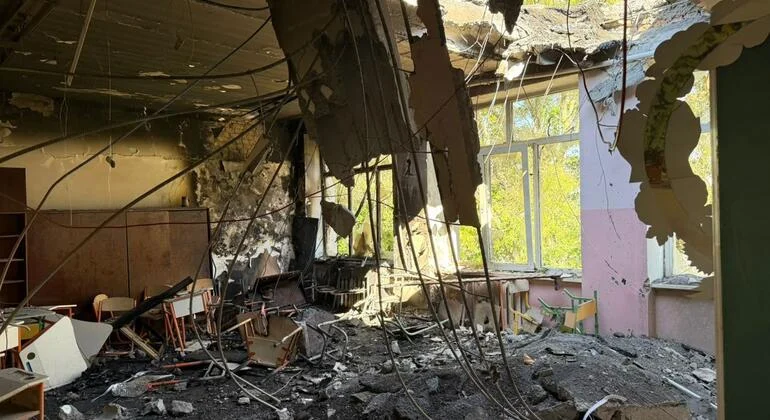
GENEVA – In a harrowing address to the United Nations Human Rights Council, UN High Commissioner for Human Rights Volker Türk has characterized the ongoing war in Ukraine as a “human rights catastrophe” of staggering proportions. As the conflict drags into another winter, Türk’s office released data indicating a sharp, violent escalation in hostilities, marked by systemic sexual violence, the weaponization of civilian infrastructure, and the transformation of the country into a testing ground for lethal autonomous technologies.
Calling for an immediate pivot toward negotiated peace, the High Commissioner warned that the combination of militarized economies and the relentless targeting of non-combatants has created a cycle of suffering that threatens to destabilize the region for generations to come.
The Human Toll: A Surge in Civilian Casualties
The statistics presented by the Office of the High Commissioner for Human Rights (OHCHR) paint a grim picture of life on the ground in Ukraine. During the first eight months of this year, the UN verified approximately 15,280 civilian casualties—a figure that translates to an average of more than 400 people killed or wounded every single week.
This represents a 55 percent increase compared to the same period in 2025, signaling that despite the relative stagnation of the frontlines, the intensity of the violence has not abated. Rather, the war has become increasingly indiscriminate. Russian aerial glide bombs, deployed heavily across the Donetsk, Kharkiv, Sumy, and Zaporizhzhia regions, accounted for nearly 2,500 of these casualties, a 62 percent increase over the previous year’s corresponding period.
For the civilian population, the war is not a distant geopolitical struggle but a constant, suffocating dread. In Kyiv alone, residents endured 33 hours of air raid alerts within a single 48-hour window earlier this week. The destruction has spared little: apartment blocks, schools, medical facilities, and essential retail hubs have become routine targets, leaving families without shelter or access to basic necessities as winter approaches.
A Laboratory for Drone Warfare
One of the most alarming aspects of the current phase of the war is the rapid evolution of tactical technology. Mr. Türk explicitly labeled Ukraine as a “laboratory for drone warfare.” The proliferation of both surveillance and loitering munitions has turned the battlefield into a high-tech killing field, with profound implications for international humanitarian law.
The High Commissioner expressed grave concern that the carnage caused by these drones is not contained within Ukrainian borders. He urged the international community to take urgent action to regulate the proliferation of such weapons, warning that the lessons learned—and the tactical failures allowed—in this conflict will inevitably export violence to other global theaters.
Beyond drones, the deliberate targeting of energy and commercial infrastructure has weaponized the environment against the population. Russian strikes on supermarkets and food supply chains have already induced localized shortages of essential goods like dairy and vegetables. In areas such as Oleshky, an estimated 2,000 residents remain effectively trapped, surviving without electricity, gas, or running water, held hostage by the logistics of occupation and the ongoing bombardment.
Cruelty Manifest: Sexual Violence and Accountability
Perhaps the most visceral evidence of the moral decay of this conflict is the systematic use of sexual violence. A recent report by the UN rights office documented more than 1,000 cases of sexual violence against civilians and prisoners of war (POWs). Of these, 89 percent were attributed to Russian authorities, while 11 percent were linked to Ukrainian forces.
While the majority of victims were men—particularly those held in detention centers—the report notes that women and children are frequently targeted in occupied territories. Mr. Türk described these acts as a “terrible manifestation of the cruelty that has come to define this war.”
Accountability, he insisted, must be a prerequisite for any lasting peace. "Alongside peace, there must be accountability," Türk told the Council, emphasizing that the normalization of such brutality cannot be allowed to stand in the international legal order.
Implications for the Russian Federation
While the focus remains on the devastation within Ukraine, Mr. Türk also turned his lens toward the Russian Federation. He urged Russian leadership to reflect on the long-term domestic consequences of the war. He described a Russian society increasingly defined by fear, state-mandated denial, and a hyper-militarized economy that prioritizes the machinery of death and destruction over the foundational pillars of healthcare and education.
Furthermore, the UN expressed alarm regarding the use of foreign fighters. Interviews conducted with prisoners of war from 36 different countries held by Ukraine revealed a disturbing pattern: many had been deceived by recruitment networks, promised work or better conditions, only to find themselves forced into the frontlines of a war they did not understand. This "mercenarization" of the conflict adds another layer of complexity to the human rights violations occurring on the ground.
Chronology of Escalation: 2024-2025
- Early 2025: Initial phases of the year showed a moderate, albeit brutal, level of conventional warfare.
- Mid-2025: Increased reliance on Russian glide bombs and the expansion of the drone war led to a measurable spike in civilian infrastructure damage.
- Q3 2025: A sharp uptick in targeted attacks on energy and food infrastructure created a pre-winter crisis, complicating humanitarian aid efforts.
- Current Period (Late 2025): The UN reports a 55% surge in casualties compared to the previous year, with air raid alerts reaching record-breaking durations in major urban centers.
Towards a Negotiated Peace: The UN’s Roadmap
Despite the gloom, Mr. Türk offered a framework for de-escalation. He proposed a series of confidence-building measures grounded in human rights, which he argues could serve as the foundation for broader negotiations:
- Economic De-escalation: An immediate, mutually agreed-upon end to all attacks on civilian energy infrastructure and commercial food targets.
- Local Ceasefires: Implementing localized "humanitarian windows" along the frontlines to facilitate the movement of civilians to safety.
- POW Exchange: A full, comprehensive exchange of all prisoners of war, removing a major source of tension and a site of frequent human rights abuse.
Addressing the international community—and specifically those nations possessing diplomatic leverage—the High Commissioner issued a final, somber plea. "To the international community, and particularly states with influence, I say: please take urgent action to push for a negotiated peace now, before this tragedy becomes even worse," he stated.
As the UN prepares to review these findings, the message from Geneva is clear: the cost of inaction is being measured in human lives. The “catastrophe” in Ukraine is not merely a regional security issue; it is a profound failure of global diplomacy that threatens to leave a permanent scar on the 21st century. Whether the world’s powers heed the call for an immediate ceasefire or allow the “laboratory of war” to continue its work remains the defining question of the coming months.
 Nana Muazin
 Reynand Wu
 Raul Delapena Setiawan
