

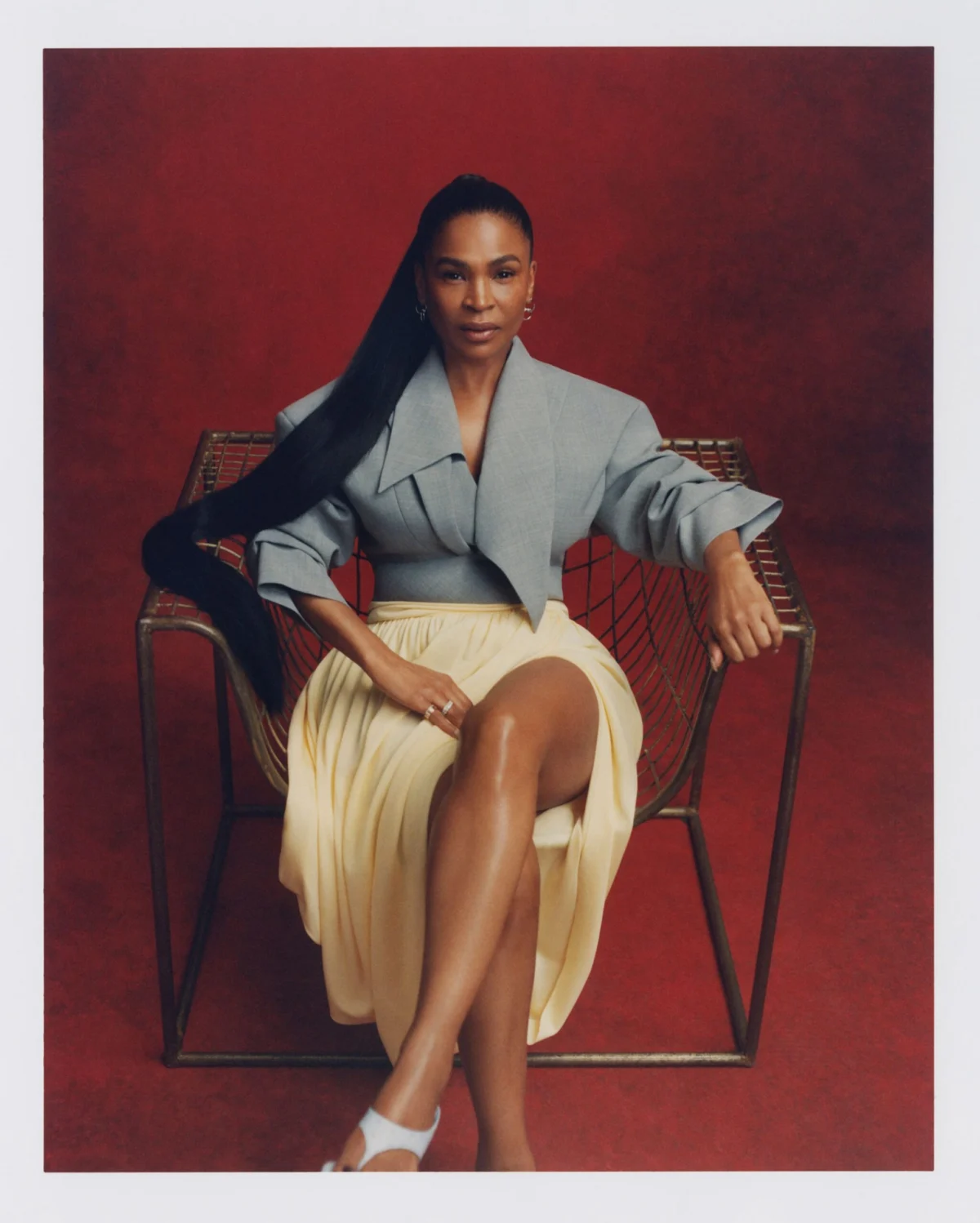
Main Facts
Nia Long is stepping into a deeply reflective and creatively expansive chapter of her storied career. Meeting for a quiet early lunch at West Hollywood’s iconic Chateau Marmont, the celebrated actor carries the lingering emotional weight of Michael, the upcoming Michael Jackson biographical film directed by Antoine Fuqua, slated for an April release. In the film, Long delivers a powerful, understated performance as Katherine Jackson, the foundational matriarch of the Jackson family.
Beyond her latest cinematic role, Long is embracing a period of massive personal and professional transition at age 55. She has recently wrapped production on Don’t Ever Wonder, a romantic dramedy directed by Eugene Ashe that reunites her on-screen with Love Jones co-star Larenz Tate. The project explores the complexities of empty-nest romance and second acts in life. Simultaneously, Long is navigating a deeply personal milestone: authoring her first memoir. The book, a two-year creative labor, traces her upbringing from a Trinidadian Brooklyn household to her formative, culturally disorienting years in Iowa City, all while confronting the complexities of public scrutiny, aging, and radical self-possession.

Chronology: A Life Shaped by Art, Movement, and Memory
From Brooklyn to the Midwest
Nia Long’s journey began in Brooklyn, New York, within a vibrant Trinidadian household where her immediate neighborhood was entirely Black. However, her childhood trajectory shifted when her family relocated to Iowa City for six years while her mother pursued higher education. Growing up as a young, brown-skinned girl in a predominantly white Midwestern environment presented early psychological and emotional hurdles.
In her upcoming memoir, Long reflects on how this displacement affected her self-image. While her family continually affirmed her beauty, external societal standards told a different story. This dichotomy laid the groundwork for a lifelong pursuit of internal validation over external applause.

The Architect of ‘90s Cinema
By the 1990s and early 2000s, Long had cemented her status as a cultural touchstone. Through unforgettable performances as Nina in Love Jones, Jordan in The Best Man, and Lisa Wilkes in The Fresh Prince of Bel-Air, she became the physical and emotional embodiment of a generation’s ideal of Black excellence and beauty—a status affectionately codified by fans as "’90s Fine." Yet, Long has consistently maintained that her motivation has never been fame or accolades, but rather an unyielding commitment to truth, generational wealth, and authentic representation.
The Turning Point of 2022 and Beyond
In 2022, Long experienced the jarring intersection of personal heartbreak and intense public exposure when her high-profile 13-year relationship ended amid a widely publicized cheating scandal. Rather than shrinking from the spotlight, Long navigated the ordeal with calculated grace and unshakeable boundaries. Today, she shares a healthy co-parenting relationship with her ex while using the experience to fuel a profound journey of self-healing and empowerment.

Now, with her eldest son in his twenties and her fourteen-year-old son growing independent, Long is consciously entering a new era of artistic freedom, balancing high-profile press tours, luxury brand ambassadorships with Estée Lauder, and a thriving production slate.
Supporting Data & Creative Portfolio
- Upcoming Film Release: Michael (Biopic on Michael Jackson, scheduled for an April theatrical release). Long stars alongside Colman Domingo (who plays Joe Jackson) and Jaafar Jackson (who portrays Michael Jackson).
- On-Screen Reunion: Don’t Ever Wonder, directed by Eugene Ashe. The ensemble cast features Larenz Tate, Blair Underwood, Susan Kelechi Watson, and Algee Smith.
- Literary Milestone: A deeply anticipated, multi-year memoir reflecting on her father, late poet Doughtry Long Jr. (who passed away in 2020), her childhood in Iowa, and the evolution of Black womanhood in America.
- Commercial Partnerships: Serves as a prominent global brand ambassador for Estée Lauder.
- Family Life: Mother of two sons, managing an empty-nest transition while maintaining an active career as an actor, producer, and author.
Official Responses and Personal Insights
Long’s perspective on her career, resilience, and personal life offers a masterclass in emotional intelligence. Speaking on how she approaches character development and public pressure, her philosophy centers on uncompromised authenticity:

"There have been moments in my life where I’ve been required to be more graceful than I’ve ever had to be in the past," Long reflects, drawing a direct parallel between her own life and her portrayal of Katherine Jackson. "And that requires a sense of really being able to dig deep into some sort of self-examination. Like, what do I stand for? What’s important to me, ultimately, regardless of Hollywood, the noise? What I think I learned from her is that sometimes grace is really quiet."
Addressing the financial and structural realities of working in a historically fickle industry, Long remains unapologetically pragmatic:

"The only strategy I have in this game is my bank account. Let’s strategize how we’re going to make money and create generational wealth. That is where I’m strategic. I work hard to make sure that when I represent us, it’s not just someone putting their agenda on me. Whether it’s my hair, my makeup, my wardrobe, my lines."
On the topic of healing from public heartbreak and managing the noise of external trauma, Long offers a pragmatic framework for self-preservation:

"The amount of pouring into myself that I’ve done is strong and mighty and intentional. I’ve now identified the things that I need to work on and the things that I need to heal. But I have also identified what is intolerable… It’s not about another person’s behavior. It’s about your bottom line and the magnitude in which you’re committed to self-love."
Implications: Redefining Aging, Beauty, and Autonomy in Hollywood
Nia Long’s current cultural renaissance carries profound implications for how Black women are perceived, valued, and allowed to age within the entertainment industry. For decades, Hollywood has relied on youth-centric metrics and rigid archetypes, often freezing Black women in amber based on nostalgic pop-culture eras like the 1990s.

By openly discussing the realities of navigating midlife—including hormonal shifts, physical transformation, and the emotional labor of maintaining boundaries—Long shatters the reductive pedestal of "Black don’t crack." She refuses to let public expectations dictate her bodily autonomy or her creative choices.
Furthermore, her transition into producing, writing her memoir, and spearheading nuanced stories about mature love (such as Don’t Ever Wonder) signals a shifting paradigm. Long proves that an artist’s second act can be far richer, more autonomous, and more creatively fulfilling than their initial ascent. True freedom, as Long demonstrates while preparing to head home to make pizza with her son, requires no external validation—it is found entirely in self-possession.
 Muslim
 Sagoh
Sagoh
 Asep Darmawan
