

Warning: This article contains major spoilers for the Season 1 finale of Lanterns.
For over a decade, the legacy of the Green Lantern in live-action media has been synonymous with a cultural punchline. Following the critical and commercial disappointment of the 2011 feature film, the concept of the Emerald Knights seemed relegated to the fringes of superhero discourse. However, with the conclusion of its ambitious, genre-bending first season, Lanterns has officially reclaimed the mantle. By blending high-stakes cosmic mythology with the gritty, grounded sensibilities of a police procedural, the series has successfully revitalized a dormant franchise, proving that the light of Oa is brighter than ever.
The Evolution of a Hero: John Stewart’s Unorthodox Ascent
The heart of the Lanterns finale lies in the profound transformation of John Stewart (played by Aaron Pierre). Throughout the season, Stewart was defined by his hesitation—a man who, despite a lifetime of rigorous training, refused to accept the weight of the power ring. Sunday’s season finale, however, marked a definitive shift. In a moment of narrative catharsis, Stewart officially embraced the mantle, signaling his intent to serve as a guardian of Sector 2814, even as he carves out a path fundamentally different from his predecessors.

This departure from tradition is best exemplified by Stewart’s radical decision to draft his own iteration of the legendary Green Lantern oath. While the Corps usually demands total submission to the will of the Guardians, Stewart’s version reflects his independent nature:
"In brightest day, in darkest night, I’ll embrace my fear, I’ll do what’s right. I choose this ring, I choose this fight in service to this lantern’s light."
This is not merely a stylistic flourish; it is a declaration of autonomy. By choosing the fight rather than being commanded by it, Stewart aligns himself with the spirit of his earliest comic book appearances, where he famously refused to wear a mask, signaling that he was his own man, not a subordinate of Hal Jordan.

A Chronology of Conflict: The Mystery of the Murdered Lantern
The season’s central mystery—the brutal murder of Hal Jordan (Kyle Chandler)—served as the gravitational force pulling the narrative forward. From the premiere, the show teased the vacuum left by Jordan’s death and the subsequent ripple effects on the Corps.
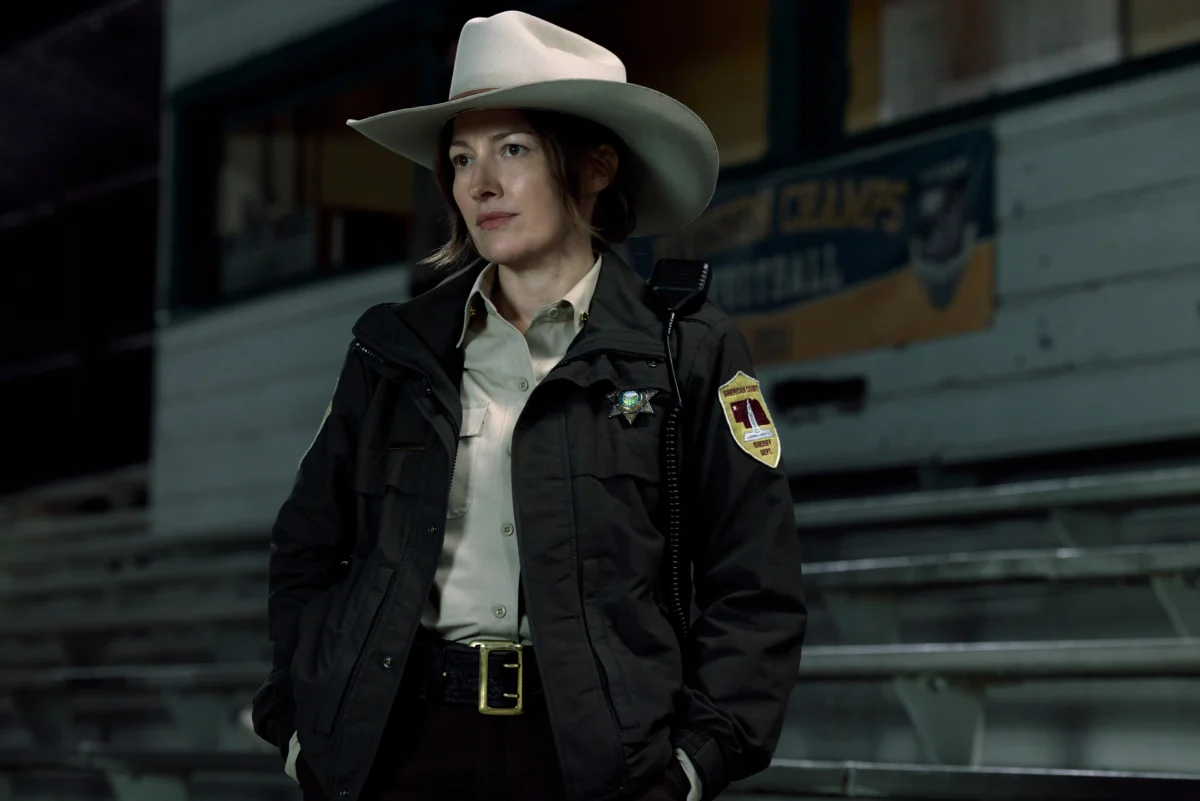
The finale’s revelation was both shocking and deeply personal: the killer was Kerry Kane (Kelly Macdonald). The motive was not one of cosmic conquest or intergalactic warfare, but a desperate, human act of protection. Kane killed Jordan to keep a harrowing secret buried: her son, Noah (Shea Pritchard), is a Manhunter—a sentient, ancient weapon of the Guardians.
This revelation serves as the cornerstone of the show’s thematic depth. Throughout the series, the audience watched as John Stewart navigated the tension between his military background and his new, cosmic responsibilities. His choice to spare Noah, despite the inherent danger the young Manhunter represents, marks a departure from the "pre-emptive strike" mentality often associated with the Corps. Stewart is gambling on the idea that nurture can overcome nature, and his decision to keep the secret of Noah’s identity suggests a hero who values individual justice over rigid, institutional dogma.

Official Perspectives: The Philosophy of the Showrunners
Co-creator and co-showrunner Chris Mundy, alongside collaborators Damon Lindelof and Tom King, faced the daunting task of reintroducing the Green Lantern mythos within the framework of James Gunn’s new DC Universe.
"His path to the ring wasn’t a path that anyone had ever taken before," Mundy explained in an interview with Gold Derby. "One, he interviewed for the job. The ring didn’t choose him, the Guardians did. Another is the relationship he is forging right now: ‘I’m down here, I’m part of this, but I’m also my own free agent as well.’"
Mundy notes that the creation of a new oath was essential to defining Stewart’s independence. "There’s something about oaths that are very much pledging allegiance to the main organization or state or whatever it is. It felt like, because of his independent path and independent reality, he could and should create his own. We stuck close to the original, but we wanted to personalize it."

Regarding the coexistence of two Green Lanterns on Earth—Stewart and the established Guy Gardner (Nathan Fillion)—Mundy emphasized that the tension was intentional. "We knew we needed to land an explanation for why Guy is the current Green Lantern. We liked the idea that they could coexist, and we liked the idea that there would be a tension within it. It felt like a very natural landing place for us."
Implications for the Future: A Universe Expanded
While a second season of Lanterns has yet to be officially greenlit, the finale has successfully planted the seeds for a vast, interconnected future. The immediate horizon for Aaron Pierre’s John Stewart is his appearance in the 2025 Superman sequel, Man of Tomorrow. This cross-pollination of characters confirms that Lanterns is not an isolated experiment but a foundational pillar of the broader DC Universe.
Beyond the immediate future of the protagonists, the finale left several tantalizing threads dangling for potential sequels:

- The Rise of Sinestro: Perhaps the most significant narrative thread is the status of Sinestro (Ulrich Thomsen). Currently free from the Guardians’ prison, Sinestro has begun the process of forging his own lanterns. While he has not yet debuted his iconic yellow ring, the show has effectively set the stage for the formation of the Sinestro Corps—a direct, ideological, and physical threat to the Green Lanterns.
- The Manhunter Dilemma: With Noah, the young Manhunter, still at large, the show has established a "nature vs. nurture" conflict that could span multiple seasons. As Mundy noted, "Noah becomes the perfect test case. John’s going to gamble that programming isn’t everything, but he’s going to be there to keep people safe if he’s wrong."
- Institutional Friction: The dynamic between Stewart and his superiors is set to evolve. As an independent agent operating within a corporate-like hierarchy, Stewart will inevitably clash with the Guardians. This "boss vs. employee" tension, as described by Mundy, provides a grounded, relatable conflict that balances the show’s high-concept sci-fi elements.
Bridging the Divide: A Critical and Cultural Success
Perhaps the most significant achievement of Lanterns is its ability to bridge the gap between two distinct audiences: the hardcore comic book devotees and the general television audience.
For the former, the show rewards their loyalty with deep-cut lore, from the inclusion of the Manhunters to the looming threat of the Sinestro Corps. For the latter, the show provides a compelling character study, utilizing the "cranky veteran vs. young rookie" tropes of classic buddy-cop dramas to ground the alien spectacle in recognizable human emotion.
"I think I can speak for all of us in the writer’s room that we wanted the people who know and care about Green Lantern to feel like we care and we’re taking good care of it," Mundy said. "But we also wanted people that don’t know comic book shows in general… to be able to enter the show and enjoy the humanity of it. Those are two groups that don’t always watch the same shows. And the fact that people on both sides of that fence seem to like it makes me really happy."

As the dust settles on the first season, Lanterns stands as a testament to the power of thoughtful adaptation. By prioritizing character over spectacle, and nuance over generic superhero tropes, the series has moved beyond the shadow of past failures. John Stewart is no longer just a man with a ring; he is a man with a mission—and for the first time in a long time, the audience is eager to see where that light leads.
 Laily UPN
 Nana
Nana
 Nana Wu
