

How do you recommend a porn theater to a friend? The question itself feels like a social minefield. It is not exactly the kind of invitation one casually tosses out over brunch. For Steve Koltai, the proprietor of Montreal’s historic Cinéma L’Amour, the answer is a lesson in distinguishing between convenience and experience.
“You want to watch the newest movie out there? Watch it on your cell phone. That’s not my business anymore,” Koltai told IndieWire. “My business is giving you social interaction, fulfilling a fantasy.”
In an era where adult content is ubiquitous, free, and accessible with a single tap, a brick-and-mortar theater specializing in pornography should, by all traditional economic logic, be an extinct species. Yet, Cinéma L’Amour persists. It remains a fixture of Montreal’s cultural landscape—a place where the velvet is worn, the lighting is perpetually crimson, and the atmosphere is thick with a history that defies easy categorization.
A Legacy Etched in Velvet and Celluloid
To step into Cinéma L’Amour is to step into a time capsule. Originally opened as "The Globe" in 1914, the building began its life serving the city’s vibrant Jewish community, offering a mix of live entertainment and early cinema. By the 1920s and 30s, it had become a hub for Yiddish films. However, as the decades shifted, so did the neighborhood and the venue’s identity.

Renamed "The Hollywood" in 1932, the theater eventually pivoted to adult programming in 1969, rebranding as "The Pussycat." Despite the radical change in content, the architecture remained remarkably intact. The picturesque horseshoe balcony and the ornate, gilded interior survived the transition, lending the venue an air of unintended regality that creates a surreal juxtaposition with the films projected on the screen.
When the Koltai family assumed ownership in 1981, they weren’t just buying a theater; they were inheriting a legacy of the erotic exhibition business. Steve’s father, Ivan, had cut his teeth in the industry by distributing adult films throughout the 1970s. He eventually expanded into exhibition, opening a sister theater in Hull, Quebec, located about two and a half hours away.
Steve Koltai recalls his youth, watching his father navigate the industry. In those days, the adult cinema was a destination, not a den of anonymity. “The mom and dad and the adults would dress up like they’re going for dinner, but they’re coming to watch a movie,” he recalls. Patrons arrived for 7:00 or 9:00 p.m. shows, treating the outing with the same social gravity as a night at the opera.
Beyond the Screen: A Multifaceted Social Hub
While the theater still screens a rotating weekly program of adult films, the business model has evolved to survive the digital age. Cinéma L’Amour is no longer just a place to watch movies; it is a community space.

During the summer, the theater finds itself in the orbit of the Fantasia International Film Festival. It plays host to raves, concerts, and diverse community events. The programming is inclusive, featuring specific nights for the lesbian and trans communities, as well as recurring rentals by local feminist organizations.
One staff member, describing the peculiar alchemy of the clientele, noted that the mix of older, long-time patrons and artsy, younger employees creates a vibe that is “half Cheers, half Cruising.” This, perhaps, is the key to its survival. The theater has ceased to be a venue for solitary consumption and has instead become a public space for private exploration.
The venue enforces a strict code of conduct—clearly posted in both English and French—which centers on consent. The rules are blunt: “No means no—and silence also means no.” While Koltai acknowledges that it is impossible for staff to monitor every encounter in the dark, the existence of the policy reflects a modern attempt to reconcile a traditional adult space with contemporary standards of safety and agency.
The Merchandise Phenomenon
Perhaps the most unexpected element of Cinéma L’Amour’s modern iteration is its booming retail arm. "I’d say a majority of the people that buy our merchandise have never been here," a tour guide noted during the 30th annual Fantasia Festival.

The theater’s branding has transcended its niche origins. When celebrities like Dakota Johnson are photographed wearing the theater’s gear, it signals a shift in the brand’s value. It has become a piece of "cool" Montreal lore.
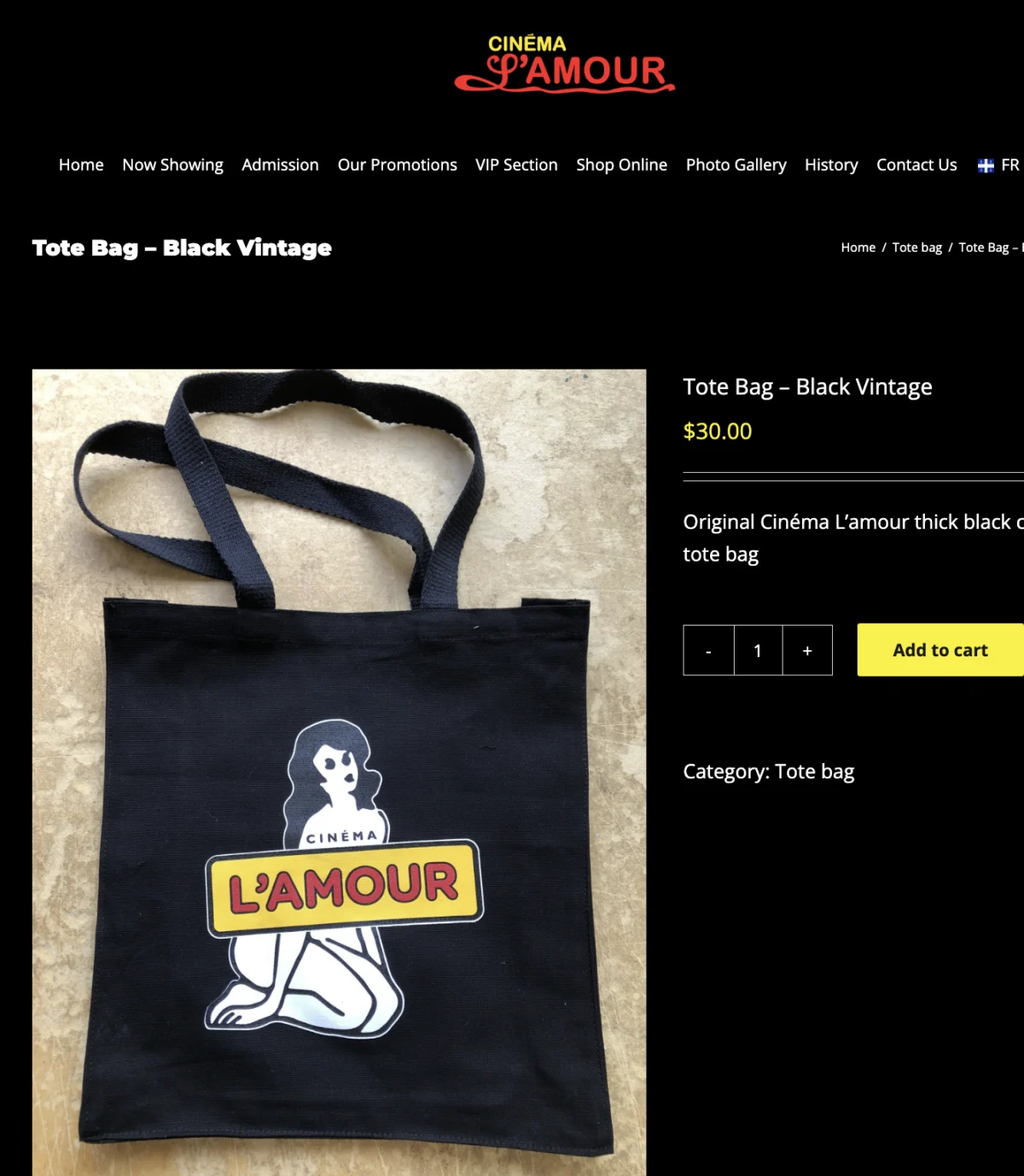
Koltai admits he was initially skeptical when his son, Devyn, suggested they start selling tote bags. “We sold thousands, thousands of tote bags,” he said, laughing at his own lack of foresight. “I didn’t realize how important tote bags were.”
The merchandise operation now ships globally—to France, Japan, Australia, and the U.S. While international trade, including U.S. tariffs, has presented logistical hurdles, the business continues to hum. For Koltai, the most meaningful item is a ringer tee, a recreation of one his late mother wore in the 1970s. It serves as a personal bridge between the past and the present.
Economic Realities and the "Survival" Strategy
The theater survives largely because the family owns the building. Beyond the screen and the merchandise, the property accommodates short-term rentals, and the staff functions as a multi-purpose team—handling everything from laundry and maintenance to customer service.

“It’s only because we own the building that we’re able to survive,” Koltai explains. This vertical integration of the business is the only reason the theater remains viable. The competition is no longer other theaters; the competition is a smartphone, and you cannot compete with a smartphone on price or convenience. You can only compete by offering a tangible, physical experience that cannot be downloaded.
However, the internal succession of the business remains a question mark. Steve’s son, Devyn, who was instrumental in the merchandise pivot, left the business six months prior to the interview. Steve now relies on a small, dedicated team, but he admits to feeling "consumed" by the workload.
“Actually, I want to slowly fade out of it,” he says. “I’m consumed by it because we’re busy—our merchandising is busy, our short-term rentals are busy.”
The Future of an Anachronism
What happens to a theater that defies time? There are no immediate plans to close, but the weight of the project is clear. As long as it is “feasible,” Koltai intends to keep the doors open. He views the preservation of the space not just as a business, but as an act of cultural maintenance.

Nicolas Archambault, director of Asian programming for Fantasia, views the theater as a natural extension of Montreal’s unique spirit. “I think it’s been acquired without us knowing it because we’re a land of immigration,” he said. The city’s residents are accustomed to living among disparate cultures—where Caribbean music, classic rock, and experimental art coexist on the same street. In such a landscape, a historic porn theater isn’t an anomaly; it’s just another facet of the urban fabric.
For the patrons, the experience remains a compelling mystery. Two attendees who visited during the Fantasia festival shared their experience on the condition of anonymity. The husband was driven by a curiosity about vintage cinema; the wife by the "charming, seedy" reputation of the place.
After a briefing from the staff, they found themselves in the couples’ balcony. “Something about the charmingly seedy red-lit environment just brought it out in me,” she reflected. While the husband was disappointed by the quality of the film—describing it as "basic contemporary pornography"—the experience of the venue itself remained a highlight of their trip. They bought the merchandise, they enjoyed the atmosphere, and they said they would return.
As the industry continues to move toward the ephemeral and the digital, Cinéma L’Amour stands as a stubborn, crimson-hued monument to the tactile. It is a place that asks for your presence, not just your attention. And as Steve Koltai prepares for a future where he might finally step away, he offers one final instruction for those trying to understand the theater’s enduring appeal:

“Just keep a little bit of a mystery, OK?”
 Iffa Jayyana
 Asro
Asro
