

Editor’s Note: The following article contains major spoilers for the Season 1 finale of HBO’s “Lanterns.”
In an era defined by sky-darkening portals, relentless CGI spectacles, and the formulaic ticking clock of world-ending threats, HBO’s Lanterns chose a different path. The series finale, which concluded its eight-episode run with a quiet, introspective resolution, opted to trade the customary laser-light shows and cosmic brawls for something far more potent: character catharsis.
Rather than culminating in a climactic battle between super-powered entities, the finale of Lanterns focused on the internal evolution of its lead, John Stewart (Aaron Pierre). After successfully solving the murder of his mentor and predecessor, Hal Jordan (Kyle Chandler), Stewart did not simply don a mask to fight crime; he claimed a legacy on his own terms. By the final frame, the series had successfully pivoted from a traditional superhero procedural into a profound meditation on grief, autonomy, and the weight of institutional expectation.
The Shift from Spectacle to Sentiment
For many viewers, the finale’s lack of reliance on the iconic Green Lantern ring—a device capable of manifesting anything the user can imagine—served as a point of contention. However, for showrunners Chris Mundy, Damon Lindelof, and Tom King, the decision was a deliberate rejection of “incident” in favor of “emotion.”
“This story was always about these two guys,” Mundy explained during a recent panel discussion featuring stars Kyle Chandler and Aaron Pierre. “We knew that if we landed it emotionally with them, we would have done our job. We barely even talked about the lack of big action set-pieces because we all just knew this is what we were going for—that a bombastic ending would have been a distraction.”

The showrunners were quick to point out that the series did not lack for action; it simply chose to utilize it as a vessel for character development rather than mere visual filler. They pointed to the visceral, grounded brawl between Hal and John in Episode 5 as the template for how the show handles conflict. “What I love about that huge fistfight is that it’s technically a massive sequence, but it’s still just two guys working through their issues,” Mundy noted. “The finale needed to be an even quieter connection.”
A Departure from Cinematic Norms
The criticism leveled at Lanterns regarding its restrained use of the ring highlights a recurring tension in modern superhero storytelling. In the 2011 Green Lantern film, the reliance on the ring to generate swords, ships, and masks was widely perceived as a crutch—an attempt to mask a lack of narrative depth with digital pyrotechnics.
Damon Lindelof, a veteran of long-form television, argued that the medium of TV provides a unique luxury that films lack: time. “If we had to make a two-hour Lanterns movie about this meeting between John and Hal, you would have been forced to dedicate the third act to a massive, bombastic set-piece, leaving you with maybe two or three minutes of coda for the emotional payoff,” Lindelof said. “We got to stretch that emotional arc over the course of three episodes. It was incredibly liberating to know we didn’t have to prioritize the spectacle.”
The “Hal-o-gram” and the Human Factor
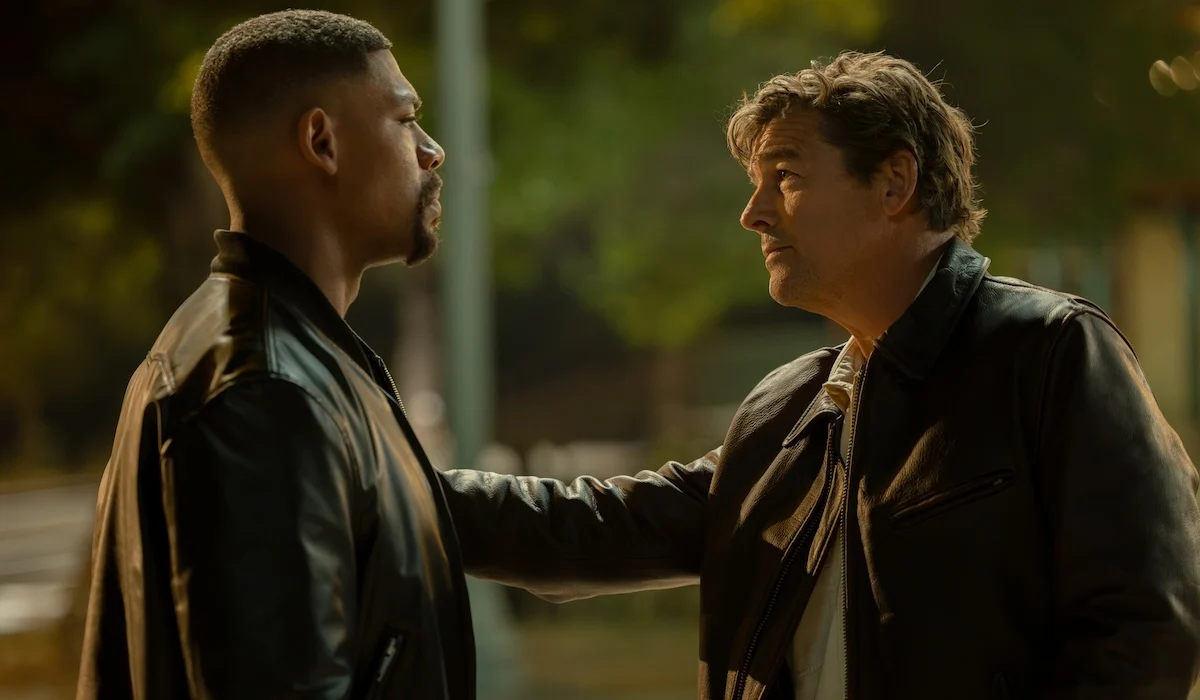
The emotional centerpiece of the finale is the final interaction between John and the "Hal-o-gram"—a digital, sentient echo of the late Hal Jordan. What begins as a playful, characteristically prickly exchange between the two men culminates in a vulnerable, raw, and deeply human moment: an admission of love.
For Kyle Chandler, who played the mentor figure with a grit that masked a buried heart, the moment was transformative. “Maybe in a film from the 50s or 60s, you’d have a stoic archetype like The Duke just refusing to say those words,” Chandler remarked. “But these were words that were actually expressed. It was painfully exposed.”

The chemistry between Chandler and Pierre served as the anchor for the entire season. Despite the volatile and tumultuous nature of their characters’ relationship, the actors found the moments of stillness to be the most rewarding. Pierre, reflecting on the finale, hinted at the weight of their final scene together. “Kyle believes he made me cry on that day, and I think I made him cry,” Pierre said. “It was moving for us as the characters, but also as individuals playing those characters.”
Forging a New Oath
Perhaps the most controversial and significant narrative choice in the finale was John Stewart’s decision to author his own oath. In the lore of the Green Lantern Corps, the oath is a sacred, immutable text. By having John deviate from the traditional words, the creators signaled a definitive break from the rigid structures of the past.
“Of course, we were crazily nervous,” admitted Mundy. The writing team, led by contributors like Justin Britt-Gibson, treated the oath not as a replacement, but as a “remix”—a way to ground the character in his own personal journey rather than the expectations of an alien organization.
Lindelof emphasized that for John Stewart, an ex-military man who has spent his life fulfilling the expectations of others, the act of writing his own oath was a necessary step toward self-actualization. “When you watch the totality of John’s story, it’s hard to say he is in total alignment with the Green Lantern Corps or the Guardians,” Lindelof noted. “He has pledged his loyalty to the military and his parents for his entire life. To become the hero he needs to be, he has to move beyond those organizations. His oath had to be on his own terms.”
The Burden of Risk
The creative team acknowledged that these bold choices—minimizing the ring, focusing on dialogue over destruction, and rewriting the sacred oath—are likely to divide the fandom. However, they maintain that these risks were essential to the show’s integrity.

“We started to say, ‘If we’re not afraid of doing an idea, then we probably shouldn’t do it,’” Lindelof stated. “We have the baton for this period of time. You can’t take a risk for risk’s sake; it has to be earned by the character. It felt like it was the right thing to do, even if it’s the thing that divides the audience.”
Implications for the Future of the Franchise
As of now, HBO has not officially announced a second season for Lanterns. However, the finale has effectively reset the status quo for the character of John Stewart. By ending the season with Stewart embracing his own path, the series has moved away from the "trainee" narrative that often defines superhero origin stories and into a more complex, mature space.
The series has proven that, in the right hands, superhero stories do not need to be slaves to their source material’s most bombastic elements. Instead, by focusing on the "human factor," Lanterns has successfully bridged the gap between genre fiction and high-concept drama. Whether or not the story continues, the first season stands as a testament to the idea that a hero’s greatest power is not the ring on their finger, but the strength of their own conviction.
“Lanterns” is currently available to stream on HBO and Max.
 Iffa Jayyana
 Asro
Asro
