

New York — To navigate the weekend throngs at the Metropolitan Museum of Art is often to mistake endurance for enlightenment. Yet, tucked away in a somewhat labyrinthine section of the museum’s second-floor galleries, visitors are currently encountering an exhibition that demands a quiet, almost reverent pause.
Krasner and Pollock: Past Continuous, a masterclass in exhibition design and art-historical re-evaluation, places the turbulent, intertwined lives and practices of Lee Krasner and Jackson Pollock under a brilliant, uncompromising lens. Curated and orchestrated with a striking lack of fussiness, the show avoids heavy-handed didacticism, allowing the volatile subtext of their legendary relationship—and the staggering genius of Krasner’s output—to sit quietly and neatly on the surface.
Main Facts: A Breathtaking Upending of Art History
At its core, Past Continuous is not merely another dual-artist showcase intended to cash in on mid-century nostalgia. It is a calculated, breathtaking upending of the patriarchal narratives that long relegated Lee Krasner to the footnotes of Abstract Expressionism as merely the long-suffering wife, manager, and caretaker to America’s most volatile artistic icon.
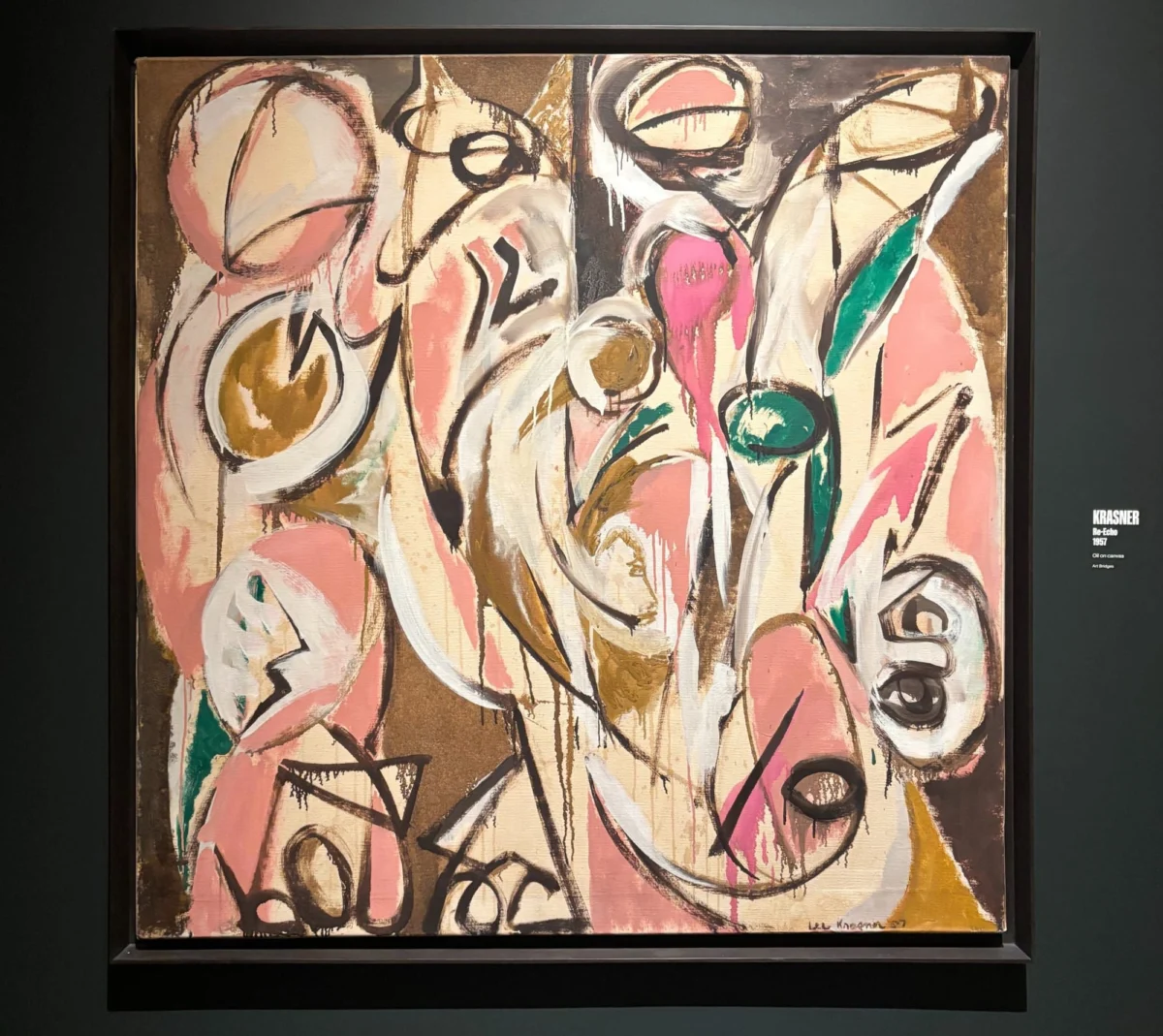
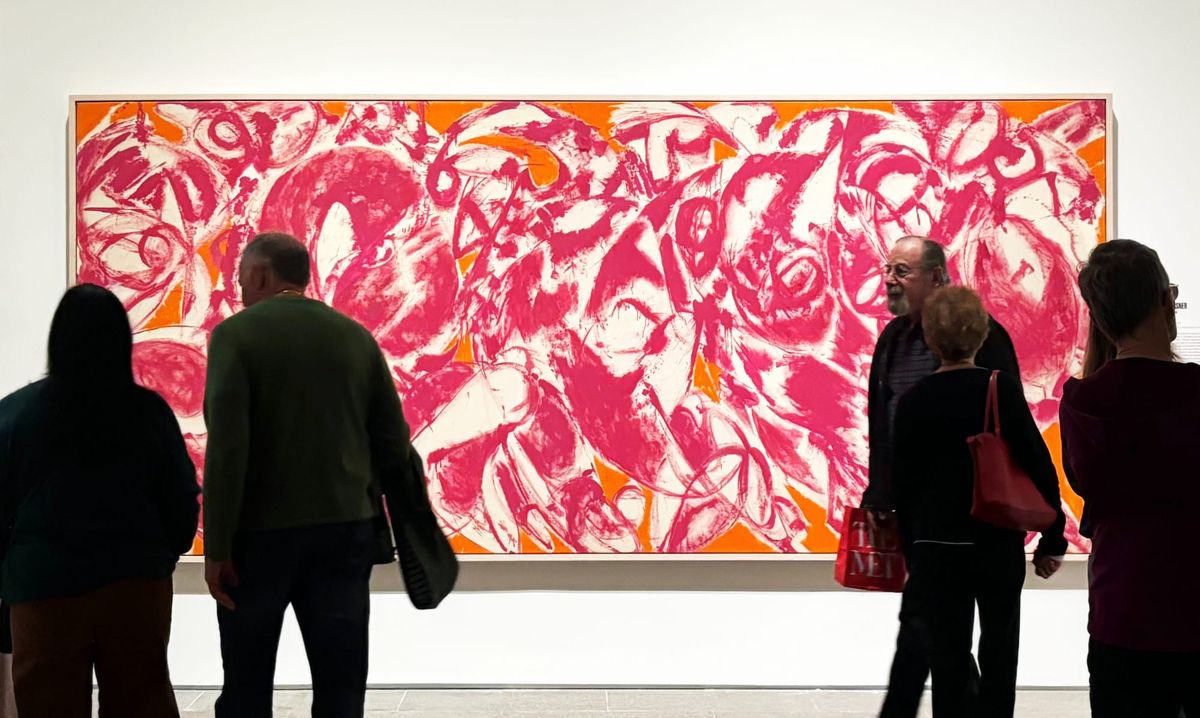
The exhibition features masterworks such as Krasner’s 1965 oil-on-canvas Combat and her 1957 canvas Re-Echo, juxtaposed against Pollock’s iconic drip paintings and lesser-known experiments. Yet, the curatorial brilliance lies in how the space resists forcing a direct, competitive dialogue between the two. Instead, it presents them as two distinct minds operating within overlapping orbits of brilliance, trauma, and survival.
The underlying tension of the galleries is palpable. While the exhibition’s title hints at the restorative, continuous power of memory and artistic evolution, viewers walk in chasing a different, more visceral inquiry: the mechanics of an impossible marriage, the shadow of sudden tragedy, and, above all, the indomitable survival of a female artist operating at the height of misogynistic exclusion.
Chronology: From the Long Island Cottage to the Met Galleries
To understand the weight of Past Continuous, one must map the timeline of the Krasner-Pollock phenomenon, a narrative defined as much by geography and tragedy as by canvas and pigment.
- 1940s: Lee Krasner, already an accomplished artist steeped in Hans Hofmann’s rigorous modernist teachings, meets Jackson Pollock. Recognizing his staggering, untamed talent, she becomes instrumental in shaping his career, introducing him to key dealers like Peggy Guggenheim and steering his chaotic energies toward the canvases that would revolutionize American art.
- October 1945: Krasner and Pollock marry, subsequently moving out of New York City to a modest, wooden farmhouse and barn in Springs, East Hampton, Long Island—a landscape that would profoundly influence both of their palettes.
- August 11, 1956: The trajectory of American art is irrevocably fractured. Driving under the influence, Pollock crashes his convertible into a tree in Springs. He is killed instantly, along with passenger Edith Metzger. Another passenger, Ruth Kligman, survives.
- Post-1956: Krasner, thrust into sudden widowhood and staggering grief, inherits the complex burden of managing Pollock’s estate while reclaiming her own studio practice. Rather than collapsing, she enters some of the most prolific and innovative periods of her career, notably her Night Journeys and subsequent large-scale abstractions.
- Present Day: The Metropolitan Museum of Art opens Krasner and Pollock: Past Continuous, offering contemporary audiences a synthesized view of their parallel trajectories, decades after their deaths.
Supporting Data: The Architecture of Memory and Misogyny
The journey through Past Continuous begins long before viewers encounter the paintings. Entering the gallery requires passing through a narrow, dimly lit transitional hallway. Here, a silent, hypnotic video installation loops collaged film footage and photographic stills documenting the couple’s Long Island cottage, their paint-splattered hands, and the verdant, marshy environs of Springs.
This atmospheric threshold sets a deeply personal, almost dreamy tone—one that is occasionally punctured by the persistent realities of public reception. As observed by critics traversing the galleries, the ghosts of mid-century sexism remain remarkably active among contemporary museumgoers. It is not uncommon to overhear whispers dissecting Krasner’s physical appearance or marital status, demonstrating that even within the hallowed halls of a major encyclopedic institution, the female artist’s body and worth are still routinely subjected to external policing.
Statistically and critically, retrospectives dedicated to Krasner have steadily dismantled the mid-20th-century myth that Pollock worked in a vacuum. Her mastery of scale, her radical shifts in technique—from the tight, rhythmic "Little Image" paintings of the late 1940s to the explosive, gestural works born out of grief—demonstrate an artist whose technical rigor often surpassed that of her husband.
Official Responses and Curatorial Intent
Representatives and curators at The Met have emphasized that Past Continuous was designed to step away from the sensationalist tabloid history that has long clouded public perception of the couple.

"We are not interested in sensationalizing the crash or reducing their union to a soap opera," a museum spokesperson noted regarding the exhibition’s conceptual framework. "The focus is strictly on the formal and psychological continuities between their practices—how they borrowed from, challenged, and sustained one another during periods of immense creative pressure."
Art historians have similarly praised the exhibition for refusing to frame Krasner solely through the lens of victimization. While Pollock’s battles with severe alcoholism and infidelity are well-documented historical facts, the museum’s wall texts and layout deliberately pivot the narrative toward agency. Krasner’s decision to take over Pollock’s studio after his death—using his former workspace to create her own massive canvases—is highlighted not as an act of mourning, but as an assertion of artistic dominance.
Implications: Rewriting the Canon for the 21st Century
The implications of Past Continuous extend far beyond the walls of the Metropolitan Museum of Art. For decades, the canon of Abstract Expressionism was taught as a fraternity of hard-drinking, mythic men whose genius existed independently of domestic support systems.
Exhibitions like this one dismantle that falsehood piece by piece. By displaying Krasner’s monumental works with the same curatorial reverence historically reserved for Pollock, Rothko, or de Kooning, The Met reinforces a necessary correction in art history: acknowledging that the vanguard of American modernism was co-authored, negotiated, and, in many ways, sustained by women.
Ultimately, Past Continuous forces viewers to confront their own voyeurism. We may arrive at the gallery looking for the echoes of a tragic marriage, the smoke of a 1956 car crash, or the whispers of a complicated domestic power dynamic. But we leave confronting something far more enduring: the resilient, unyielding brilliance of an artist who outlived her myth to paint on her own terms.
 Muslim
 Dwi Wanna
 Asro
Asro
