

By Global News Desk
October 6, 2026
Main Facts
Grammy Award-winning pop superstar Olivia Rodrigo has ignited a fierce national conversation regarding institutional accountability following a scathing public statement targeting Cornell University. Taking to Instagram on October 4, 2026, the singer-songwriter threw her immense platform behind a survivor identified in court documents only as “Jane Doe,” who is currently at the center of a high-profile civil lawsuit and a state-level criminal investigation involving allegations of drugging and gang rape.
The legal battle stems from an incident in October 2024, when Jane Doe was allegedly drugged and assaulted by multiple members of Cornell University’s Chi Phi fraternity. The case has since expanded far beyond the university’s Ithaca, New York campus, transforming into a lightning rod for broader systemic criticisms regarding how elite higher-education institutions handle campus sexual violence, protect fraternities, and fail vulnerable students.
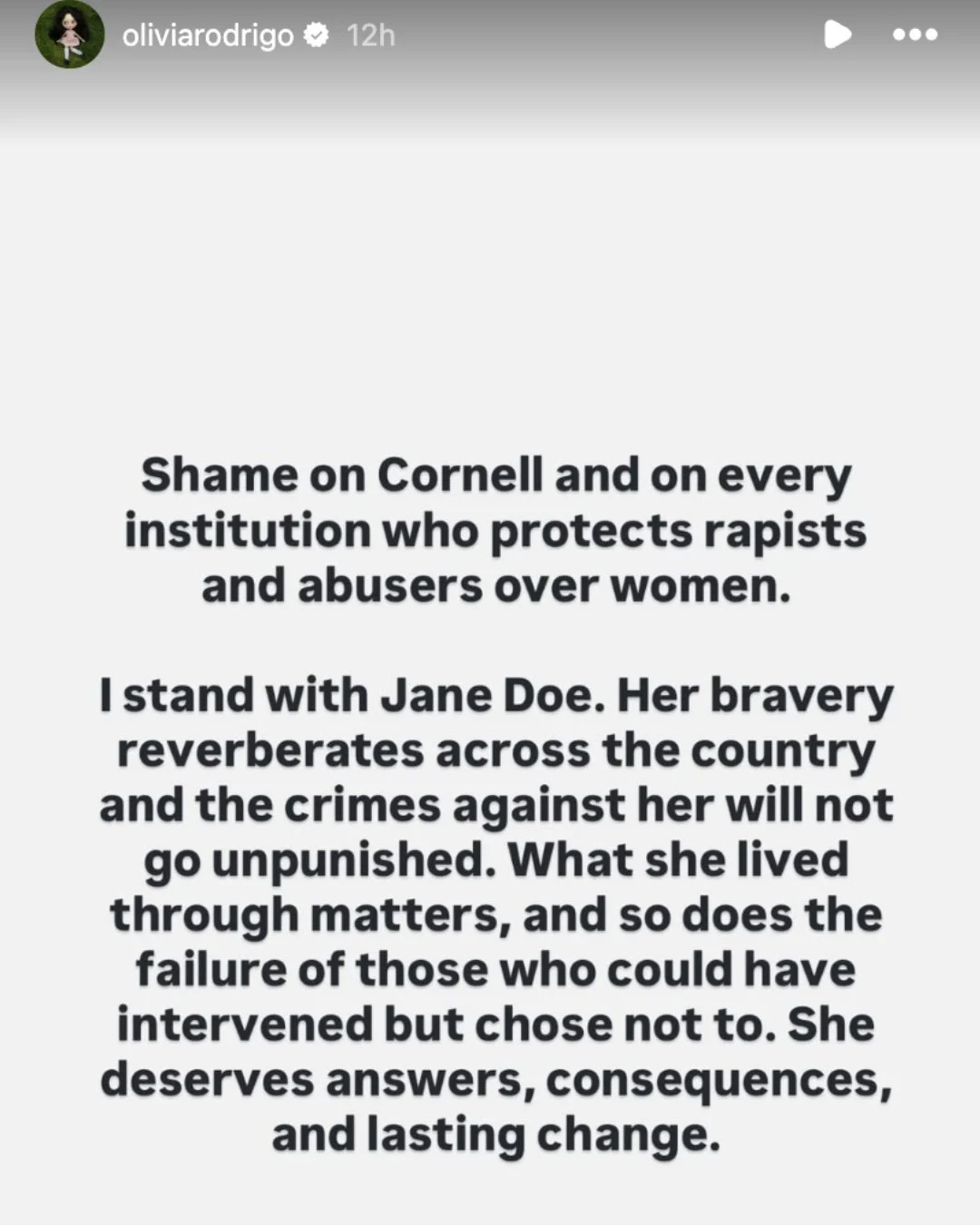
“Shame on Cornell and on every institution who protects rapists and abusers over women,” Rodrigo wrote in her widely shared Instagram story. “I stand with Jane Doe. Her bravery reverberates across the country and the crimes against her will not go unpunished. What she lived through matters, and so does the failure of those who could have intervened but chose not to. She deserves answers, consequences, and lasting change.”
Rodrigo’s uncompromising condemnation marks a significant escalation in the cultural fallout surrounding the case. As public pressure mounts, New York Attorney General Letitia James has stepped in, leading an independent criminal investigation into the allegations against the fraternity members and evaluating the university’s institutional response.
Chronology of Events
To fully understand the weight of Olivia Rodrigo’s intervention and the trajectory of the Cornell sexual assault scandal, it is essential to trace the timeline of events from the alleged crime to the current legal and cultural showdown.
October 2024: The Alleged Incident
According to court filings submitted nearly a year later, the survivor, Jane Doe, attended a gathering hosted by Cornell University’s Chi Phi fraternity. During the event, she was allegedly given a substance without her consent, rendering her incapacitated. Multiple members of the fraternity are accused of subsequently sexually assaulting her. In the immediate aftermath, the alleged victim faced significant barriers in securing institutional support, prompting her to seek external legal and advocacy assistance.
September 2026: The Lawsuit and State Intervention
The case burst into the national spotlight in September 2026 when Jane Doe officially filed a civil lawsuit in federal court. The legal action named specific members of the Chi Phi fraternity as defendants and explicitly implicated Cornell University for negligence, creating an unsafe campus environment, and failing to enforce Title IX protections adequately.
Almost concurrently, New York Attorney General Letitia James announced that her office was launching an active criminal investigation into the allegations. The involvement of the state’s top prosecutor signaled to the public that the case would not be quietly handled by internal university disciplinary boards, setting the stage for a much larger legal reckoning.
Early October 2026: The Cultural Backlash and Artist Mobilization
As details of the lawsuit circulated, public outrage grew across social media, eventually drawing the attention of prominent figures within the entertainment industry. On October 4, 2026, Halestorm frontwoman Lzzy Hale published a blistering commentary on Instagram. While Hale did not explicitly name Cornell University in her post, her powerful words left no doubt about her subject matter.
“If you are the kind of man who thinks it’s ok to reduce another human being to nothing more than something you can stick your d*ck into… there is something severely wrong with you,” Hale wrote, condemning the culture of toxic masculinity and institutional protectionism.
Hours later, Olivia Rodrigo amplified the movement by directly naming Cornell University and expressing solidarity with Jane Doe. Rodrigo’s post instantly galvanized her millions of followers, turning a regional campus lawsuit into an international discussion point on systemic misogyny.

Supporting Data and Context
The outcry surrounding the Cornell case is underscored by sobering statistics regarding sexual assault on college campuses across the United States. According to data compiled by organizations like the Rape, Abuse & Incest National Network (RAINN), undergraduate women aged 18 to 24 face a significantly higher risk of experiencing sexual violence compared to their non-student peers. Furthermore, studies consistently show that fraternity members are disproportionately implicated in campus sexual assault allegations relative to the general student population.
Despite these persistent trends, institutional transparency and accountability remain notoriously low. Title IX offices and university administrations have frequently faced criticism from student advocates, legal experts, and survivors for prioritizing institutional reputation, donor relations, and Greek life revenue over the safety and justice of students.
The Cornell University Chi Phi case sits precisely at the intersection of these systemic failures. The civil lawsuit contends that warning signs regarding the fraternity’s behavior were ignored by university officials long before the October 2024 assault took place. By focusing on both the direct perpetrators and the administrative enablers, the lawsuit challenges the traditional playbook that universities use to insulate themselves from liability.
Official Responses and Institutional Silence
As of mid-October 2026, the official response from Cornell University’s administration has been heavily scrutinized. While standard university statements issued in the wake of the lawsuit’s filing emphasized a commitment to student safety and cooperation with law enforcement, critics argue that these boilerplate declarations ring hollow in light of the severe institutional negligence alleged by Jane Doe.
The Chi Phi national organization and the local Cornell chapter have faced immense pressure, with temporary suspensions and internal reviews initiated across various Greek life governing bodies. However, student activists on the Ithaca campus argue that piecemeal disciplinary actions are insufficient to address a culture that has tolerated predatory behavior for years.
Meanwhile, Attorney General Letitia James’s office has remained steadfast in its investigation. Investigators are reportedly examining electronic communications, security footage, and internal university records to determine whether administrative staff were aware of dangerous conditions at the fraternity house and failed to intervene. Legal analysts suggest that the Attorney General’s involvement could lead to sweeping criminal charges and unprecedented civil penalties for the university if systemic cover-ups are proven.
Implications for Campus Safety, Greek Life, and Music Activism
The repercussions of the Cornell University sexual assault case—amplified by the vocal support of artists like Olivia Rodrigo and Lzzy Hale—extend far beyond the confines of a single Ivy League campus. The unfolding events carry profound implications across multiple spheres:
1. A Reckoning for Greek Life
Universities nationwide are closely monitoring the legal proceedings at Cornell. The prospect of criminal liability for institutions and civil liability for fraternities could fundamentally alter the landscape of Greek life in American higher education. Institutions that have long turned a blind eye to dangerous hazing, illicit substance use, and sexual misconduct within fraternities may now be forced to enact zero-tolerance policies or risk total dissolution of Greek chapters.
2. The Power of Celebrity Advocacy
Olivia Rodrigo’s intervention highlights the evolving role of pop stars as active participants in social justice movements. Rodrigo has consistently leveraged her massive platform to champion progressive causes. Earlier this year, her all-women lineup festival, Daisy Chain Fields, successfully raised $20 million dedicated to supporting reproductive rights, healthcare access, and combating gender-based violence.
By utilizing her Instagram presence—which reaches tens of millions of impressionable young fans—to spotlight Jane Doe’s case, Rodrigo ensures that institutional gatekeepers cannot quietly sweep the scandal under the rug. Her advocacy bridges the gap between grassroots survivor networks and mainstream popular culture, keeping public pressure squarely fixed on Cornell University.
3. Raising the Standard for Institutional Accountability
The legal and public relations nightmare currently facing Cornell serves as a cautionary tale for universities across the globe. The days of relying on internal arbitration, mandatory non-disclosure agreements, and reputational damage control to silence survivors are facing an unprecedented challenge. With state attorneys general taking aggressive action and cultural icons demanding radical transparency, the standard for how institutions must protect and serve their student bodies is being forcefully rewritten.
As Olivia Rodrigo continues her sprawling international trek, “The Unraveled Tour”—with upcoming dates at Charlotte’s Spectrum Center and performances scheduled through February—her message remains a driving force in the cultural zeitgeist. For Jane Doe and survivors of campus sexual violence everywhere, the chorus of condemnation led by Rodrigo, Hale, and countless advocates signals that the demand for accountability is no longer just a campus issue—it is a national mandate.
 Laily UPN
 Ali Ikhwan
 rifanmuazin
