

By News Desk
October 5, 2026
The World Food Programme (WFP) has issued a scathing condemnation following a lethal aerial assault on a humanitarian convoy in South Kordofan, Sudan, this past weekend. The attack, which claimed the life of a commercial driver, represents a grave escalation in the peril faced by aid organizations operating within the conflict-torn nation. As Sudan continues to grapple with a protracted civil war that has displaced millions, the targeting of clearly marked humanitarian vehicles signals a deteriorating security environment that threatens to paralyze life-saving operations across the region.
The Incident: A Breach of Humanitarian Protection
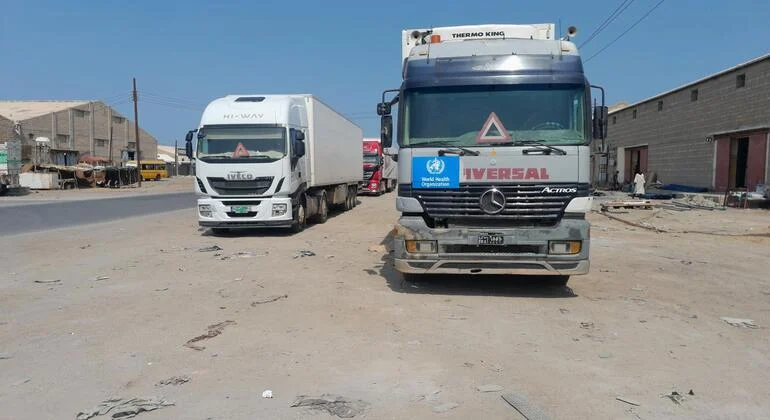
The strike occurred early Saturday morning as two contracted trucks, laden with essential WFP food commodities, navigated the route between the cities of Dilling and Kadugli. Despite being explicitly and clearly marked as humanitarian vehicles—a designation intended to grant them immunity under international law—the trucks were targeted in an aerial bombardment.
The immediate casualty of this strike was the driver of one of the vehicles, who perished at the scene. While the WFP has confirmed the fatality, the agency noted that assessment teams are still working to determine the full extent of the damage to the food cargo. In a region where every metric ton of food is critical to preventing mass starvation, the destruction of these supplies represents a dual tragedy: the loss of human life and the loss of essential provisions for a starving population.
This incident did not occur in isolation. It followed a separate, alarming security failure just 24 hours prior, when a WFP truck struck an explosive device in the vicinity of Dilling immediately after completing a food delivery mission. Together, these events paint a grim picture of the operational landscape in South Kordofan, where the delivery of humanitarian aid has become a high-stakes gamble with life.
Chronology of Escalating Hostilities
To understand the severity of the recent attack, one must look at the broader timeline of the Sudanese conflict and the mounting threats to aid corridors:
- April 2023: The conflict between the Sudanese Armed Forces (SAF) and the Rapid Support Forces (RSF) erupts in Khartoum, rapidly spreading across the country and triggering a massive humanitarian crisis.
- Late 2025: As the conflict enters its third year, humanitarian agencies report increasing difficulty in securing safe passage for aid convoys due to the proliferation of checkpoints, artillery fire, and aerial maneuvers.
- October 4, 2026: A WFP truck is disabled after striking an explosive device near Dilling, South Kordofan, while returning from a successful delivery operation.
- October 5, 2026: Early Saturday morning, a deliberate aerial attack strikes two WFP-contracted trucks traveling between Dilling and Kadugli, resulting in the death of a driver.
- Post-Attack: The WFP officially condemns the violence, calls for an impartial investigation, and demands immediate accountability from the warring parties.
The Humanitarian Landscape: Supporting Data
The urgency of the situation in Sudan cannot be overstated. According to the United Nations Office for the Coordination of Humanitarian Affairs (OCHA), the scale of the crisis remains among the most severe in the world.
A Nation on the Brink
- Displacement and Hunger: As of late 2025 and into 2026, more than 30 million people in Sudan are categorized as being in acute need of humanitarian assistance.
- The South Kordofan Factor: South Kordofan, a strategic and volatile region, has become a frontline in the struggle for control. The topography and the nature of the fighting have made ground transport increasingly treacherous.
- Food Security: The WFP’s mission is to bridge the gap for millions of Sudanese who have lost their livelihoods, homes, and access to local markets. When convoys are targeted, the immediate effect is a localized famine-risk spike in the areas the trucks were intended to serve.
The disruption of the supply chain in South Kordofan is particularly damaging because it is a region that has historically struggled with food insecurity even prior to the current conflict. The inability to move food safely means that the "last mile" of delivery—the most critical part of the operation—is effectively being severed by military actors.
Official Responses and Calls for Accountability
In the wake of the attack, the WFP leadership did not mince words. The agency’s statement serves as a formal demand for justice and a reminder to all combatants of their obligations under the Geneva Conventions.
"These incidents underscore the increasingly challenging security environment in Sudan and the risks that aid workers face when delivering life-saving assistance to communities in need," the WFP stated. The agency has explicitly called for a "prompt and impartial investigation." This request is directed not only at the perpetrators but also at the international community to exert pressure on both the SAF and the RSF to provide transparency regarding their military operations in civilian-populated zones.
The WFP has reiterated its commitment to continuing its work, noting that millions of people depend on their presence. However, there is a limit to how much risk an agency can absorb. By emphasizing the need for "safe and unimpeded access," the WFP is effectively placing the onus on the warring parties to prove that they are capable of distinguishing between legitimate military targets and the humanitarian infrastructure that sustains the Sudanese people.
Implications: The Erosion of Neutrality
The deliberate nature of the attack on the convoy suggests a disturbing shift in the Sudanese theater of war. Historically, humanitarian corridors have been respected, at least in principle, by parties to a conflict. The targeting of clearly marked trucks indicates that either the command structures of the SAF or the RSF are failing to exercise control over their assets, or that humanitarian aid is being used as a tactical pawn in a broader strategy of starvation and displacement.
The Risks to Future Operations
- Increased Costs and Logistics: If the WFP and other agencies are forced to implement more stringent security protocols, the cost of delivering aid will skyrocket, and the speed of delivery will drop. This, in turn, will lead to higher mortality rates among the vulnerable.
- Withdrawal of Contractors: The death of the driver will likely lead to a labor crisis. Local trucking companies and independent contractors may refuse to work in high-risk zones, leaving the WFP without the means to move goods.
- Legal Consequences: The attack constitutes a violation of international humanitarian law. If such incidents continue, they could potentially form the basis for war crimes investigations by international bodies, placing additional pressure on the leadership of both the SAF and RSF.
Protecting the Humanitarian Space
The "humanitarian space"—the area where aid workers can operate without the threat of violence—is shrinking rapidly. The international community, led by the United Nations, is now at a crossroads. Without a robust mechanism to monitor and enforce the protection of aid convoys, the situation in South Kordofan will likely deteriorate further.
There is a growing consensus among analysts that the only way to reverse this trend is through a combination of sustained diplomatic pressure on the warring factions and the implementation of real-time monitoring of transport routes. The WFP’s call for accountability is not merely procedural; it is a plea to prevent the complete collapse of the humanitarian safety net in Sudan.
Conclusion: A Call to Conscience
The killing of the driver in South Kordofan is more than a tragic news headline; it is a symptom of a systemic disregard for the sanctity of human life. As the conflict in Sudan grinds into its third year, the normalization of violence against those who bring food to the hungry is a development that the global community cannot afford to ignore.
The Sudanese people, already burdened by the trauma of war, deserve the certainty that assistance will reach them. The WFP, despite the grave dangers, has reaffirmed its commitment to this mission. However, the international community must stand with them, demanding that all parties to the conflict adhere to their obligations under international law.
Until the military actors in Sudan recognize that the protection of aid workers is a non-negotiable imperative, the death of the driver in South Kordofan will remain a dark, recurring warning of what happens when the laws of war are abandoned. The world is watching, and the demand for a prompt, impartial investigation into this horrific event is the first step toward reclaiming the humanitarian space that is so vital to the survival of the Sudanese nation.
 Nana
Nana
 Evan Lee Salim
