

BANGKOK — Inside the walls of the Central Women’s Correctional Institution, the rhythmic hum of sewing machines and the soft rustle of hand-woven fabric serve as a heartbeat for a silent transformation. For years, these sounds were confined to the shadows of the justice system, heard only by the guards and the women serving their sentences. But in a groundbreaking initiative launched in November 2025, those sounds are now echoing in the classrooms of Bangkok’s top design schools.
The project, titled Through the Wall, is a collaborative effort between the United Nations Office on Drugs and Crime (UNODC) and the Thailand Institute of Justice (TIJ). By pairing design students with incarcerated women, the initiative aims to dismantle the social stigma surrounding imprisonment while creating sustainable, market-ready products that bridge the gap between life behind bars and the outside world.
The Human Thread: Redefining Value Through Craft
For many of the women at the Central Women’s Correctional Institution, the workshop is more than a vocational training center—it is a sanctuary. Take Weo, an inmate who has developed a distinctive technique for manual sewing. While the facility offers high-end sewing machines, Weo prefers to thread needles by hand.
"My mind is calmer when I feel the fabric directly," she explains to a group of design students visiting the facility. By eschewing the efficiency of a machine, she creates intricate, unique patterns that cannot be replicated by mass-production lines. Her process is a testament to the fact that incarceration does not stifle creativity; rather, it often refocuses it.
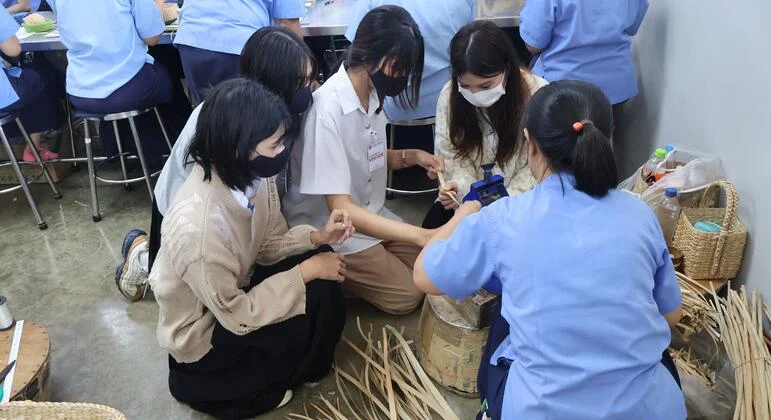
This interaction is the core of the Through the Wall initiative. As students move through the rows of women, sketchbooks in hand, the initial apprehension that characterizes the first encounter begins to dissolve. Walls are not just made of concrete; they are built of fear, bias, and the societal "othering" of those who have committed crimes. Through shared labor—threading needles, weaving baskets, and debating design aesthetics—these barriers are being dismantled, one stitch at a time.
Chronology of a Social Experiment
The project began as a conceptual bridge to address the high rates of recidivism in Thailand. Recognizing that vocational training often produces goods that lack market appeal, the UNODC and TIJ sought to professionalize the process.
- November 2025: The Through the Wall initiative is officially launched, inviting design students from leading universities to enter the prison space.
- Early 2026: Twenty-two students conduct site visits, engaging in workshops to understand the limitations and possibilities of the prison environment.
- Mid-2026: A competition is held featuring nine distinct projects. Students are tasked with creating products that are both commercially viable and reflective of the rehabilitation journey.
- Late 2026: The winning design, "Time-Made," is selected for mass production, with plans to integrate the winning students’ marketing strategies into the correctional facility’s business model.
The Winning Vision: Time-Made
The competition winner, a project titled Time-Made, epitomizes the initiative’s philosophical depth. The design features intricately smocked watch straps—a nod to the very thing that is both a burden and a commodity in prison: time.
"We wanted our product to remind people that we can use time carefully and meaningfully," says Game, a 21-year-old design student and co-winner of the competition. "In the outside world, we take time for granted. In prison, every second is accounted for. We wanted to create a product that forces the wearer to consider the value of their own time, and the time the creator spent reclaiming her life."
The concept resonated with the judges, who praised the students for elevating prison-made goods from mere "souvenirs" to high-end lifestyle products that tell a compelling narrative of redemption.
Supporting Data: Why Vocational Training Matters
The necessity of this project is backed by stark international data. Recidivism remains one of the greatest challenges for global justice systems. When incarcerated individuals leave prison without marketable skills or a sense of professional identity, the likelihood of returning to crime increases exponentially.
According to UNODC experts, approximately 150 women at the Bangkok facility are actively engaged in weaving, knitting, and machine sewing. However, the Through the Wall initiative introduces a critical missing component: market intelligence.
"The project aims to create prison-made goods that appeal to modern consumers while equipping correctional officers with essential marketing skills," explains Aki Okanan, a former prison reform expert at UNODC. By teaching the staff and inmates how to analyze consumer trends—such as the shift toward sustainable, handmade, and ethically sourced goods—the project transforms a static vocational program into a dynamic entrepreneurial incubator.
Official Responses and Strategic Vision
The leadership behind the project views the initiative as a paradigm shift in how society views justice. Chontit Chuenurah of the TIJ notes that the project is as much about the public as it is about the inmates.
"The stigma surrounding those who have made mistakes has long been a wall in our society," Chuenurah stated during the project’s launch. "To help them cross that barrier, we must restore their human dignity. By weaving their stories into these products, we use the creativity of the youth to build a bridge between the prison and the outside world, replacing fear with understanding."
The project also serves as a model for other nations struggling with prison overcrowding and ineffective rehabilitation programs. By involving the private sector and design communities, correctional facilities can transition from sites of punishment to sites of production and self-discovery.
The Psychological Impact: Perspectives from the Inside
For students like Natty, 21, the visit was a transformative educational experience. "I had expected the prison to look gloomy and scary," she admits. "I was surprised to find the workroom bright and airy, filled with women who are genuinely proud of their craft."
Natty, who has studied lifestyle products for three years, noticed that the inmates often defaulted to dark, muted colors. "I want to take the skills they have and introduce them to brighter fabrics. It’s about giving them the confidence to design for a future where they aren’t hidden."
Perhaps the most poignant story is that of "Ana" (a pseudonym), an inmate from Latin America. Arrested for drug trafficking, Ana has spent four years in the Bangkok facility. During that time, she has mastered the art of creating high-quality stuffed animals and has achieved fluency in the Thai language.
"I have never seen Thailand outside of these walls," Ana reflects. "But when I go back to Brazil, I know what I will do. I have the skills, I have the connections, and I know how to run a business. This place has given me the tools to build a life that doesn’t depend on the mistakes of my past."
Implications: Building a Sustainable Future
As the students exit the facility, passing through the same layers of security that the women face daily, the mood is often somber. The contrast between the students’ freedom and the women’s confinement is a visceral reminder of the stakes involved.
However, the implications of Through the Wall extend far beyond the exhibition of a few watch straps or plush toys. The initiative suggests that:
- Vocational training must be market-driven: Skills training is only effective if it leads to employment or entrepreneurship.
- Stigma is a systemic barrier: By integrating professional designers and students into the prison environment, the "wall" of public perception begins to crumble.
- Humanization is a tool for reform: When society sees the products of a person’s labor rather than just their criminal record, the path to reintegration becomes significantly smoother.
The Through the Wall project is, at its heart, an act of empathy. It recognizes that while the law may dictate the duration of a sentence, it should not dictate the limit of a person’s potential. By providing a platform for these women to communicate through their creations, the initiative is proving that even in the most restricted environments, there is room for growth, innovation, and a meaningful return to society.
As these designs hit the market, they carry with them more than just aesthetic value; they carry the hope that for these women, the wall is no longer an end, but a beginning.
 Asep Darmawan
 Lina Irawan
 Suro Senen
