

By Global Spirits Desk
Published: October 2023 / Updated for Comprehensive Review
Main Facts
In a decisive move that bridges its pioneering roots with a newfound focus on elevated core specifications, Jefferson’s Bourbon has announced a sweeping overhaul of its flagship expressions. Known widely for avant-garde maturation experiments—ranging from ocean-going voyages on container ships to aggressive wine cask finishes applied to ultra-aged stocks—the brand is turning its attention inward. The core lineup, long reliant on non-age-stated (NAS) consistency and approachable proofs, is receiving a major technical and aesthetic evolution.
At the forefront of this revamp is Jefferson’s Reserve, which now carries a formal, guaranteed eight-year age statement and a proof bump to 96 (48% ABV), a notable jump from its previous 90.2 proof. Simultaneously, the brand’s high-volume entry point, Jefferson’s Very Small Batch Bourbon, has been elevated from 82.3 proof to a more assertive 88 proof (44% ABV).
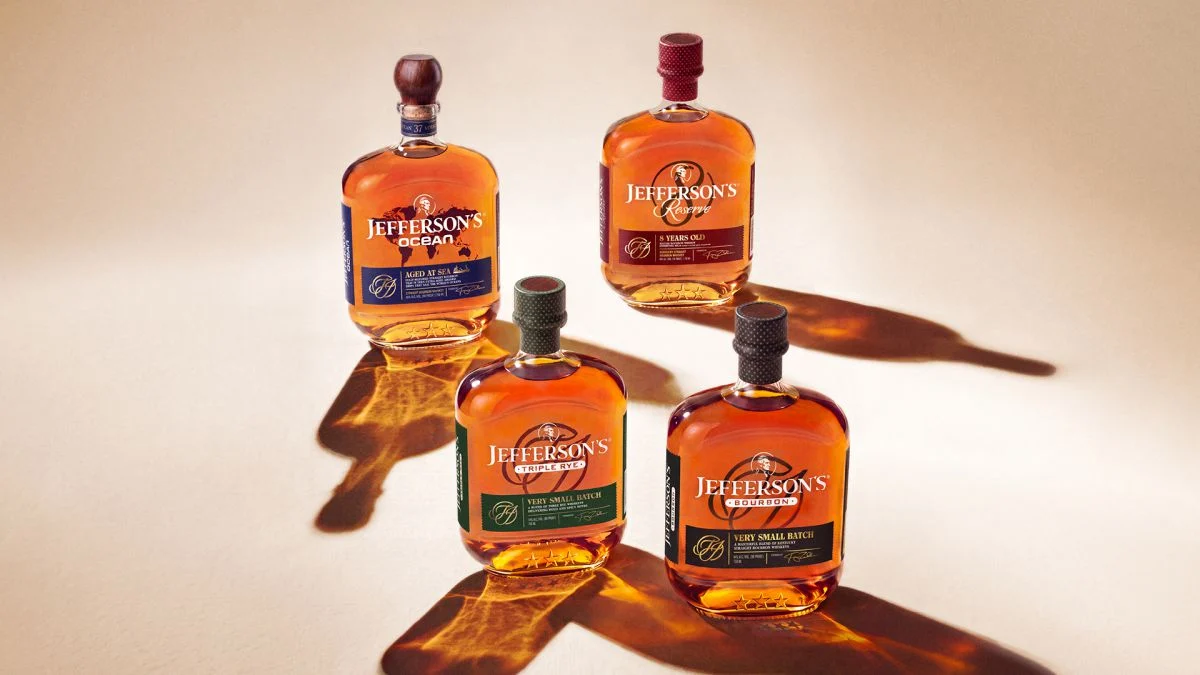
Alongside these liquid enhancements, Jefferson’s has rolled out a comprehensive packaging redesign across its portfolio—including Very Small Batch, Triple Rye, Reserve, and the cult-favorite Ocean Aged at Sea series. According to brand representatives, the updated bottle architecture and label geometry are engineered to establish a unified visual identity and simplify consumer navigation on crowded retail shelves. These newly upgraded expressions are hitting retail shelves nationwide, with alternative bottle formats (375 ml, 1-liter, and 1.75-liter) slated for distribution later in the year.
Chronology: The Journey from 1997 to the Modern Era
To understand the weight of Jefferson’s current pivot, one must trace the brand’s unique trajectory through the modern American whiskey renaissance.
- 1997: Father-and-son duo Chet and Trey Zoeller found Jefferson’s Bourbon with a vision of curating and blending exceptional sourced stocks rather than immediately diving into brick-and-mortar distillation. Their philosophy leans heavily on blending art, drawing inspiration from Thomas Jefferson’s spirit of inquiry and experimentation.
- 2009–2010s: The brand leans aggressively into boundary-pushing aging experiments. Trey Zoeller hits upon the "Ocean" concept—partly inspired by aging rum barrels on ships in the Caribbean centuries ago—sending barrels of bourbon on container ships to weather the extreme thermal cycling, agitation, and saltwater air of global sea voyages.
- 2019: Global spirits conglomerate Pernod Ricard acquires Castle Brands, the parent company of Jefferson’s, integrating the brand into its prestige American whiskey portfolio while keeping Trey Zoeller at the helm to preserve the label’s entrepreneurial spirit.
- 2023–2024: The brand achieves critical milestones. Chet and Trey Zoeller are jointly inducted into the Kentucky Bourbon Hall of Fame. Tragically, Chet Zoeller passes away in 2024, leaving Trey to carry forward the family legacy alongside master blender Ale Ochoa. During this period, experimental releases reach new heights, including the release of a stunning 20-year-old Founder’s Reserve finished in French Bordeaux wine casks.
- Late 2023 to Present: Recognizing shifts in consumer preferences and an increasingly competitive American whiskey market, Jefferson’s initiates its most substantial core portfolio upgrade to date, installing age statements, raising proofs, and modernizing its bottle design.
Supporting Data: Proof, Age, and Market Dynamics
The mechanics of whiskey blending and proofing are delicate sciences. When a brand alters the age or alcohol-by-volume (ABV) of its core offerings, it risks alienating traditionalists or shifting flavor profiles that consumers have relied upon for decades. However, the data behind Jefferson’s updates suggest a calculated, quality-forward strategy.
The Numbers Game
- Jefferson’s Reserve:
- Previous State: Non-age-stated (NAS), bottled at 90.2 proof (45.1% ABV).
- New State: Minimum 8-year age statement, bottled at 96 proof (48% ABV).
- Implication: The extra 5.8 proof points deliver more aromatic volatility, carrying richer esters and higher-chain fatty acids to the nose and palate, while the eight-year floor guarantees a mature, mellow oak backbone that counterbalances the higher heat.
- Jefferson’s Very Small Batch:
- Previous State: Bottled at 82.3 proof (41.15% ABV).
- New State: Bottled at 88 proof (44% ABV).
- Implication: Moving from a low-tier entry proof to 88 proof crosses a psychological threshold for craft whiskey enthusiasts. The 5.7-proof increase cuts through dilution in cocktails and provides a weightier mouthfeel without sacrificing approachability.
Market Context
The American whiskey market has experienced unprecedented fluctuations over the last half-decade. Following explosive, pandemic-era growth driven by stay-at-home spending and collector frenzy, the market has cooled. According to recent industry data cited by trade publications, domestic whiskey production and sales have faced a normalization phase, with inventory adjustments hitting various tiers of the industry.
In a crowded market where thousands of craft and legacy labels compete for shelf space, standing still is no longer an option. By adding a concrete age statement—a feature highly coveted by modern bourbon consumers who equate years in oak with quality—Jefferson’s has enhanced the value proposition of its core offerings without a radical price adjustment.
Official Responses and Tasting Profiles
Behind every blend is a team of sensory experts translating warehouse inventories into consumer experiences. Master Blender Ale Ochoa has spearheaded the technical execution of these core upgrades, ensuring that the brand’s foundational flavor profile remains intact while gaining depth and complexity.

"Getting to this age statement meant going back through our older, more mature barrels and crafting this bourbon with intention," stated Ale Ochoa regarding the newly minted Jefferson’s Reserve 8-Year-Old. "Aged a minimum of eight years in American oak, this bourbon offers dark fruit and vanilla custard upfront, then baking spice, oak, and toasted almond carrying through to a long, spicy finish."
Tasting Notes Breakdown: The Upgraded Lineup
- Jefferson’s Reserve 8-Year-Old (96 Proof):
- Nose: Rich aromas of sun-ripened dark cherries, Madagascar vanilla bean, and toasted marshmallow.
- Palate: A velvety arrival showcasing custard and caramel, quickly evolving into cinnamon, clove, and structured, dry charred oak.
- Finish: Extended and warming, leaving lingering notes of roasted almonds, cracked black pepper, and subtle pipe tobacco.
- Jefferson’s Very Small Batch Bourbon (88 Proof):
- Nose: Clean, approachable honeyed corn, crisp green apple, and a hint of fresh leather.
- Palate: Balanced and smooth, featuring sweet corn cake, butterscotch, and a light dusting of citrus zest.
- Finish: Clean and medium-length, with residual sweetness and a gentle warming spice that makes it remarkably versatile for neat sipping, on-the-rocks pours, or elevated classic cocktails like an Old Fashioned.
Implications: What This Means for Collectors, Drinkers, and the Industry
The decision by Jefferson’s to upgrade its core lineup carries several vital implications for the broader spirits landscape.
1. Elevating the Baseline
For years, distilleries and non-distilling producers (NDPs) alike relied on low-proof, non-age-stated bottles to capture the entry-to-mid-tier bourbon consumer. As consumer palates have evolved—educated by single-barrel picks, cask-strength releases, and a flood of transparent labeling—the tolerance for lower proofs and ambiguous aging has dwindled. By stepping up to 88 proof on the Small Batch and 96 proof with an 8-year age statement on the Reserve, Jefferson’s is signaling that the baseline of American whiskey must rise to meet consumer sophistication.
2. Navigating the Packaging Paradox
The rollout of new packaging is always a tightrope walk for legacy brands. Enthusiasts can be fiercely nostalgic, often viewing label redesigns with skepticism. However, Jefferson’s approach has been deliberately measured. Rather than a disruptive overhaul that erases its heritage, the new bottle architecture is designed to streamline a portfolio that has expanded wildly over the years—incorporating everything from rye whiskeys and standard bourbons to ocean-aged expressions and wine-finished rarities. A cohesive visual hierarchy helps consumers navigate the family of products more intuitively, turning casual buyers into brand explorers.
3. Balancing Innovation with Tradition
Jefferson’s built its modern reputation on high-concept gimmicks—a term sometimes used affectionately, sometimes critically, by whiskey critics. From sending barrels across equator lines on massive container ships to resting whiskey in French Bordeaux casks, the brand proved it wasn’t afraid to break conventions. However, a brand cannot survive on novelty alone. By fortifying its traditional, un-gimmicked core expressions with genuine age and thoughtful proofing, Jefferson’s is proving that its foundation is just as strong as its wildest experiments.
4. Economic Resilience in a Correcting Market
With input costs, glass shortages, and barrel tariffs creating economic pressures across the spirits industry, brands must continually justify their price points. Delivering an 8-year age-stated bourbon at 96 proof provides tangible, quantifiable value to the consumer. It answers the perennial market question: What am I paying for? In this case, the consumer is paying for time, wood interaction, and proof—the three holy grails of whiskey maturation.
Conclusion
Jefferson’s Bourbon stands at a fascinating crossroads in its history. As it moves forward under the leadership of Trey Zoeller and Master Blender Ale Ochoa—and with the enduring memory of co-founder Chet Zoeller guiding its ethos—the brand refuses to rest on its laurels.
The introduction of the Jefferson’s Reserve 8-Year-Old, the proof elevation of the Very Small Batch, and the clean, modern packaging refresh demonstrate an acute awareness of where the whiskey market is today and where it is heading tomorrow. Whether enjoyed neat by a fireside, poured over a crystal-clear cube of ice, or mixed into a meticulous cocktail, these upgraded expressions prove that even a brand famous for traveling the globe knows that sometimes, the best path forward is refining what is right in your own backyard.
 Asep Darmawan
 Lina Hope
 Raul Delapena Setiawan
