

By Crystal Bell
Published October 11, 2026
Main Facts: The Evolution of the Convention Floor
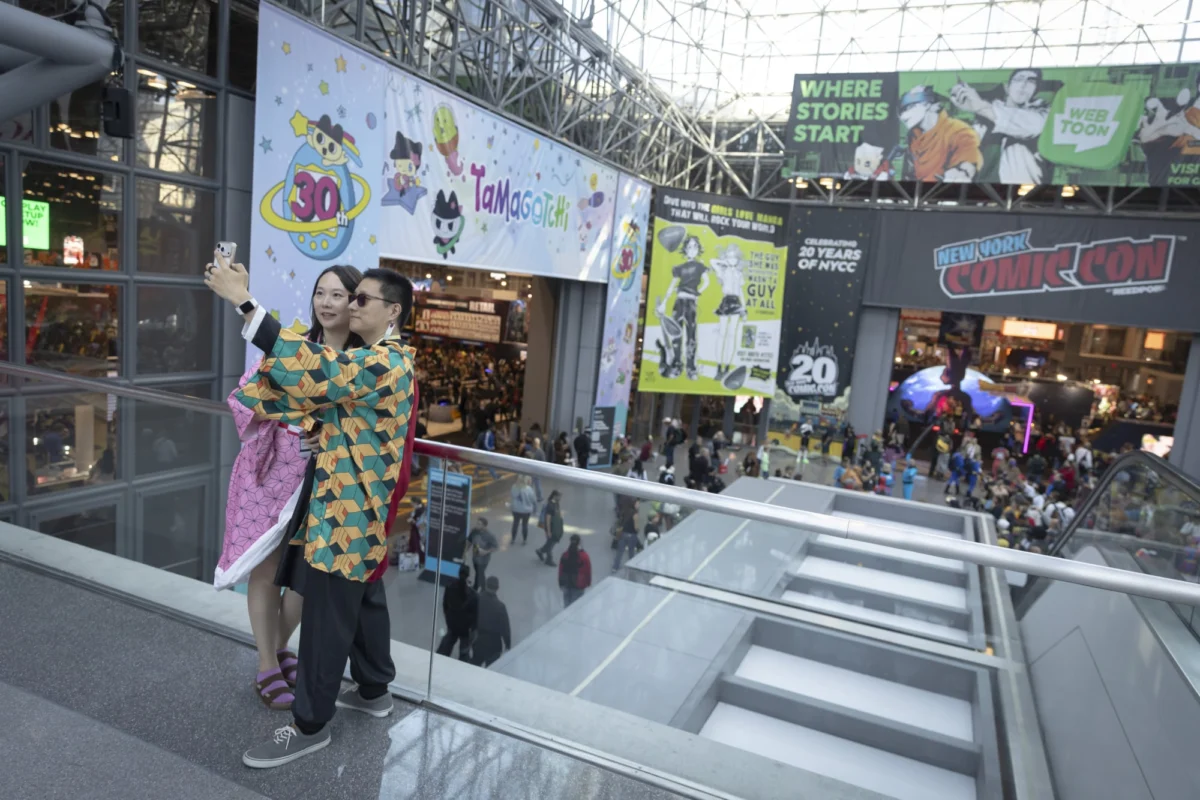
From the dedicated creator lounge perched high above the Javits Center, the view of New York Comic Con (NYCC) is nothing short of panoramic. Below, thousands of fans stream through the main entrance—a kaleidoscopic procession of intricate, hand-crafted cosplay, oversized fantasy props, and beloved characters brought vividly to life. Towering banners celebrating everything from retro Tamagotchi phenomena and The Apothecary Diaries to prestige dark fantasy YAGA hang overhead alongside celebratory markers for NYCC’s 20th anniversary. It is a sensory spectacle in its own right, and an even more potent backdrop for a viral TikTok video.
That visual synergy is entirely intentional. For this milestone year, convention organizers deliberately engineered the lower portions of the venue’s Crystal Palace banners with photo- and video-capture in mind. They anticipated precisely how modern attendees would document their experiences and immediately beam them out to global feeds.
The creator lounge itself offers a strategic vantage point. Complete with robust Wi-Fi, dedicated recording and editing bays, and vital charging stations, the space is engineered to accommodate the booming contingent of digital creators arriving at the convention with cameras, professional audio equipment, and massive built-in audiences.
On the bustling show floor below, cosplayers strike poses for passing smartphones, fans curate moments for their grids, and digital influencers stop attendees for impromptu interviews. Modern comic conventions are no longer just places to consume pop culture; they have evolved into sprawling, real-world content studios where every corridor, sponsor booth, and photo-op is purpose-built to feed the internet economy.

Chronology: From Post-Pandemic Pivot to Creator-First Infrastructure
The structural transformation of comic conventions into content ecosystems did not happen overnight. Its origins can be traced back to 2021, a pivotal inflection point when live events began cautiously returning in the wake of pandemic-era lockdowns. At that precise moment, short-form video formats on platforms like TikTok and Instagram Reels were radically rewriting how audiences discovered and interacted with entertainment.
Sensing a paradigm shift, NYCC organizers hired two external digital creators to officially take over the convention’s brand-new TikTok account for the duration of the event. The experiment yielded staggering metrics: according to marketing director Fallon Prinzivalli, that single four-day activation reached more than 8 million unique viewers.
"We started engaging with them very intentionally following the pandemic when live events were coming back," Prinzivalli recalled.
The success of that initial social media takeover catalyzed a systemic overhaul of how the convention handles digital talent. Organizers abandoned archaic accreditation models where internet personalities were forced to apply under ill-fitting traditional press guidelines. Instead, they instituted a dedicated creator relations program, complete with specialized badges and, ultimately, physical real estate tailored to their production workflows.
Supporting Data: The Logistics and Demand of the Creator Economy
Managing the intersection of traditional fandom and high-volume digital publishing requires precise logistical planning. Today, NYCC issues a strictly limited allotment of complimentary creator badges. While the convention’s baseline application criteria generally require a minimum threshold of 200,000 followers across platforms, Prinzivalli notes that exceptions are frequently made for micro-creators who demonstrate exceptional community engagement, original content concepts, and high cultural impact.

The demand for these credentials has outstripped available supply by orders of magnitude. For the 2026 event, organizers received thousands of applications, forcing them to close submissions early in August once capacity caps were reached. (Organizers have declined to publicly disclose the exact number of creator badges issued).
The physical manifestation of this program—the creator lounge—was born out of a simple operational realization: digital producers need more than a folding table and an internet connection.
- Connectivity: High-speed, dedicated Wi-Fi networks capable of handling massive video file uploads.
- Infrastructure: Portable lighting setups, ring lights, and complimentary tripods provided on-site.
- Ergonomics: Quiet zones featuring charging outlets and seating, allowing creators to decompress away from the floor’s sensory overload before editing breaking news or conducting rapid-fire interviews.
Official Responses: Blurring the Lines Between Fan, Reporter, and Celebrity
The integration of content creators into the core operational fabric of NYCC has forced a re-examination of what constitutes "media" in the modern entertainment landscape.
For Kallen Zborovsky-Fenster, a New York City-based creator known online as @king_kallen, NYCC represents a cornerstone of his annual production schedule. Weeks before the convention doors open, he is deep in pre-production—drafting interview frameworks, packing mobile audio gear, and mapping out content strategies focused on upcoming blockbusters like Avengers: Doomsday and shifting continuity within the DC Universe.
"This is one of my highest priority events," Zborovsky-Fenster said. As a Columbia University student with aspirations in entertainment production and law, he views his second consecutive year with a creator badge not just as an opportunity to make content, but as a vital networking arena. "When you meet new people, through them, you meet more people," he notes.

Similarly, Caroline Martini (@newyorkcaroline) manages a complex balancing act between active participation and production schedules. Armed with a running list of shot lists saved in her iPhone Notes app, she captures convention vlogs and cosplay showcases—including her own hand-crafted Lord of the Rings Éowyn costume—for TikTok, Instagram Reels, and YouTube Shorts. Yet, Martini remains deliberate about stepping away from the creator hub. Because her friends often lack creator badges, she prioritizes experiencing Comic Con with her community over pure optimization.
For news-focused creators like Brandon Bullock (operating as Anime News Guy), the lounge serves as a tactical newsroom. Because his coverage relies on breaking announcements emerging directly from convention panels, Bullock must shoot on the floor, sprint upstairs to edit, and publish content while the news cycle is white-hot.
Fallon Prinzivalli has witnessed firsthand how traditional boundaries have eroded. Many creators within the NYCC ecosystem command followings that rival traditional actors, routinely getting swarmed on the convention floor by fans demanding selfies. At modern pop culture conventions, an individual can seamlessly inhabit three roles simultaneously: passionate fan, credentialed reporter, and internet celebrity.
Implications: The Circular Future of Fandom and Media
The shift toward content-optimized conventions extends far beyond creator lounges and specialized badges. It has fundamentally altered the architectural and experiential design of major live events.
"We’re very conscious that everything we create now is a shareable moment," Prinzivalli explained.

This philosophy governs everything from corporate sponsor activations to physical wayfinding. For NYCC’s 20th anniversary, the strategic styling of the Crystal Palace entrance banners was mapped out specifically to maximize aesthetic appeal for mobile viewfinders. Furthermore, NYCC has significantly scaled its internal livestream production infrastructure, broadcasting from major stages with roaming floor segments and a dedicated studio in the River Pavilion. By deploying hybrid media personalities—such as creator and podcast host Brandon Davis—alongside seasoned journalists, the convention effectively projects its energy far beyond the physical walls of the Javits Center.
Ultimately, this creates a circular cultural feedback loop. Digital communities forge the initial bonds that drive fans to in-person gatherings; those live gatherings generate raw media—photos, vlogs, investigative interviews, and shared laughter—which are subsequently beamed back out to social feeds to recruit the next wave of attendees.
As the creator economy matures, massive cultural institutions are taking note. The usernames are becoming faces, the mutuals are becoming lifelong friends, and the people behind the cameras are cementing their status as the primary architects of modern pop culture.
"I think the creator economy is becoming so much larger now, and big entities are really starting to take it seriously," Zborovsky-Fenster reflected, "because a lot of people get that information from content creators."
 Reynand Wu
 Asro
Asro
 Basiran
