

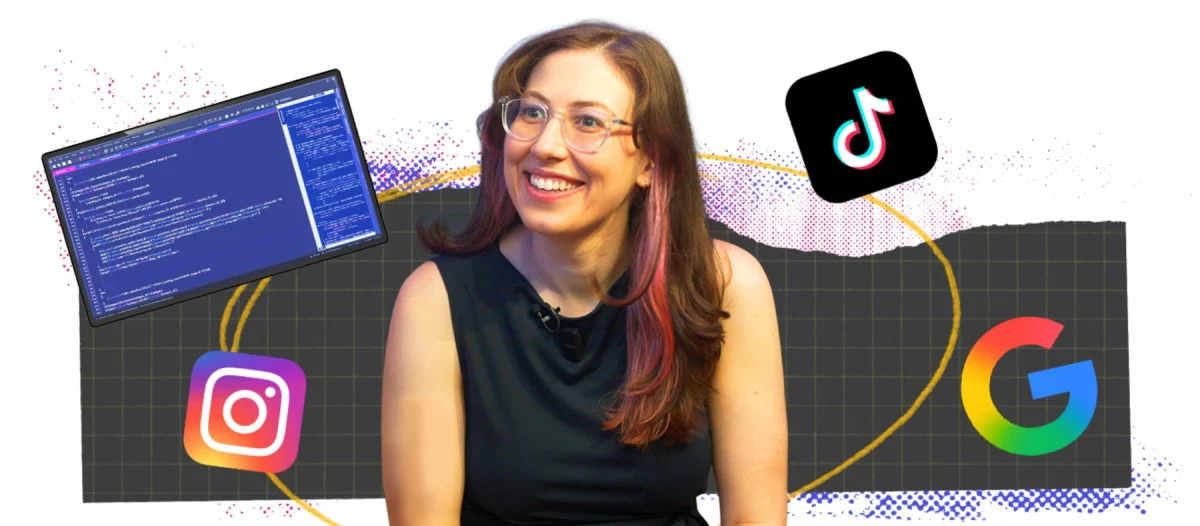
For six and a half years, Alberta Tech lived a double life. By day, she sat in front of dual monitors as a software engineer at Google, spending a significant portion of her tenure building and optimizing features for YouTube—one of the most powerful digital platforms on the planet. By night, she transformed into a digital satirist, mining the quiet horrors of remote work, tiny New York apartments, and the hyper-specific eccentricities of the tech industry for short-form comedy.
Earlier this year, the illusion of the dual life finally broke. Alberta traded her code reviews for a full-time career as a creator, stepping away from corporate stability to lean entirely into the unpredictable world of internet comedy. In an exclusive interview as part of Mashable’s Creator Playbook, Alberta opens up about the realities of leaving Big Tech, why humor is the ultimate decoder ring for complex engineering concepts, and the golden rule every aspiring creator must follow before handing in their resignation.
Main Facts: The Intersection of Software and Satire
The modern creator economy is crowded with lifestyle vloggers, beauty gurus, and gaming streamers, but Alberta carved out a distinct, highly specialized niche: she makes tech funny to the people who build it.
- The Corporate Background: Alberta spent over six years in software engineering, gaining deep technical fluency that later served as her core differentiator. Her audience consists predominantly of software developers, engineers, and tech-adjacent professionals who demand authenticity.
- The Transition Point: After years of balancing a demanding engineering job at Google with content creation, Alberta officially went full-time as a creator, moving away from a traditional corporate career path.
- The Content Strategy: Her work tackles heavy, shifting concepts—ranging from generative AI hallucinations to the evolution of "vibe coding"—and translates them into accessible, highly relatable comedy.
- The AI Stance: Once a hard skeptic of generative AI, she has integrated LLMs into her research workflow while remaining deeply critical of AI’s current ability to generate genuine comedy or replace human-centric creative concepts.
Chronology: From Pandemic Boredom to Full-Time Creator
Phase 1: The Pandemic Pivot (2020)
Like millions of professionals worldwide, Alberta found herself confined to her living space during the early lockdowns of the COVID-19 pandemic. Seeking an outlet from the monotonous cycle of remote software development, she began experimenting with short-form video on TikTok.
Initially, her content was broad and experimental, touching on the universal claustrophobia of lockdown life and the unique eccentricities of renting small apartments in New York City. However, the algorithm and her own inclinations quickly pointed her toward a more defined lane: the shared cultural experiences of software developers and tech workers.
Phase 2: The Dual Life (2020–2026)
For years, Alberta maintained a delicate balancing act. While working on core features for YouTube during the day, she quietly built an independent presence online. Conscious of corporate boundaries and the inherent risks of blending personal commentary with a major tech employer, she rarely mentioned her specific corporate affiliation explicitly. Instead, she relied on the innate credibility of her technical vocabulary and industry insights to build trust with a niche audience that could instantly spot an outsider trying to fake industry knowledge.

Phase 3: The Leap (2026)
As her audience expanded and the demands of producing high-tier short-form content grew, the splitting of her focus became untenable. Realizing that maintaining her creative ambitions required undivided attention, Alberta made the decision to leave Google. Telling her manager was a high-stakes moment—one met with a mixture of professional surprise and curiosity—but it marked the permanent transition from software engineer to full-time digital creator.
Supporting Data & Industry Context: Navigating the Creator Economy
The economics of transitioning from a lucrative Big Tech salary to full-time content creation are daunting. Software engineers command some of the highest base salaries and compensation packages in the corporate world, making the leap to the creator economy an uncalculated financial risk for many.
However, Alberta’s trajectory highlights a broader trend within digital culture: hyper-niche expertise is becoming one of the most durable defensible moats for modern creators. According to digital media analysts, audiences are increasingly fatigued by generalized lifestyle content, gravitating instead toward creators who possess legitimate domain expertise.
The AI Experiment: Testing the Limits of Automation
As artificial intelligence reshapes the tech landscape, Alberta has actively experimented with its boundaries in her own workflow. While she utilizes LLMs for research mapping—identifying rabbit holes, background contexts, and structural pathways for her video concepts—she remains steadfast about its creative limitations.
To test the capabilities of modern AI video generation, Alberta ran a controlled experiment: she took a script from a previous viral video and recreated the entire piece using AI video generation tools, keeping the text identical.
- The Results: The AI-generated iteration performed reasonably well, proving to her that the underlying concept and script are far more vital than the production vessel itself.
- The Implication: While video generation models are scaling in quality at a terrifying pace, the core human element—the original idea and comedic timing—remains the irreplaceable anchor.
Official Perspectives & Insights
During her conversation with Mashable, Alberta offered a raw look into the mental framework required to succeed in both software development and digital media.

On the Necessity of Industry Credentials
"My audience now is just over half software engineers and developers. To speak to that group of people, you need to have some kind of credential behind you. You need to know what you’re talking about."
On Why Comedy Demystifies Complex Tech
"I like to say that comedy is one of the best ways to get to the root of a problem, to get to the root of a topic. If somebody is laughing at something that is kind of technical, they have to understand it in some capacity."
On the Evolution of "Vibe Coding"
When asked about the industry buzzword "vibe coding," Alberta noted how the term has shifted from a derogatory label for blindly trusting AI-generated code to a description of integrated agentic engineering workflows.
"Now a lot of developers have tools that fit into their workflows, so they can actually look at that code, know what’s going on, or give very specific instructions as to what they want the AI to do… We don’t have a great word to describe that process yet."
Implications: Advice for Aspiring Career Switchers
For professionals eyeing their own exits from traditional corporate structures to pursue creative ventures full-time, Alberta’s primary takeaway is rooted in harsh economic and creative realism.
Many aspiring creators make the mistake of assuming that building an audience is simply about showing up. Alberta argues that an audience does not initially care about an individual creator as a person; they care exclusively about the value or entertainment delivered to them.

Her golden rule for anyone contemplating a leap from a stable day job is unequivocal:
"Don’t quit your job until you find that thing."
Only once a creator has identified their unique hook, validated their audience’s engagement, and established a repeatable framework for providing value should they consider leaving the safety net of corporate employment. For Alberta Tech, code reviews served their purpose, but by mastering the intersection of technical literacy and sharp satire, she built a sustainable digital enterprise entirely on her own terms.
 Reynand Wu
 Asro
Asro
 Basiran
