

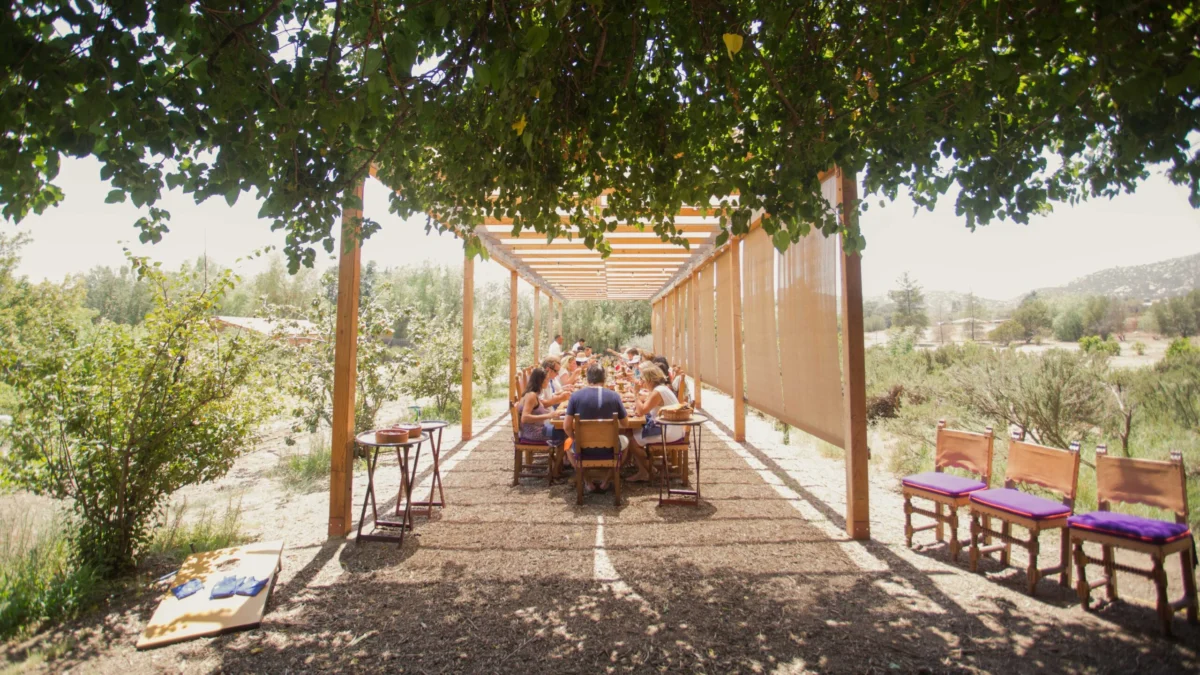
The awkwardness settled over the room almost immediately, a palpable, heavy shroud that threatened to stifle the involuntary, self-conscious smiles tugging at our cheeks. We were sixteen strangers, gathered in a secluded dining room nestled within the mountainous countryside of Tecate, Baja California. We had all voluntarily surrendered our most fundamental social tool: the ability to speak. Ahead of us lay a 90-minute, five-course “Silent Dinner,” an experience that promised not just a meal, but a profound exercise in mindfulness.
As we sat at a long, rectangular table—reminiscent of a medieval feast from Game of Thrones—the sensory reality began to set in. The clinking of cutlery against porcelain, the soft scraping of chairs, the rhythmic clearing of throats, and the relentless, audible ticking of a wall clock became the entirety of our acoustic universe. For many, this sounds like an exercise in social torture. For those of us present at the iconic Rancho La Puerta, it was a long-awaited immersion into the rising global trend of “hushpitality.”
The Rise of “Hushpitality”
The hospitality industry is undergoing a quiet revolution. As our daily lives become increasingly dominated by digital noise, constant notifications, and the relentless hum of urban living, the value of silence has skyrocketed. Hilton’s 2026 Trends Report recently identified “hushpitality” as a cornerstone of the future of travel. It is a direct response to the modern traveler’s growing, desperate need to “turn down the volume” of the world.
Rancho La Puerta, a legendary wellness destination that has been operating since 1940, has been ahead of this curve for over a decade. For at least 15 years, the resort has hosted its Silent Dinner as a core part of its wellness programming. While the dinner is a singular event, it reflects the broader ethos of the 4,000-acre property, which integrates silent meditation, sunrise mountain hikes, and the intentional absence of man-made noise into the daily rhythm of the guest experience.

A Chronology of the Silent Meal
The experiment began the moment our guide struck a bell. The rules were absolute: no speech, no digital devices, and no attempts to force interaction. The objective was to strip away the artifice of small talk and reach a state of pure, observational presence.
The Opening Act: The Tension of Stillness
The first twenty minutes were defined by a lingering, nervous tension. Without the social crutch of conversation, we were forced to navigate the basic mechanics of dining in a vacuum. If a diner required service—perhaps a refill of water or an extra slice of bread—they were forced to rely on pantomime. I found myself raising my arm and miming the motion of slicing a loaf across my palm; to my relief, our server understood instantly, sparing me from the embarrassment of a failed charade.
Some guests, opting for full sensory detachment, kept their eyes closed for the duration of the courses. Others abandoned the utensils, eating with their hands to foster a more primal connection to the food. The table was scattered with odd, whimsical knickknacks—ceramic figures and sculptures that acted as surrogate companions. I spent a significant portion of the first course staring into the painted eyes of a three-eyed ceramic creature, finding that the absurdity of the situation helped quell the rising, nervous laughter that threatened to erupt into the silence.
The Shift: Finding Flow in the Void
It wasn’t until the third course—a rich, earthy black bean soup—that the atmosphere in the room shifted. The initial anxiety evaporated, replaced by a strange, collective calm. As a mother of a toddler living in the constant, high-octane environment of New York City, I am rarely granted the luxury of stillness. My life is a blur of demands, queries, and background noise.

In this pocket of absolute reprieve, the transformation was visceral. My shoulders dropped, my breathing deepened, and the internal monologue that usually raced through a never-ending to-do list began to quiet. I found myself thinking with unusual clarity. A favorite line from a book I had read months ago, buried in the depths of my digital notes, surfaced in my mind. I began to visualize memories of my daughter’s early childhood with newfound vividness. Most surprisingly, the conclusion to an article I had been struggling to write for weeks arrived with effortless ease.
I wasn’t “doing” anything. I was simply being. In that state of “was-ness,” silence ceased to be an obstacle and became a mirror.
Supporting Data: The Science of Quiet
The efficacy of the Silent Dinner is supported by a growing body of research into the psychological effects of sensory deprivation and noise reduction. Studies in neurobiology suggest that the brain requires periods of “default mode network” activation—the state in which we are not focused on an external task—to process information, consolidate memories, and foster creativity.
In a traditional social setting, the brain is constantly processing linguistic cues, body language, and social hierarchies. By removing speech, the burden on the prefrontal cortex is significantly reduced. This allows for what psychologists call “attunement.” When we cannot talk, we become hyper-observant of the non-verbal cues of others—a slight nod, a shared smile, or the way a neighbor pauses before taking a bite. This leads to a deeper, albeit wordless, sense of empathy.

Official Perspectives and the Guest Experience
At the conclusion of the 90-minute session, the toll of the bell felt almost jarring. We were jolted from a collective cocoon of introspective calm. However, the experience did not end there. The transition back into the “speaking world” was marked by a profound sense of camaraderie.
We spent the final hour debriefing, a session that proved to be just as vital as the meal itself. One woman, clearly moved by the experience, noted that she had never shared so many meaningful, wordless smiles with strangers in her life. An elderly gentleman shared that he had spent the meal imagining he was dining with his late wife; the confession was so touching that his neighbor reached over to offer a supportive hug.
The staff at Rancho La Puerta view these dinners as more than just a novelty. By design, they create a space where guests can stop performing their identities. “When you take away the noise, you don’t just hear the room,” one staff member noted. “You hear the parts of yourself that have been drowned out by the noise of the world.”
Implications for the Future of Travel
The success of this event at Rancho La Puerta suggests that the travel industry is on the cusp of a significant shift. The demand for “hushpitality” is not merely a passing phase; it is a fundamental re-evaluation of what it means to be “rested.”

- The Digital Detox: As hotels move toward “phone-free” zones, the focus will shift from high-speed connectivity to high-quality disconnection.
- Architectural Silence: Future hotel designs will likely prioritize sound-dampening materials and layouts that facilitate quiet contemplation, rather than just aesthetic grandeur.
- Mindful Consumption: The rise of silent dining indicates a trend toward “slow travel,” where the quality of an experience is measured by the depth of internal reflection rather than the quantity of activities.
Conclusion: The Shared Solitude
As the evening concluded, nobody was in a hurry to leave. The transition from silence to conversation was gentle, almost cautious. We traded observations, shared contact information, and lingered in the soft, Mexican evening air.
During those 90 minutes, we had all retreated into our own private, mental worlds. Yet, in our collective commitment to silence, we had built a shared one. We learned that communication is not strictly the province of words. Sometimes, the most meaningful connections are made in the gaps between them. We arrived as sixteen strangers, but we left as a group of people who had, in the most profound way possible, truly heard one another.
For those looking to replicate this experience, the lesson is clear: you do not need to travel to a luxury ranch in Baja to find quiet. However, the external structure of a “hushpitality” environment provides a necessary container for the practice. In a world that demands we always have something to say, the most radical, luxurious act is to sit down, close our mouths, and listen to the silence.
 Ali Ikhwan
 Lina Irawan
