

By Daniel Johnson, Geneva
23 October 2026
The humanitarian situation in Yemen’s third-largest city, Taiz, has plummeted into a state of acute emergency as a relentless blockade by de facto Houthi forces enters its third week. International aid agencies, including the United Nations, are sounding the alarm, warning that the city—long a flashpoint in the country’s protracted conflict—has been effectively hermetically sealed off from the outside world.
With supply lines severed, the civilian population is facing a multi-front crisis: a rapid depletion of food stocks, a skyrocketing cost of basic necessities, and a critical shortage of fuel that is paralyzing essential services, most notably water distribution.
The Siege: 20 Days of Isolation
The current crisis began in early September, when the fragile calm maintained by the 2022 truce evaporated, replaced by a surge in hostilities between Houthi separatists and the Aden-based government. By early October, the encirclement of Taiz was complete.
"It’s 20 days and counting since Taiz has been cut off," said Jens Laerke, spokesperson for the UN Office for the Coordination of Humanitarian Affairs (OCHA). "We are seeing increasingly that the fighting makes it impossible for us to get in and impossible for people to get out. Access roads have been cut off, and that means that very little fuel, food, or other supplies have reached the city since."
For the 800,000 residents trapped within the city walls, the silence of the aid convoys is deafening. The blockade has transformed Taiz into an island of deprivation, where the basic mechanics of survival—clean water, medical treatment, and caloric intake—are becoming luxuries that most cannot afford.
Chronology of the Escalation
To understand the current emergency, one must look at the timeline of the recent collapse:
- Early September 2026: The relative stability provided by the 2022 truce begins to fracture as military skirmishes between government forces and Houthi fighters intensify along the western coast.
- 7 June – 19 October 2026: Displacement metrics from the International Organization for Migration (IOM) show a massive internal migration, with over 258,000 individuals displaced across Taiz and Lahj governorates, placing unprecedented strain on host communities.
- October 3, 2026: The encirclement of Taiz intensifies, with major access roads rendered impassable due to direct combat and the threat of mines.
- October 17, 2026: The first significant waves of refugees are recorded crossing the Gulf of Aden into Djibouti, with at least 3,836 Yemeni nationals fleeing the security vacuum.
- October 23, 2026: The UN formally declares that aid access to Taiz has been almost entirely severed, marking 20 days of total supply stagnation.
The Water Crisis and Economic Desperation
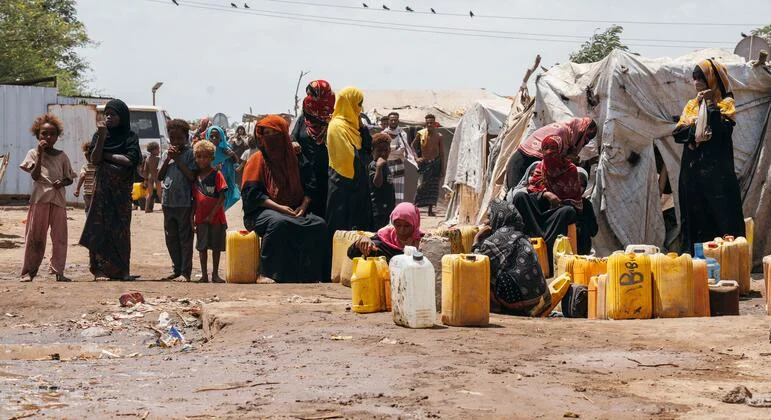
The most immediate, life-threatening consequence of the siege is the collapse of the city’s water infrastructure. Most of Taiz’s residents rely on private water trucks to supply their homes. However, the blockade has created a double-edged sword: there is no fuel to power the trucks, and the roads they would normally traverse are blocked by combatants.
"With the roads closed and the diesel to run the trucks very scarce, water production in the city has fallen by about half," Mr. Laerke explained during a press briefing in Geneva. "The cost of the truck-delivered water has roughly tripled. You can imagine what that does to these people who are trapped there."
The economic ripple effect is devastating. As the price of water triples, families are forced to choose between hydration and food. This "price-gouging by circumstance" is driving thousands of families into deeper cycles of poverty, leaving them vulnerable to preventable diseases that thrive in conditions of poor sanitation.
The Nutritional Emergency: Children at the Brink
The United Nations Children’s Fund (UNICEF) has characterized the situation as a "slow-motion catastrophe" for the youth of Taiz. The city has become a epicenter for acute malnutrition, with figures that illustrate a terrifying trajectory.
In the year 2026 alone, UNICEF screened over 168,000 children in Taiz. Of those, 52,000 were found to be acutely malnourished. Perhaps most alarming is the cohort of 11,500 children suffering from severe acute malnutrition (SAM)—a condition that, if left untreated, carries a high risk of mortality.
"We have pre-positioned nearly 8,000 cartons of ready-to-use therapeutic food across the governorate," said UNICEF spokesperson Ricardo Pires. "That is enough to sustain services for roughly three months. But even when stocks are available, access constraints and disruptions to supply routes make it nearly impossible for our partners to transport the supplies, and even more difficult for desperate families to safely reach treatment centers."
The inability to deliver these lifesaving supplies is not merely a logistical failure; it is a violation of the fundamental rights of the child. The irony of having food stocks nearby but being unable to bridge the final few miles is a source of profound frustration for international aid workers on the ground.
Official Responses and the Broader Conflict
The World Food Programme (WFP) remains in a state of high alert. Azfar Deen, WFP Regional Communications Officer for Eastern and Southern Africa, emphasized that the agency is currently engaged in a desperate bid to negotiate humanitarian corridors.
"We’re desperately trying to regain access to Taiz, and we continue to support the broader operations across Yemen," Deen stated. However, the political reality remains bleak. The conflict, which has claimed at least 1,574 lives and injured nearly 7,000 others since August, shows little sign of de-escalation.
The Aden-based government has called on the international community to exert maximum pressure on Houthi forces to lift the blockade, labeling the act a "collective punishment." Conversely, the humanitarian community continues to demand that all parties to the conflict adhere to international humanitarian law, which mandates the protection of civilians and the unhindered movement of humanitarian relief.
Implications: A Regional Spillover
The crisis in Taiz is not contained within city limits. It is acting as a catalyst for regional instability. The recent exodus of thousands of Yemenis to Djibouti is a stark indicator that the population has lost hope in the domestic security apparatus.
As these families flee, they leave behind an infrastructure that is crumbling under the weight of sustained military action. The displacement of over a quarter of a million people since June has created a demographic burden that neighboring governorates, such as Lahj, are ill-equipped to handle. These areas are now "overstretched," with health clinics and schools functioning at three or four times their intended capacity.
Furthermore, the escalation since August has signaled that the 2022 truce was a fragile shell. The return to full-scale kinetic warfare suggests that the conflict has entered a more entrenched, brutal phase. With no political dialogue currently on the horizon, the prospect of a long-term siege appears increasingly likely.
Conclusion: The Moral Imperative
As the siege of Taiz enters its fourth week, the international community faces a critical moral test. The data is clear: 600,000 people who depend on humanitarian aid are currently being denied it. The 200,000 women and children trapped in the city are the most vulnerable, and their window for survival is closing as the stocks of food and water reach critical lows.
The UN’s call for access is not merely a request; it is a demand for the preservation of human life. Without a cessation of hostilities or, at the very minimum, the establishment of protected humanitarian corridors, the city of Taiz risks becoming a graveyard for the innocent victims of a conflict that has already claimed too much.
The global community remains tasked with the urgency of the moment: to ensure that diplomacy and humanitarian corridors prevail over the brutal reality of the blockade. For the people of Taiz, the next 24 hours may determine whether they receive the sustenance they need to survive, or whether they will be forced to endure another agonizing week of isolation.
 Lina Hope
 Asro
 Layla Zulfa
