

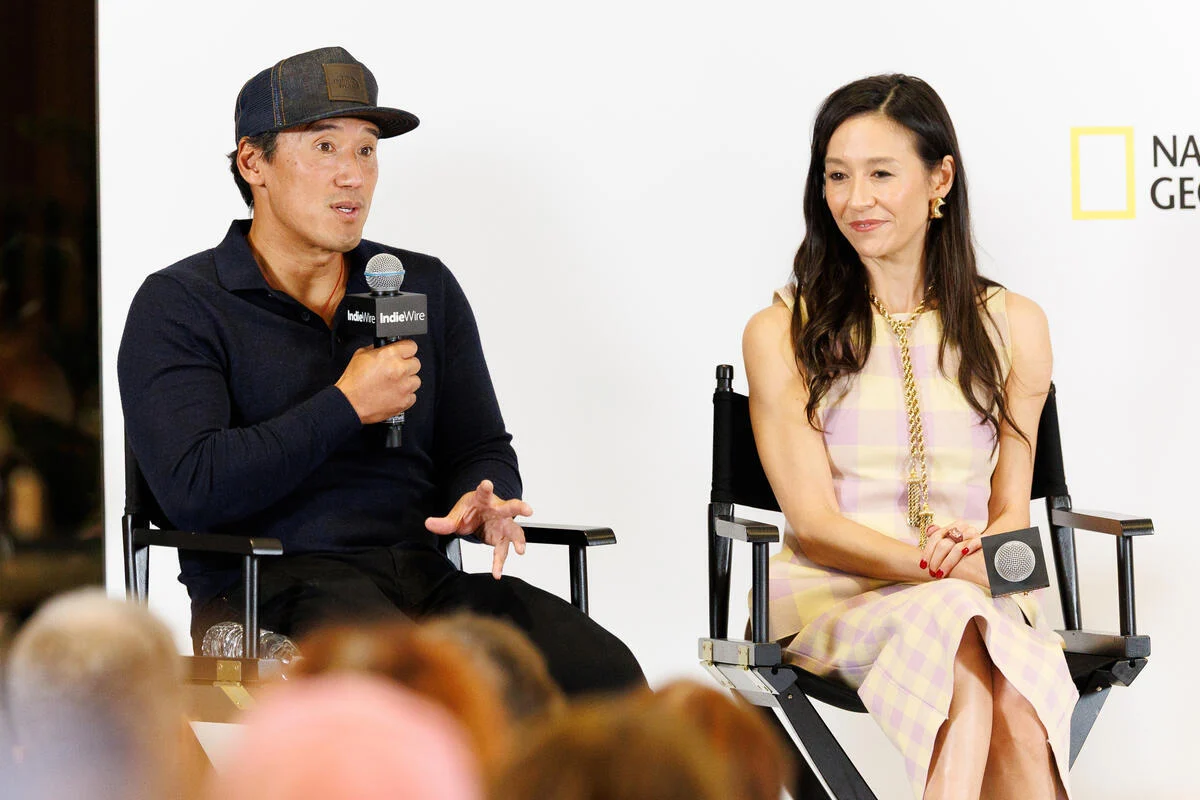
From the dizzying, rope-free ascent of El Capitan in Free Solo to the frost-bitten, oxygen-deprived slopes of the world’s highest peaks, documentary filmmakers Elizabeth Chai Vasarhelyi and Jimmy Chin have built a career on the precipice of human possibility. They are the cinematic chroniclers of the impossible, turning their lenses toward athletes who treat death as a variable to be managed rather than an inevitable conclusion.
However, their latest project, Everest: The Other Side, shifts the focus from the act of conquest to the weight of legacy. The film follows Jim Morrison as he endeavors to complete the dream of his late wife, the legendary mountaineer Hilaree Nelson: to ski down the daunting slopes of Mount Everest. During a recent IndieWire "Art of the Doc" event in Los Angeles, the duo sat down to discuss the magnetism of the extreme and the profound, fragile humanity that lies beneath the adrenaline-fueled headlines.
The Anatomy of the Extreme: Bridging the Relatability Gap
For audiences, the figures in Vasarhelyi and Chin’s films often feel like mythic deities. They are the people who do not tremble where others freeze, who calculate risk with the cold precision of a supercomputer, and who find comfort in the thin air of the death zone. But for the directors, the narrative utility of these subjects is not their prowess, but their capacity for feeling.
"In all our films, you think you’re seeing these exceptional, extraordinary, extreme athletes," Jimmy Chin remarked during the panel discussion. "But at the end of the day, they’re still human beings like the rest of us. What I’m interested in is bridging that gap where people feel like they can’t relate to people out there doing these things. But the story is really human, and this film is about very human experiences. Even though they’re climbing and skiing the most extreme places in the world."
Chin, himself a world-class climber and skier, brings a unique perspective to this "humanization" process. He understands the sensory input of the mountain—the biting cold, the deafening silence, the psychological exhaustion. By embedding this experience in the narrative, the film transcends the "sports documentary" label, becoming instead a meditation on grief, purpose, and the commitments we make to those who are no longer with us.
A Legacy in Motion: The Story of Hilaree Nelson
The narrative heart of Everest: The Other Side belongs to Hilaree Nelson. A titan of the sport, Nelson was known not just for her physical resilience, but for her startling, grounded honesty regarding her vocation.
Elizabeth Chai Vasarhelyi noted that while many extreme athletes shroud their activities in romanticized notions of glory or "finding oneself," Nelson’s approach was remarkably pragmatic. It was, in a sense, a professional commitment to a calling that consumed her.
"I had met a lot of extreme athletes, but Hilaree had a candor to her vocation that I hadn’t heard before," Vasarhelyi explained. "It’s not romantic. She says in the film, ‘I know it’s just a mountain, but it’s everything to me. And I’m like a dog with a bone.’ And I understand that."

This "dog with a bone" mentality is the driving force of the film. By documenting Jim Morrison’s journey to honor her final goal, the filmmakers allow the audience to peer into the life of a woman who was a mother, a partner, and a pioneer, stripping away the mountain-top mythology to reveal the deeply personal motivations that drive someone to risk everything.
Chronology of the Project: From Grief to the Summit
The production of Everest: The Other Side is a testament to the endurance required to capture such volatile subject matter. The project did not begin as a standard production; it emerged from the tragedy of loss and the subsequent desire to find closure in the environment that shaped the couple’s life together.
- The Initial Vision: Before her passing, Hilaree Nelson had set her sights on the descent of Everest—a feat of skiing that represents the pinnacle of high-altitude technical skill.
- The Catalyst: Following the tragedy, Jim Morrison sought to translate his grief into action, viewing the completion of the descent not as a stunt, but as a final conversation with his partner.
- The Expedition: The filming process mirrored the extreme conditions of the sport itself. Unlike studio-bound projects, the crew had to manage the logistics of high-altitude cinematography, ensuring that the camera captured the raw, unscripted emotion of the climb.
- The Editorial Process: In the edit suite, Vasarhelyi and Chin focused on pacing—balancing the sheer physical spectacle of the mountain with the quiet, devastating moments of introspection.
- The Release: National Geographic confirmed an October 30 theatrical release, marking the culmination of a multi-year journey of production and emotional processing.
Supporting Data: The Global Reach of the "Nat Geo" Model
The partnership between Vasarhelyi, Chin, and National Geographic Documentary Films highlights a larger trend in the industry: the hunger for premium, non-fiction storytelling that bridges cultural divides. National Geographic’s portfolio has become a cultural touchstone for high-stakes, ethically reported, and visually stunning documentary work.
With a reach of 300 million people across 180 countries and 33 languages, the reach of these films is unprecedented. The studio has cultivated a reputation for tackling "provocative and globally relevant stories." This strategy relies on a symbiotic relationship between the filmmaker’s artistic vision and the studio’s global distribution infrastructure.
Recent successes—including the Oscar-nominated Fire of Love, the BAFTA-nominated The Rescue, and the cultural phenomenon Free Solo—have set a high bar. Everest: The Other Side fits neatly into this canon, utilizing the same ethos of "immersive intimacy" that has become the hallmark of the Vasarhelyi-Chin collaboration.
Official Perspectives: The Ethics of Documenting Risk
One of the persistent criticisms of extreme sports documentaries is the ethical implication of filming individuals in life-or-death scenarios. Does the camera crew’s presence encourage more risk? How do directors reconcile their artistic goals with the safety of their subjects?
In the "Art of the Doc" discussion, it was clear that for Vasarhelyi and Chin, the camera is not an instigator but a witness. Their process is rooted in deep, long-standing relationships with their subjects. They do not drop into these environments for a quick shoot; they are embedded in the community, understanding the nuances of the sport’s culture.
The directors argue that by documenting these stories, they are not glamorizing danger, but exploring the necessity of passion. In the case of Everest, the "risk" is a secondary component to the "reason." The film argues that for people like Hilaree Nelson, the mountain is not an obstacle to be overcome for a trophy, but a home—a place where they feel most like themselves.

Implications for the Future of Documentary Filmmaking
The success of Everest: The Other Side and the body of work produced by Vasarhelyi and Chin points toward a shift in how we perceive the "heroic" narrative. We are moving away from the era of the untouchable adventurer and into an era of the vulnerable expert.
1. The Death of the "Superhuman" Trope
Audiences are increasingly fatigued by documentaries that portray subjects as devoid of fear or consequence. The future of the genre lies in the "Human-First" approach—highlighting the domestic, the mundane, and the tragic elements that define even the most extraordinary lives.
2. Technological Evolution
As cameras become smaller, lighter, and more capable of capturing high-fidelity imagery in extreme temperatures, the "look" of these films will continue to evolve. We are seeing the rise of "POV" storytelling that feels less like a broadcast and more like a first-person experience, allowing the audience to empathize more deeply with the physical strain of the subjects.
3. The Role of the Filmmaker as Collaborator
The modern documentary filmmaker is no longer a detached observer. Projects like this require a high degree of emotional intelligence, as the director often becomes a confidant, a grief-counselor, and a creative partner. This collaborative intensity is what separates the merely "informative" from the "transformative."
Conclusion: Why We Watch
Why are we so drawn to people who push themselves to the edge? Perhaps it is because, in a world that is increasingly digitized and sedentary, we need the reminder that the human spirit is still capable of immense, tangible effort.
Elizabeth Chai Vasarhelyi and Jimmy Chin do not just film mountains and cliffs; they film the human capacity for purpose. In Everest: The Other Side, they remind us that behind every world record, every first descent, and every daring feat, there is a person—a person who loves, who grieves, and who finds, in the highest places on earth, a reason to keep moving forward.
As the film prepares for its October 30 release, it stands as a poignant invitation to look past the peak and into the heart of the climber. It is a story about the "other side" of Everest—not the side that faces the sky, but the side that faces the soul. Through the lens of two of the most accomplished documentarians of our time, the mountain becomes a mirror, reflecting our own aspirations, our own fears, and our own profound desire to leave something meaningful behind.
 Basiran
 Nila Kartika Wati
 Lina Hope
