

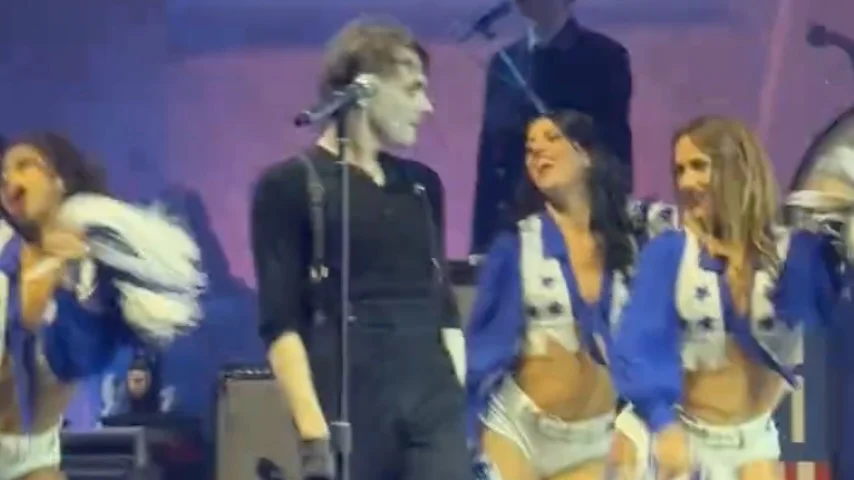
LOS ANGELES — In an unexpected legal clash bridging the worlds of stadium-sized rock theater and elite professional sports branding, the ownership group behind the Dallas Cowboys Cheerleaders has filed a federal lawsuit against rock icons My Chemical Romance.
The litigation, initiated by Pro Silver Star Ltd., stems from a dramatic and politically charged performance during the opening night of the band’s highly anticipated, five-night sold-out residency at the historic Hollywood Bowl. During the concert, backup dancers wore attire that closely mirrored the globally recognized uniform of the iconic NFL cheerleading squad, ultimately participating in a simulated, violent military conflict on stage.
The lawsuit seeks not only unspecified monetary damages but also an immediate temporary restraining order and a temporary injunction to halt the use of the costumes for the remainder of the residency. The case highlights the increasingly complex boundaries between first amendment artistic expression, trademark law, and the strict brand-management strategies of major sports conglomerates.
Main Facts of the Case
At the center of the legal dispute is a specific theatrical sequence that took place on October 21, 2026, during the first performance of My Chemical Romance’s The Black Parade revival tour. As the band tore through their anthemic hit "Teenagers," a troupe of dancers dressed in outfits strikingly similar to the famous Dallas Cowboys Cheerleaders (DCC) uniform took the stage.
According to court filings submitted by Pro Silver Star Ltd.—the corporate entity that owns and protects the intellectual property rights of the Dallas Cowboys Cheerleaders brand—the performance did not stop at mere visual homage. Following a synchronized dance routine, the performers playing the role of cheerleaders armed themselves with rifles to defend the band against a fictional, militarized opposing force within the narrative of the concert’s dystopian storyline. The sequence culminated in a staged firefight where these performers were depicted being shot.
Pro Silver Star Ltd. argues that this juxtaposition—combining an internationally renowned, family-friendly sports trademark with imagery of armed conflict, graphic violence, and political dystopia—infringes upon their trademark, dilutes the brand, and causes irreparable reputational harm. Furthermore, the legal complaint emphasizes viewer confusion, noting that numerous audience members and online commentators mistakenly believed that the actual Dallas Cowboys Cheerleaders had endorsed or participated in the politically charged rock concert.
Chronology of Events
To understand how a routine rock concert snowballed into a high-stakes intellectual property lawsuit, it is necessary to examine the sequence of events leading up to and immediately following the October 21 performance.
- October 21, 2026: My Chemical Romance kicks off their five-night residency at the Hollywood Bowl in Los Angeles, California. The shows are structured around a theatrical revival of their seminal 2006 concept album The Black Parade, staged within a fictional totalitarian dictatorship complete with elaborate sets, pyrotechnics, and armed conflict. During the performance of "Teenagers," dancers wearing uniforms resembling the Dallas Cowboys Cheerleaders take the stage, engage in choreography, and subsequently partake in a simulated gun battle.
- October 21–22, 2026: Fan-recorded footage of the performance circulates rapidly across social media platforms including TikTok, X (formerly Twitter), and Instagram. Confusion spreads online as viewers and commentators debate whether the dancers are professional cheerleaders moonlighting with the band or independent performers wearing spoofed costumes.
- October 22–23, 2026: Legal representatives for Pro Silver Star Ltd. review the public footage and audience reactions. Recognizing what they deem to be a severe trademark violation and brand degradation, corporate leadership moves swiftly to draft emergency legal actions ahead of the remaining sold-out Hollywood Bowl performances.
- Late October 2026: Pro Silver Star Ltd. formally files a lawsuit in federal court against My Chemical Romance, requesting a temporary restraining order, a temporary injunction to prevent future use of the uniforms during the residency, and unspecified monetary damages.
Supporting Data and Trademark Context
The Dallas Cowboys Cheerleaders are far more than a standard NFL dance troupe; they operate as a multi-million-dollar global brand, cultural phenomenon, and intellectual property powerhouse. Established in their modern incarnation in the 1970s, the DCC image—characterized by specific white-and-blue vest styling, fringe, stars, and go-go boots—is fiercely protected by Pro Silver Star Ltd.
The brand has cultivated a pristine, wholesome, and fiercely guarded public image through reality television shows (such as CMT’s Dallas Cowboys Cheerleaders: Making the Team and Netflix’s America’s Sweethearts: Dallas Cowboys Cheerleaders), international tours for the USO, and corporate endorsements. Because the visual elements of the uniform are registered trademarks, any unauthorized commercial, theatrical, or public use that creates a likelihood of consumer confusion or brand tarnishment leaves the user vulnerable to trademark infringement claims under the Lanham Act.
In legal terms, "dilution by tarnishment" occurs when a famous trademark is linked to unwholesome, violent, or controversial contexts, thereby diminishing the positive associations consumers hold toward the brand. Pro Silver Star Ltd.’s legal strategy relies heavily on this principle, arguing that associating the pristine DCC aesthetic with a simulated military massacre in a fictional dictatorship directly harms the commercial value and reputation of the franchise.
Official Responses and Legal Stance
Despite the aggressive legal maneuvering, Pro Silver Star Ltd. has taken pains in its court filings to clarify that its grievance is narrowly tailored. The organization is not attempting to censor My Chemical Romance’s music, political commentary, or overall artistic vision.
In their official legal filing, representatives for Pro Silver Star Ltd. stated:
"Silver Star is not litigious, and it takes no issue with MCR’s music, its artistic ambitions, or any message Defendants seek to convey. Silver Star does not Defendants to change their setlist, narrative, politics, choreography, or even their decision to put gun-toting performers on stage. Silver Star asks only that those performers not wear the DCC Uniform while doing it. The universe of alternative costume designs is effectively unlimited."
This precise wording is a calculated legal maneuver. By explicitly stating they have no issue with the song, the choreography, or the presence of armed performers, Silver Star attempts to preempt First Amendment defenses—such as parody, fair use, or artistic expression—that My Chemical Romance’s legal team will likely raise. The argument is simple: the band has a right to express anti-war, dystopian, or anti-establishment political messages through their art, but they do not have the right to utilize a protected, proprietary trademark to do so when countless alternative costume designs are available.
As of the publication of this report, representatives, management, and legal counsel for My Chemical Romance have not issued a formal public statement responding to the lawsuit or the request for a restraining order.
Broader Implications for Music, Art, and Trademark Law
The legal battle between Pro Silver Star Ltd. and My Chemical Romance touches upon broader, ongoing tensions within modern entertainment regarding the intersection of copyright law, trademark protection, and artistic freedom.
1. The Limits of Parody and Satire
While the First Amendment provides robust protections for satire, parody, and transformative artistic expression, trademark law applies a different standard than copyright law. Trademark holders possess a statutory duty to protect their marks from unauthorized commercial exploitation and dilution. When a parody crosses a line that causes actual consumer confusion—with fans genuinely believing a corporate entity has endorsed a violent or politically charged narrative—the legal shield of parody weakens significantly.
2. The Theatricality of The Black Parade
My Chemical Romance’s The Black Parade is rooted in theatricality, satire of American consumerism, militarism, and institutional hypocrisy. The song "Teenagers" itself is a critique of teenage angst, gun culture, and societal paranoia. Utilizing archetypal American symbols—such as high school cheerleaders—to critique institutional violence is a classic satirical device. However, by designing the costumes to explicitly mimic a specific, trademarked professional sports brand rather than a generic cheerleading squad, the band’s creative team inadvertently crossed a legal red line.
3. Precedent for Future Collaborations and Stage Productions
If Pro Silver Star Ltd. successfully secures an injunction or forces a settlement, it could set a strict precedent for how bands and theatrical producers utilize recognizable corporate and athletic iconography on stage. Set designers, costume directors, and touring musicians may be forced to exercise greater caution, ensuring that satirical costumes veer sufficiently away from real-world, legally protected uniforms to avoid swift and costly intellectual property litigation.
As the legal proceedings unfold in federal court, all eyes remain on My Chemical Romance’s remaining tour dates to see whether the band will alter their wardrobe choices, modify their choreography, or mount a vigorous defense of their artistic right to shock, subvert, and provoke through rock-and-roll theater.
 Nana
 Raul Delapena Setiawan
 Muslim
