

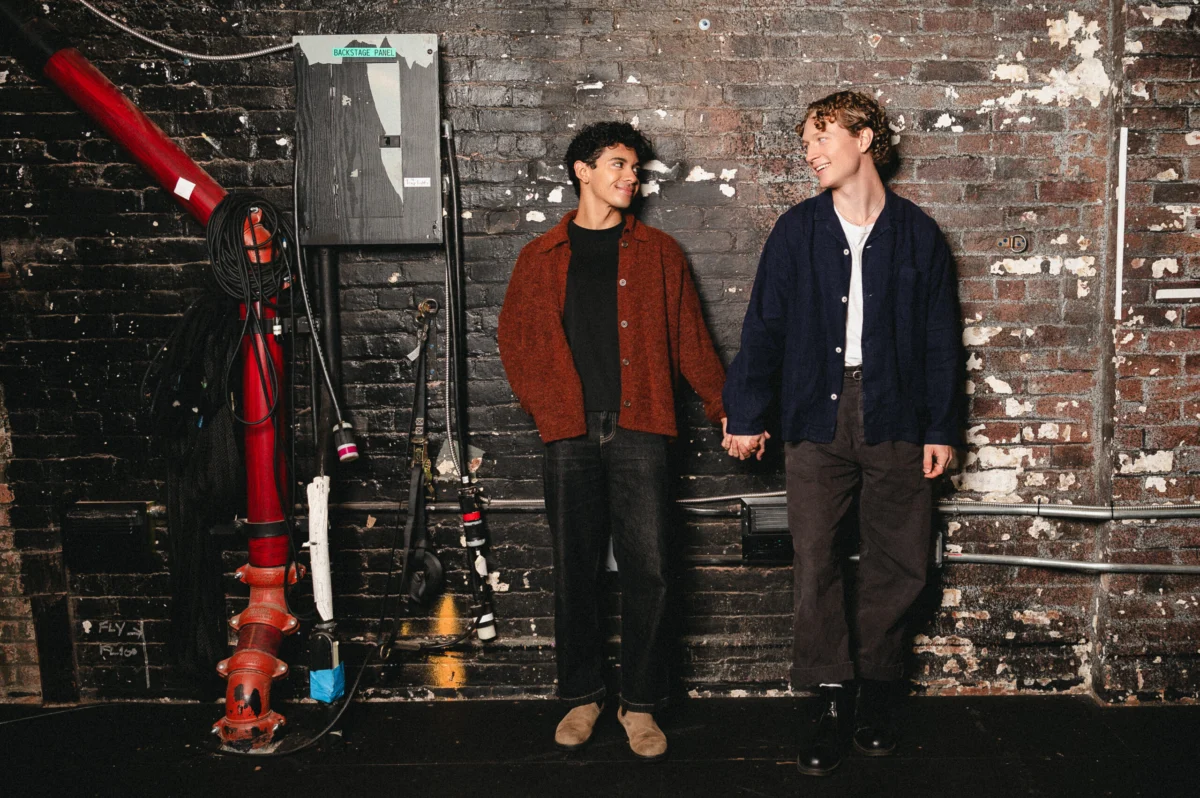
The enduring charm of The Fantasticks has long been defined by its simplicity: two young lovers, two meddling fathers, and a story about the universal, sometimes painful, transition from youthful idealism to the realities of adulthood. However, as the production begins its first-ever Broadway run at Manhattan’s Hayes Theater, audiences are discovering that the world’s longest-running musical has undergone a profound, timely transformation. By embracing gender-flipped casting and modernizing its narrative, this production—directed by Christopher Gattelli—is proving that the magic of Tom Jones and Harvey Schmidt’s classic remains as potent as ever, even when viewed through a contemporary lens.
A Fresh Take on a Timeless Romance
For decades, the romantic arc of the show centered on the characters of Matt and Luisa. In the Hayes Theater production, those roles are filled by newcomers Maxim Chlumecky and Nathan Levy, who portray the central couple as Matt and Lewis. This is not merely a change of nomenclature; it is a fundamental shift in the show’s emotional geometry.
The narrative still tracks the romantic tension of two lovers whose relationship is staged by their parents, but the dynamics of that parental interference have shifted. In this iteration, the meddling patriarchs are replaced by two mothers, played by the formidable Tony winner Ruthie Ann Miles and Tony nominee Leslie Rodriguez Kritzer. This change does more than update the family structure; it alters the tone of the entire piece, creating a fresh, queer-centered narrative that resonates with 2026 audiences while honoring the show’s original, whimsical spirit.
Chronology of a Classic’s Evolution
The Fantasticks has been an off-Broadway and regional theater staple since its debut in 1960. For over 60 years, its structure remained largely static. However, the seeds for the current Broadway transformation were sown by the late creator Tom Jones himself.

In the early 2000s, Jones began to grapple with the changing social landscape. Recognizing that the show’s language regarding the "abduction" plotline—originally termed "The Rape Ballet"—had become problematic, he worked to update the script. He successfully replaced the controversial terminology with "The Abduction Ballet" and removed explicit references to "rape" in songs like "It Depends on What You Pay."
Following Jones’ passing in 2023, director Christopher Gattelli took the mantle of preservation and innovation. Having recently steered the stage version of Schmigadoon! to significant critical acclaim and 12 Tony nominations, Gattelli approached The Fantasticks not as a museum piece, but as a living, breathing work of art. By integrating the revisions Jones made late in his life with the new gender-flipped casting, Gattelli has created a "composite version" that bridges the gap between the 1960s original and the modern Broadway landscape.
Supporting Data: Casting and Creative Choices
The casting of Chlumecky and Levy has drawn immediate comparisons to other high-profile queer romances in popular media, including the fictional obsession of HBO’s Heated Rivalry. While the actors humbly describe their portrayal as "off-brand Heated Rivalry," their director is quick to push back against the modesty.
"There will be a lot of love for them," Gattelli notes. "I’m telling you, they are quite the discovery and quite the pairing. People are going to fall in love with them without a doubt."

The technical adjustments to the script have been subtle but impactful. For instance, the famous monologue where the protagonist expresses their desire to be special—"Please, God, please, don’t let me be normal!"—has been reimagined. Recognizing that the term "normal" carries a vastly different weight for a queer man than it did for the traditional character of Luisa, the creative team has implemented a new line. While the actors are keeping the exact wording under wraps until the official opening, the change serves as a prime example of how the production is adapting the emotional heart of the story to fit the identity of its new leads.
Official Responses and Creative Vision
The creative team emphasizes that these changes were not made to subvert the original intent, but to amplify it. Gattelli points out that the show’s endurance lies in its ability to balance the "then" and the "now."
"The fact that they did this gender swap made it even more obvious that this show could be about two boys or two girls instead of just a boy and a girl," Gattelli explains. "At its heart, it’s a musical about love, loss, and growth, and the way they captured that is like magic in a bottle."
The actors echo this sentiment. For Chlumecky, the rehearsal process has been an exercise in discovery. "There’s been a lot of figuring out in the rehearsal room which jokes work and which emotional keys work now that three characters have switched genders," he explains. "But we’re also making sure to honor what The Fantasticks has always been."

Levy adds, "If anything, it’s given us the confidence to continue to ask questions and not be afraid to suggest new things. As Chris has said, Tom himself went back into his own work and changed it, and we realize how impressive and honorable that is."
Zane Phillips, who portrays the enigmatic El Gallo, also notes that the character’s interaction with the two mothers creates a unique dynamic. "Modern sensibilities require that we update it," Phillips says. "And Tom did a really good job making the revised version sound natural… it doesn’t change any of the story."
Implications for Modern Musical Theater
The implications of this production extend far beyond the Hayes Theater. By successfully integrating gender-fluid casting into one of the most traditional pillars of the American musical theater canon, the production signals a major shift in how historical works are treated in the 21st century.
1. The Power of "Composite" Adaptations
Gattelli’s approach of keeping the original text alongside modern revisions creates a template for future revivals. It suggests that classics need not be abandoned or strictly performed as period pieces; instead, they can be adapted to reflect contemporary values without losing their essential DNA.

2. Expanding the Definition of "Universal"
The transition of the "don’t let me be normal" monologue highlights a shift in theater-making. Where once "universality" was assumed to be the experience of the majority, this production suggests that specific, lived experiences of minority groups can, in fact, reveal new layers of universal truth. As Gattelli notes, the desire to be "someone special" is a human experience that transcends gender, and this new version makes that theme resonate even more forcefully.
3. Redefining the "Rivalry"
The playful branding of this production as "Chill Rivalry" is a nod to the current pop-culture climate. By acknowledging the audience’s desire for compelling, complex romantic relationships, the production invites a younger demographic into a theater space that they might have previously considered "old fashioned."
Final Reflections
As the cast enters their final weeks of previews before the November 16 opening, the energy at the Hayes Theater is palpable. The process of refining these iconic scenes has been one of both technical rigor and emotional vulnerability. For Chlumecky, the reward is in the audience’s reaction. "I’m excited for audiences to get goose bumps, too," he says. "It’s going to be cool."
In the end, The Fantasticks remains what it has always been: a story about the bittersweet beauty of growing up, the necessity of disillusionment, and the transformative power of love. By allowing the story to be told through the eyes of Matt and Lewis, the production hasn’t changed the play—it has allowed the play to grow up with its audience. It serves as a testament to the fact that when a story is truly built on "magic in a bottle," it doesn’t matter who is holding the cork; the magic will find its way out.
 Neng Nana
 rifanmuazin
 Raul Delapena Setiawan
