

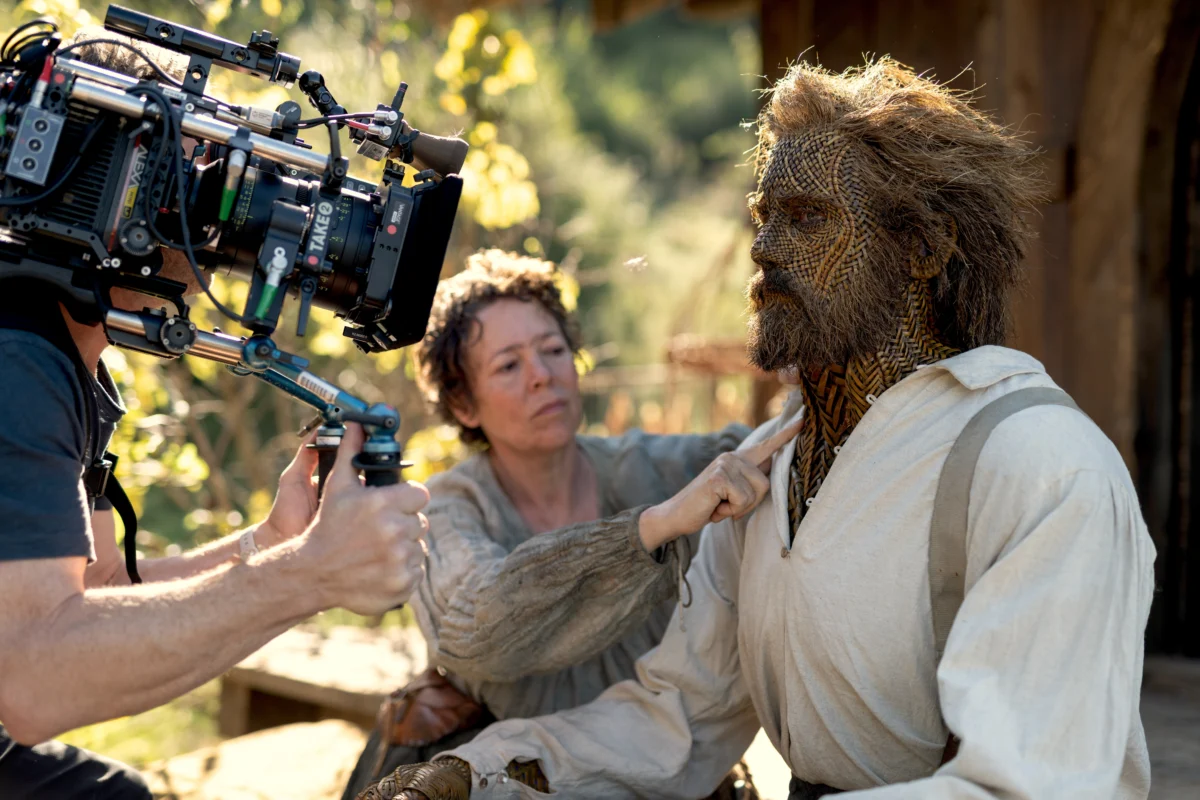
You will never look at a humble wicker basket the same way again after witnessing Wicker, the daring, raunchy, and visually arresting period comedy that has become a surprise breakout hit at the box office. Based on Ursula Wills-Jones’s short story "The Wicker Husband," the film presents a premise that feels both mythological and bizarrely intimate: an outcast Fisherwoman, played with career-defining nuance by Olivia Colman, commissions a master Basket Weaver (Peter Dinklage) to craft her a husband.
The result is a man woven entirely from reeds—a character who is as fragile as he is romantic, and as rigid as he is expressive. Bringing this creature to life required the towering, 6’4" frame of Alexander Skarsgård and a level of technical innovation that pushed the boundaries of modern prosthetics and costume design into uncharted territory.
The Genesis of a Botanical Behemoth
The challenge facing directors Eleanor Wilson and Alex Huston Fischer was clear: if the audience did not believe in the reality of the Wicker Husband, the film’s central, tender romance would crumble like dry straw. The success of the film hinged entirely on the quality of the practical effects. To achieve this, the production turned to the legendary Wētā Workshop, specifically tasking art director and prosthetic makeup designer Joe Dunckley and makeup and hair designer Sarah Rubano with an eighteen-month developmental odyssey.

"Traditional materials wouldn’t be viable because wicker’s geometry is just far too complex; it’s really unmoldable," Dunckley explained in an interview with IndieWire. The team realized early on that they were not just building a suit; they were inventing an entirely new category of prosthetics. While the team had a firm grasp on the cutting edge of 3D printing technology, the hardware was never intended for the complex, interlaced patterns required to mimic woven plant fibers.
A Chronology of Craft: From Avatar to the Wicker Husband
The creation process was a serendipitous intersection of talent and timing. The Wētā textiles and weaving team had just concluded their long-term work on James Cameron’s Avatar franchise, where they had spent years perfecting the weaving of complex Na’vi costumes. This expertise was immediately transferred to the world of Wicker.
The production timeline functioned as a loop of feedback and refinement:

- Conceptualization: The art team blocked out the basic human-like forms.
- Weave Sampling: Head weaver Jasmin Van Lith created physical samples to test structural integrity.
- Integration: Those physical samples were digitized back into 2D and 3D models.
- Iterative Testing: The team 3D-printed test pieces to ensure the "wicker" could mimic muscle fiber—tight enough to hold form, but supple enough to allow Skarsgård to move, flex, and emote.
This process was repeated over dozens of iterations to ensure that every movement—from a subtle head tilt to a romantic gesture—looked organic rather than like a rigid statue.
Supporting Data: The Anatomy of a Wicker Man
To make the character functional, the design team had to move away from heavy, singular structures. Rubano noted that the final suit consisted of 50 individual, 3D-printed body pieces anchored to a foundation of high-performance spandex and power mesh.
The facial construction was perhaps the most demanding element. Rubano likened the application to "a Batman mask," involving individual wicker ears, a jaw piece, cheekbones, and a forehead prosthetic. To maintain the character’s humanity, the team used muka—a traditional New Zealand flax fiber—which was shredded, teased, and knotted into the wicker structure to replicate hair, eyelashes, and stubble.

Because the costume was almost entirely practical, the team had to minimize the need for CGI. Only the most minute details, such as the removal of natural pinkness from Skarsgård’s tear ducts or the addition of sunlight flickering through the weave, were handled digitally. For the rest, it was all down to the physical performance of the actor and the ingenuity of the design team.
Dressing the Husband: A Collaborative Costume Effort
While Wētā handled the "flesh and bone" of the wicker, the challenge of clothing the character fell to Hungarian costume designer duo Tóth András Dániel and Attila Godena-Juhász. Their task was to ensure that the clothes looked lived-in and historically grounded, even though the film takes place in an intentionally nebulous, otherworldly setting.
Dániel and Godena-Juhász drew heavily from Hungarian folk art—a visual language largely unfamiliar to international audiences, which helped cement the film’s "otherworldly" atmosphere. One of the most humorous anecdotes from the production involved a last-minute request from the directors to see the Wicker Husband in his birthday suit.

"We invented a technique: printing on an elastic base with a special paint that, if you treat it with heat, it’s three-dimensional… wicker penis included," Dániel recalled with a laugh. "Alex made a joke that because he came to the workshop for several fittings, he really wanted to know the size of his [penis]."
The clothing itself was designed to feel "grown out of." Because Skarsgård’s frame was already enlarged by the prosthetics, the designers purposely made his garments slightly too small, creating a poignant silhouette of a man who has outgrown his world.
Official Responses and Creative Philosophies
The creative team was acutely aware of the risk: they were asking the audience to fall in love with a pile of sticks. "We weren’t making a human being or a creature of flesh and blood," Dunckley noted. "We were making a romantic lead."

The designers emphasized that their goal was to hide Skarsgård’s skin, but never his soul. By using the padding underneath the wicker to maintain the silhouette even when Skarsgård wasn’t in full makeup, they allowed the actor to focus on his performance rather than the weight of the suit.
The actors and directors have praised this collaborative, low-tech approach. By keeping the interactions between Colman and Skarsgård grounded in a physical reality—even a surreal one—the chemistry between the two remained tangible. The "wedding suit" seen in the film, a dark blue-greyish tweed based on 17th-century menswear, became a symbolic piece of the character’s evolution, grounding his strange existence in a recognizable, sophisticated history.
Implications for Future Filmmaking
The success of Wicker carries significant implications for the future of practical effects in Hollywood. In an era dominated by green screens and motion capture, Wicker stands as a testament to the power of tactile, tangible filmmaking.

The production proved that even the most "unmoldable" textures can be replicated with enough research and iterative design. By blending high-tech 3D printing with traditional weaving techniques and deep-seated historical research, the team behind Wicker has set a new benchmark for character design.
Furthermore, the film challenges the industry’s reliance on digital shortcuts. When audiences see a character as complex as the Wicker Husband, they respond to the "reality" of the performance—the way light catches the fibers, the way the costume moves with the actor, and the subtle imperfections that come with hand-crafted elements.
As the film continues its successful run, it serves as a reminder that the best "magic" in cinema doesn’t happen on a hard drive—it happens in a workshop, through eighteen months of painstaking research, a bit of trial and error, and a willingness to embrace the absurd.

Ultimately, Wicker is a victory for the artisans. It is a film that demands to be looked at closely, not just for its romantic narrative, but for the incredible, splinter-free engineering that allowed a man of reeds to capture the hearts of audiences worldwide. As the credits roll, one is left with a single, lingering thought: in the right hands, anything can be brought to life.
 Nana
 Evan Lee Salim
 Asep Darmawan
