

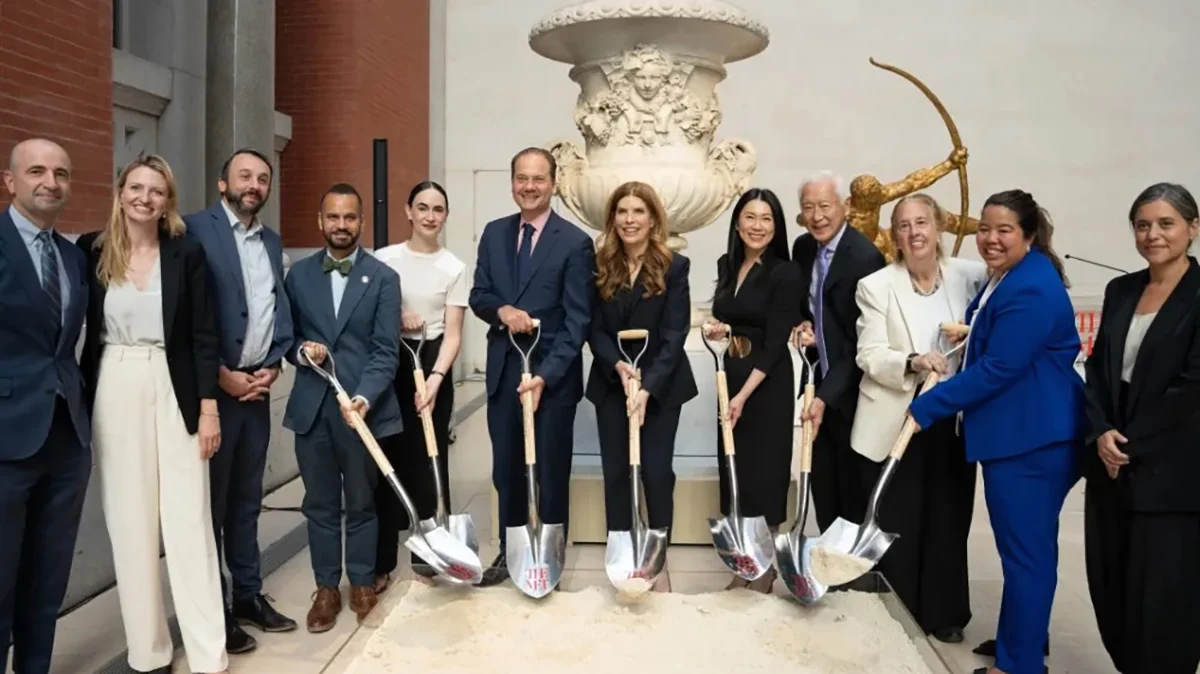
In a momentous ceremony that marks a transformative chapter for one of the world’s most prestigious cultural institutions, the Metropolitan Museum of Art officially broke ground this Tuesday on its highly anticipated modern and contemporary art wing. Named the Oscar L. Tang and H. M. Agnes Hsu-Tang Wing, the project represents more than just a structural expansion; it is a bold architectural statement intended to redefine how the public engages with 20th and 21st-century art within the storied halls of the Met.
The groundbreaking event, held on the museum’s Fifth Avenue campus, saw a convergence of institutional leaders, philanthropic visionaries, and prominent New York political figures. Among those in attendance were the donors themselves, Oscar L. Tang and H. M. Agnes Hsu-Tang, alongside the Met’s director and CEO Max Hollein, the curator of modern and contemporary art David Breslin, and head of capital projects Brett Gallard. The presence of New York City Council Speaker Julie Menin, alongside Council Members Virginia Maloney and Gale Brewer, and state officials Assemblymember Keith Powers and Senator Jose Serrano, underscored the project’s significance not only to the art world but to the cultural fabric of New York City itself.
A Decade in the Making: The Chronology of an Ambition
The path to this week’s groundbreaking has been characterized by meticulous planning, strategic shifts in architectural vision, and an unprecedented level of private support. While the museum had been contemplating an expansion of its modern and contemporary footprint since 2014, the project moved from the realm of abstract planning to tangible reality in 2021.
That year, the project received its most critical catalyst: a transformative $125 million gift from Oscar L. Tang and H. M. Agnes Hsu-Tang. As two of the world’s most influential art collectors and longtime patrons of the arts, their contribution was not only a financial windfall but a vote of confidence in the Met’s future. At the time of the announcement, the gift stood as the largest single capital donation in the institution’s history, setting the tone for the fundraising campaign that followed.
Following the securing of funding, the museum launched an exhaustive search for an architectural vision that could balance the Met’s historic Beaux-Arts architecture with the fluid, demanding requirements of contemporary art. In 2022, the Met announced the selection of Frida Escobedo, the visionary Mexico City-based architect, to lead the design. Escobedo, known for her ability to integrate site-specific historical context with contemporary material innovation, spent the next three years refining a design that would respect the labyrinthine history of the Met’s campus. In 2025, the museum finally unveiled the blueprints for the wing, revealing a structure that promises to harmonize with the museum’s existing aesthetic while signaling a new era of openness and accessibility.
Architectural Innovation: Designing for the Future
The new Tang Wing will occupy a 126,000-square-foot footprint, designed to address the evolving needs of contemporary artistic practice. Central to the design philosophy is flexibility. The wing will feature approximately 70,000 square feet of dedicated exhibition space spread across five levels.
One of the most striking features of Escobedo’s design is the variation in ceiling heights, which will range from 11 to 22 feet. This deliberate design choice acknowledges the vast spectrum of contemporary art, from intimate, two-dimensional works that require focused, gallery-style lighting and proportions, to the massive, immersive installations that define the current era of artistic production.
The exterior and structural logic of the wing have been carefully considered to reflect the Met’s eclectic architectural lineage. “The design for the Tang Wing weaves together the many architectural styles that make up The Met’s campus,” Escobedo noted during the reveal. “It honors each building’s own history while creating a space that is distinctly of our time.” The top two levels of the structure will be subtly recessed, creating outdoor terrace spaces that provide a new vantage point over the city and the museum’s own grounds.
Furthermore, the design addresses the beloved tradition of the Met’s rooftop garden. The previous 5th-floor garden, a staple of the museum’s visitor experience, was closed in October 2023 to clear the site for construction. It is slated to return in 2030, relocated to the fourth-floor terrace of the new wing, where it will boast significantly expanded square footage and enhanced accessibility.
Financial Foundations and Institutional Support
The scale of the Tang Wing project is matched only by the scale of its financing. To date, the Metropolitan Museum of Art has successfully raised $670 million. According to official statements from the institution, this capital is earmarked for the total construction costs of the building, with a substantial remainder allocated to support the wing’s ongoing operating costs.
This financial cushion is vital for an institution of the Met’s size, ensuring that the new wing remains a sustainable asset rather than a budgetary burden. The fundraising success is a testament to the Met’s status as a global powerhouse, capable of attracting high-level philanthropy that transcends standard endowment growth.
Max Hollein, the Met’s Director and CEO, emphasized the collaborative nature of this achievement during the ceremony. “Working with Frida Escobedo on her visionary design has been an enormous privilege,” Hollein said. “Together with our trustees and donors, we are excited to celebrate this important milestone as we begin the work that will turn that vision into a reality.”
Implications for the Museum and the Public
The completion of the Tang Wing in 2030 will fundamentally alter the experience of visiting the Metropolitan Museum of Art. For decades, the Met has been lauded for its encyclopedic collection, yet its modern and contemporary offerings have historically felt fragmented compared to the overwhelming richness of its historical holdings.
The Tang Wing will provide a cohesive narrative space for the 20th and 21st centuries. By centralizing these works in a building specifically designed for contemporary art, the museum is signaling a commitment to remain relevant in a rapidly changing cultural landscape. The inclusion of a top-floor café and expanded terrace space also speaks to a broader goal: transforming the Met from a place of quiet contemplation into a dynamic social hub for New Yorkers and global tourists alike.
The political presence at the groundbreaking also highlights the economic implications of the project. As New York City continues to recover and evolve in a post-pandemic world, large-scale cultural infrastructure projects serve as engines for tourism and local employment. The construction phase alone will generate hundreds of jobs, while the completed wing is expected to draw millions of additional visitors, further solidifying the Met’s role as the anchor of the city’s “Museum Mile.”
Looking Toward 2030
As the ground is broken and the first phase of construction begins, the focus now shifts to the complex logistical task of building in the heart of Manhattan. The Metropolitan Museum of Art remains open to the public, though the construction zone will necessitate navigating around the site over the next several years.
For the art world, the Tang Wing represents a test of whether a historic institution can successfully integrate the ephemeral, fast-moving, and often radical nature of contemporary art into its permanent collection. With Frida Escobedo’s design acting as the bridge between the Met’s past and its future, and with the unwavering support of the Tangs, the institution is positioning itself to not only house the art of the future but to actively shape the discourse surrounding it.
The unveiling in 2030 will be more than just the opening of a new gallery; it will be a milestone in the history of museum architecture and a defining moment for the Metropolitan Museum of Art. As the city watches the steel rise, the anticipation centers on how these new, flexible, and light-filled spaces will interact with the art of our time—and the art yet to be created. For now, the ceremony served as a reminder that even the most established institutions must continuously break new ground to remain the keepers of our collective cultural heritage.
 Ali Ikhwan
 Laily UPN
 Raul Delapena Setiawan
