

Warning: This article contains major spoilers for the season finale of AMC’s The Vampire Lestat.
The first season of The Vampire Lestat has drawn to a haunting, cataclysmic close, marking a bold evolution for the Anne Rice-derived universe that began with Interview with the Vampire. In the closing moments of the finale, titled “The Failures,” Sam Reid’s titular vampire stands upon his balcony in Montreal, surveying a world transformed into a smoldering ruin. It is an image of profound desolation, signaling that the "Brat Prince" of the undead has finally reached the zenith of his own self-destructive tendencies.
The Architect of Ruin: Behind the Final Frame
For Sam Reid, the filming of that final sequence was a masterclass in imagination. While the audience sees a cityscape decimated by some unknown force—a direct result of the events Lestat has set into motion—the production set in Montreal remained blissfully intact.

“They told me that the whole world has essentially been bombed,” Reid explains. “We’re in a post-apocalyptic environment that Lestat is responsible for. I always knew that was going to be the last beat from the day we started filming, and it’s a good resolution because Lestat has spent the season working his way up to accepting his own failures. Now those failures have led to this cataclysmic event, and he fully understands that he’s responsible for it.”
This moment of realization serves as the thematic anchor for the season. Throughout these episodes, Lestat has been a figure of internal chaos, sifting through over two centuries of memories and transgressions. The finale’s visual of the ruined world is not merely a plot point; it is a manifestation of the character’s psyche, proving that Lestat’s journey is as much about confronting the collateral damage of his ego as it is about his survival.
Chronology of the Reckoning
Fans of Anne Rice’s seminal Vampire Chronicles recognize the trajectory immediately: the rise of Akasha, the Queen of the Damned. In the original source material, the second book culminates in a massive, global concert that acts as a beacon for the ancient progenitor of all vampires.

Showrunner Rolin Jones initially intended to bring that massive, concert-driven awakening to the screen for the Season 1 finale. However, logistical and creative realities led to a pivot. “We get a lot of money to make this show, but we’re not Game of Thrones,” Jones admits with a laugh. The production opted for a more “interior landscape” for the season’s conclusion, choosing to use the concert as a potential opening act for a hypothetical fourth season rather than a finale spectacle.
This decision allowed the show to focus on the emotional toll of the narrative. The season has functioned as a deep dive into the “tragic clown” archetype of Lestat, forcing him to reconcile with his past, his loves, and the monsters he has created—both literal and metaphorical.
The Physical and Emotional Toll: A Descent into the Macabre
The penultimate episode provided what many critics consider the season’s most visceral sequence: the brutal severing of Lestat and Louis’s heads by the alliance of Armand (Assad Zaman) and Daniel (Eric Bogosian). The finale picks up in the immediate aftermath, with the two vampires kept alive in a manner reminiscent of the 1962 cult horror film The Brain That Wouldn’t Die.

For Jacob Anderson, who plays Louis, the experience was grueling. “It’s not the most fun I’ve had on a set,” Anderson admits. “I had to think a lot about the physicality of it—like, how does he make a sound without his lungs attached to him? I read some pretty gross things while trying to figure out how to do that. At one point, director Alan Taylor was like, ‘I need to think about that stuff slightly less.’”
The sequence was not just an exercise in body horror; it was a character study. By isolating these figures, the writers forced the characters to confront their dependencies. Delainey Hayles, who plays the complex role of Regina—a woman manipulated by Armand to stand in for Louis’s lost daughter, Claudia—notes the surreal nature of the production. “When I first got to set, I saw the hole in the table and I was like, ‘I wonder what that’s going to be for?’ Then I saw Jacob climb in it, and I was like, ‘Whoa, okay!’”
Influences and Artistic Vision
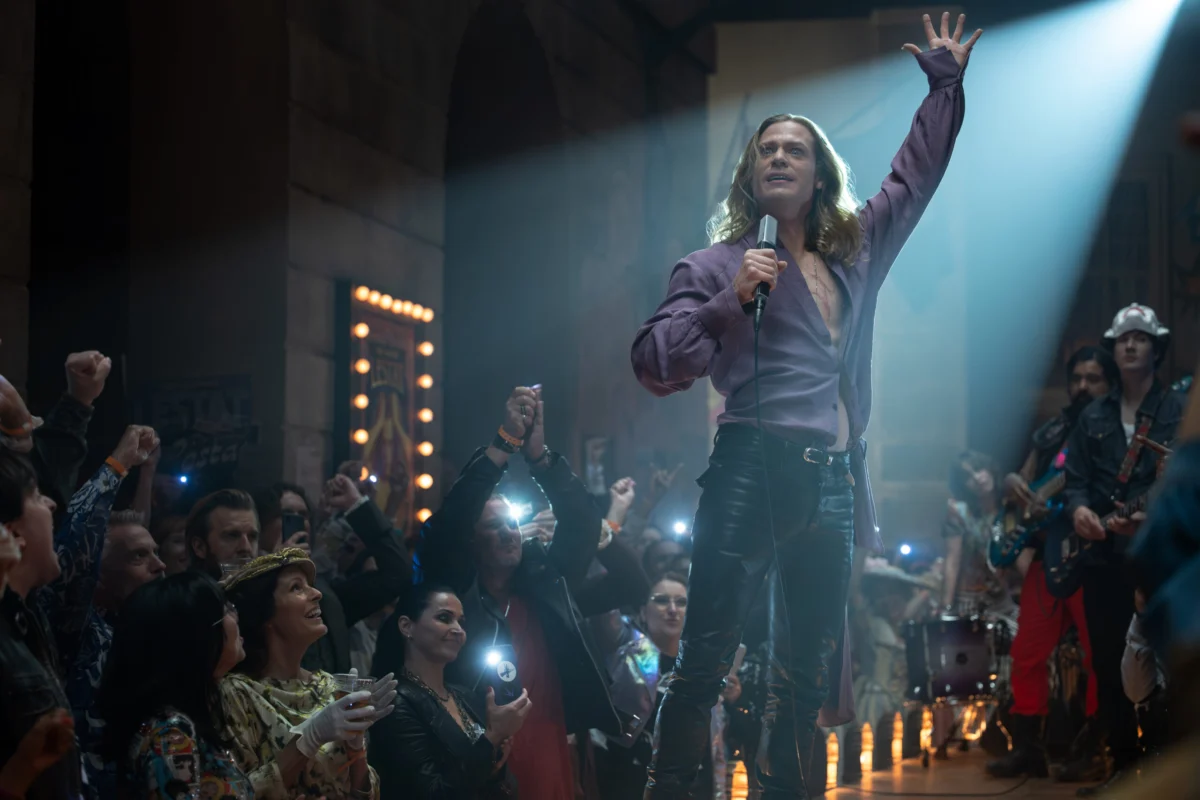
The finale’s structure, particularly the hallucinatory final performance where Lestat is confronted by the ghosts of those he has harmed, has drawn comparisons to Bob Fosse’s All That Jazz. While both Jones and Reid acknowledge the impact of Fosse’s work, they point to other, more esoteric influences that shaped the tone of the season.

“If I had to pick two movies that were the biggest influences on this season, I’d have to go with The Great Beauty and Barton Fink,” says Jones. The latter, in particular, resonates with the show’s exploration of a protagonist trapped in a surreal, dream-like state of his own making.
This artistic choice highlights the show’s departure from traditional supernatural dramas. By blending the grand, operatic nature of Anne Rice’s writing with the intimate, often uncomfortable psychological realism of arthouse cinema, the creative team has carved out a unique space in modern television. The return of Paul (Steven G. Norfleet), Louis’s brother, in the finale’s final musical number serves as a bridge between the show’s past and its present. It is a moment of catharsis for Lestat, who realizes that his quest for external validation from Louis may finally be over.
Implications for a Potential Season 4
As the industry turns its gaze toward the upcoming San Diego Comic-Con, speculation regarding a Season 4 renewal is at an all-time high. Rolin Jones is characteristically coy but optimistic. He notes that while the first two seasons were centered on a small room in Dubai, and the third on a singular, chaotic mind in Montreal, a fourth season would demand a broader scope.

“Season 4 seems to want to be told by multiple people,” Jones suggests, hinting at the ensemble nature of the Queen of the Damned narrative. When asked if the show might undergo another title change to reflect this shift, he doesn’t rule it out, noting that fans have been remarkably adaptable to the rebranding. “It seems like fans have embraced it. And when you think of some of the biggest blockbusters of all time like The Empire Strikes Back and Return of the Jedi, no colons there. That’s the title—get on board.”
The relationship between Lestat and Akasha (Sheila Atim) also looms large. Reid and Atim have reportedly had preliminary discussions about the evolution of their characters. “This season, Lestat has examined his past through a very specific lens,” Reid says. “What I hope to see happen next is Lestat acknowledge that perhaps certain things that happened in his past—potentially in the 18th century—happened in a different light that he wasn’t really ready to examine in this season.”
Conclusion: The Immortal Universe Expanded
The conclusion of The Vampire Lestat Season 1 is a testament to the show’s willingness to take risks. By shifting the perspective, embracing a new visual language, and committing to the "internal landscape" of its anti-hero, the series has moved beyond the constraints of a standard adaptation.

Whether the audience is ready for the global apocalypse that the finale teases remains to be seen, but the creative team is clearly prepared to push the boundaries of what a vampire show can achieve. As Jones puts it, the finale is designed to leave the audience in a state of suspended anticipation: “Emotionally, there are places that the characters get to by the end of this season that there’s satisfaction to this ending. But it’s also built to say, ‘We’re not done yet.’”
With the world in ruins and 50,000 vampires waiting for a show, the stage is set for a reckoning. If the history of the series is any indication, the next chapter will be as ambitious, haunting, and unapologetically bold as the one that just concluded. Fans will be watching the upcoming Comic-Con announcements with bated breath, waiting to see if the "Brat Prince" will truly get the grand, worldwide stage he so desperately craves.
 Ammar Sabilarrohman
 Siti Muinah
