

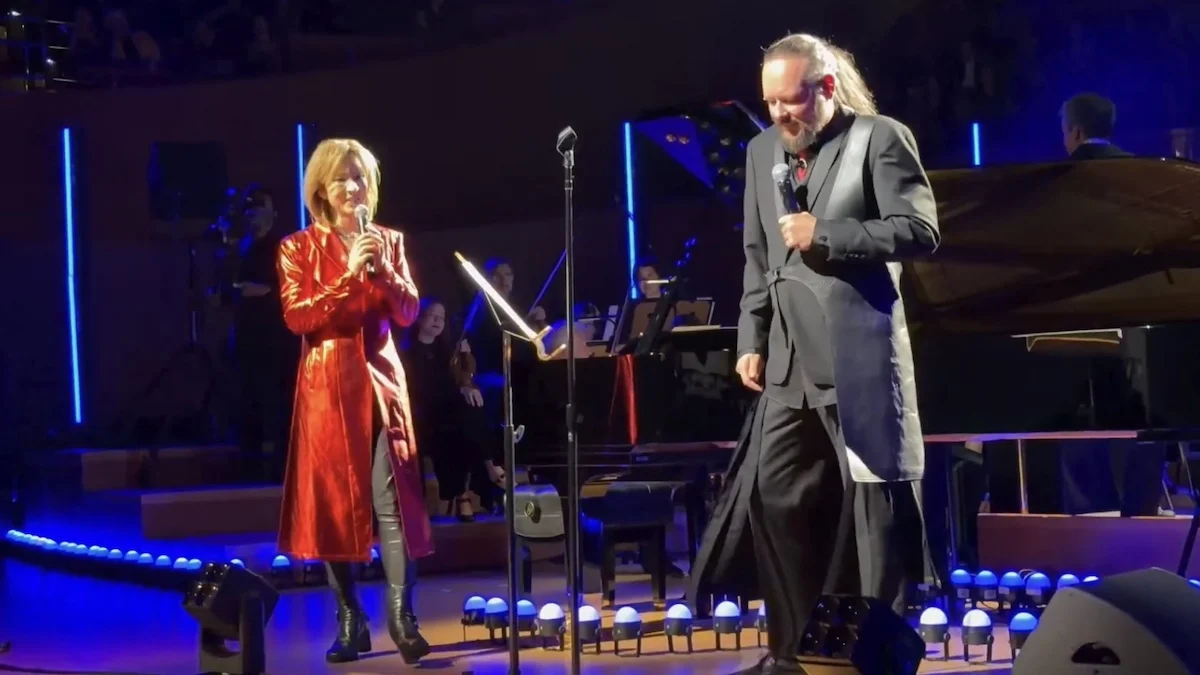
In a convergence of two vastly different musical worlds, the hallowed halls of Los Angeles’ Walt Disney Concert Hall played host to a boundary-defying collaboration this past Thursday. Jonathan Davis, the haunting, iconic frontman of nu-metal pioneers Korn, joined forces with Yoshiki—the legendary composer, pianist, and drummer behind the seminal Japanese rock band X Japan—for a radical orchestral reimagining of Korn’s 1998 anthem, "Freak on a Leash."
The performance, which served as the centerpiece of the first night of Yoshiki’s two-night residency titled "Yoshiki Classical in Los Angeles," provided a startling reminder of the versatility of the nu-metal canon when stripped of its distorted guitar fuzz and re-clothed in the intricate textures of a full symphony orchestra.
The Intersection of Genre and Vision: Main Facts
The collaboration was not merely a guest spot; it was a carefully curated artistic dialogue. Yoshiki, who has spent decades bridging the gap between classical composition and high-octane rock, invited Davis to bring his signature vocal angst into a space designed for acoustic perfection.
For those in attendance, the experience was jarring in the most compelling way. As the orchestra swelled, the familiar, staccato opening of "Freak on a Leash" was rendered not by Fieldy’s iconic bass line, but by strings and percussion that captured the song’s inherent tension. Davis, usually backed by the wall of sound that defines Korn’s live sets, stood at the center of the stage, his voice navigating the nuanced arrangements with a vulnerability rarely exposed in arena settings.
The performance served as a testament to the fact that great songwriting survives genre transmutation. By removing the heavy instrumentation, the audience was forced to engage with the lyrical pain and rhythmic complexity that initially propelled Korn to stardom in the late 90s.
A Night of Orchestral Mastery: The Chronology
The evening’s proceedings were meticulously structured to highlight Yoshiki’s dual identity as a classical pianist and a rock percussionist.
The Prelude
The night began with a series of classical compositions that showcased Yoshiki’s prowess as a composer. The Walt Disney Concert Hall, designed by Frank Gehry, provided an acoustic backdrop that allowed every nuance of the orchestral arrangements to resonate. Attendees were treated to a selection of Yoshiki’s solo work, which leaned heavily into neo-classical motifs, setting a tone of high art and refined elegance.
The Arrival of Davis
Midway through the set, the atmosphere shifted. When Jonathan Davis took the stage, the shift in energy was palpable. The audience, largely comprised of a mix of classical aficionados and lifelong Korn fans, leaned in. Davis began the rendition of "Freak on a Leash" in a subdued, almost melancholic tone. His delivery was restrained, focusing on the cadence of the lyrics rather than the aggressive bite that usually punctuates his performances.
The Orchestral Crescendo
As the song progressed, the arrangement grew in complexity. Yoshiki, stationed at his grand piano, led the orchestra through a haunting interpretation of the song’s bridge. It was here that the true brilliance of the collaboration revealed itself: the "scatting" section of the song, normally a chaotic display of vocal percussion, was transformed into a syncopated rhythmic interplay between Davis and the orchestral percussionists.
The Climax
In a final, visceral shift, the song returned to its roots. As the tempo increased, Yoshiki moved from his piano to the drum kit positioned at the front of the stage. The two musicians engaged in a frantic, high-energy finale that mirrored the intensity of a traditional Korn concert, proving that even in a formal setting, the spirit of rebellion remains intact.
The Architecture of the Sound: Supporting Data
The success of this collaboration lies in the technical alignment between Yoshiki’s compositional style and Korn’s structural foundation.
- The Orchestral Arrangement: Yoshiki is known for his "Visual Kei" style—a subculture of Japanese rock that emphasizes flamboyant aesthetics and complex, classically-influenced compositions. By applying this "X Japan" sensibility to Korn, the song’s inherent "swing" was highlighted. The use of cellos to mimic the low-end frequency of a seven-string guitar provided a depth that standard rock recordings often lack.
- Vocal Dynamics: Jonathan Davis has often cited a diverse range of influences, from industrial music to dark wave. His ability to modulate his voice—transitioning from a whisper to a guttural scream—allowed the orchestral arrangement to breathe. The data suggests that this is the first time a major nu-metal track has been integrated into a formal Yoshiki concert, signaling a potential shift in how legacy metal acts might seek to perform their catalogs in the future.
- Venue Impact: The Walt Disney Concert Hall is a notoriously unforgiving venue for non-classical acts due to its acoustic precision. However, the choice of venue was deliberate. By forcing the performance into a space that demands clarity, both Davis and Yoshiki proved that their music—often dismissed by critics as "noise" in the late 90s—is structurally sound enough to withstand the scrutiny of a symphony hall.
The Artistic Vision: Official Responses
In brief remarks following the performance, Yoshiki noted the importance of breaking down the "walls" between musical styles. "Music has no borders," Yoshiki stated in a press briefing following the show. "When I look at the history of rock and the history of classical music, they share the same DNA: they are both vehicles for extreme emotion. Jonathan understands that better than almost anyone I have worked with."
Jonathan Davis, typically reserved regarding his collaborative projects, expressed a similar sentiment. "Playing with an orchestra isn’t about being ‘polite’ or ‘proper,’" Davis noted. "It’s about finding the ghost in the machine. When you take the volume away, you realize how much pain is actually written into these songs. Yoshiki didn’t just ‘cover’ the song; he excavated it."
Industry critics have lauded the collaboration as a "bold pivot" for both artists. Music historians point to this event as a milestone in the "Cross-Pollination Era" of modern music, where artists who gained fame in the 1990s are increasingly looking toward high-culture collaborations to re-contextualize their legacies.
Implications for the Future of Nu-Metal
The performance at the Walt Disney Concert Hall has far-reaching implications for the legacy of the nu-metal genre.
The Legitimacy of Nu-Metal
For decades, nu-metal has struggled with critical legitimacy. Often maligned by the press during its 1998–2003 peak, the genre has seen a massive resurgence in the streaming era. This performance acts as a "seal of approval" from the high-art establishment. If a song like "Freak on a Leash" can be performed in the same venue as the Los Angeles Philharmonic, it suggests that the genre has moved into a "canonization" phase.
Collaborative Touring Models
The success of this two-night stand provides a blueprint for other metal artists. Rather than relying on standard "greatest hits" tours, legacy artists may look to integrate orchestral arrangements as a way to extend the lifespan of their touring careers. This model allows for higher ticket prices, more prestigious venues, and a deeper engagement with a fan base that has aged alongside the music.
Cross-Cultural Exchange
Finally, the pairing of an American nu-metal pioneer with a Japanese rock icon highlights the global nature of modern music. As the barriers between Western rock and Eastern visual arts continue to dissolve, we can expect to see more high-profile collaborations that bypass traditional industry categories.
Conclusion: A Lasting Legacy
As Yoshiki prepared for his second night at the Walt Disney Concert Hall, the buzz surrounding the Thursday performance continued to grow. The collaboration between Davis and Yoshiki was not merely a novelty; it was a sophisticated deconstruction of a modern classic. By stripping away the distortion and the artifice, they exposed the raw, beating heart of the music.
Whether this leads to a full studio project remains to be seen. However, for those lucky enough to witness the meeting of these two musical titans, it was a moment that defied expectation. In the echo of the concert hall, "Freak on a Leash" was no longer just a nu-metal song; it was a symphony of modern angst, played to the standards of the masters. As the lights dimmed and the final chords resonated through the hall, one thing was clear: the evolution of metal has only just begun.
 Asro
Asro
 Lina Irawan
 rifanmuazin
