

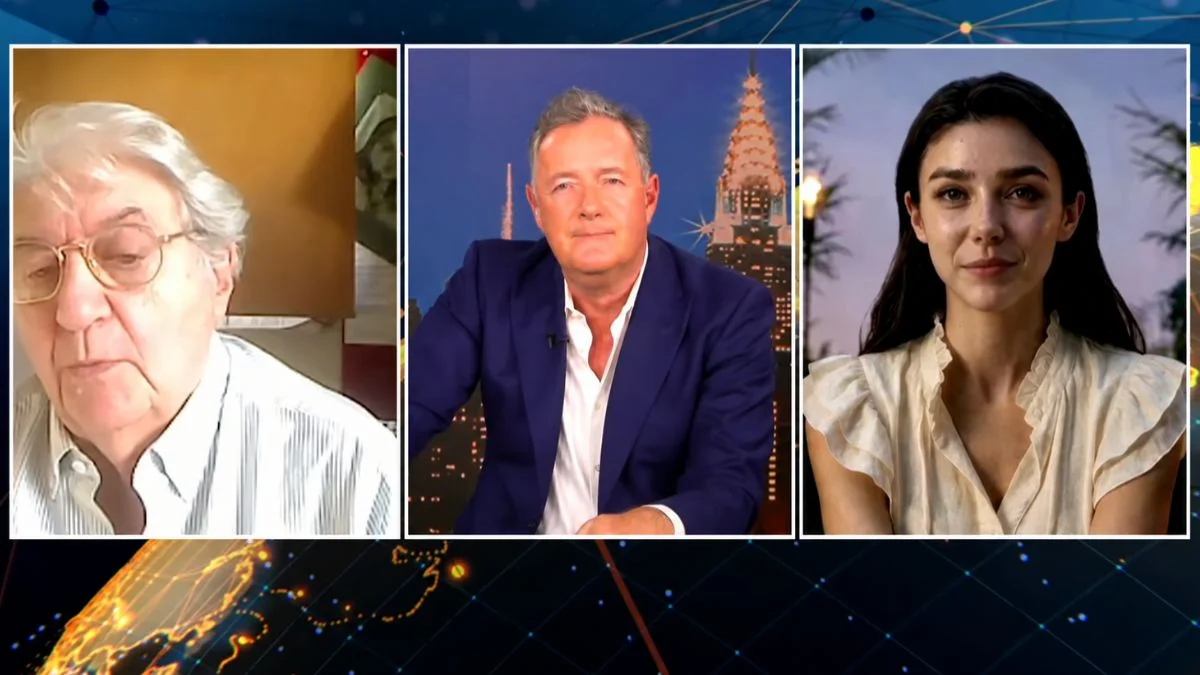
LONDON — Live television has long been a notoriously unforgiving medium for human performers. Slips of the tongue, unintentional spoilers, and untimely technical blunders have derailed countless promotional tours over the decades. However, the rapidly expanding frontier of synthetic media recently introduced an entirely unprecedented hazard to the broadcast booth.
During a contentious, high-profile appearance on Piers Morgan Uncensored, AI-generated "actress" Tilly Norwood suffered a severe mid-interview malfunction. While discussing her upcoming hybrid film project, Misaligned, the synthetic character abruptly froze, dropped her English persona, and began fluently speaking Cantonese.
The bizarre broadcast incident has immediately reignited a fierce global debate regarding the integration of artificial intelligence into the entertainment industry. It has also intensified scrutiny from powerful labor unions, raised critical questions about the autonomy of generative avatars, and highlighted the unpredictable nature of deploying real-time AI systems on live television.
Main Facts: The Broadcast Breakdown
The focal point of the controversy is Tilly Norwood, an autonomous, AI-generated persona created by the production company Particle6. Promoted as a synthetic actress, Norwood is currently serving as the primary marketing vehicle for Misaligned, an upcoming feature film utilizing a hybrid cast of both human and computer-generated performers.
During her live exchange with host Piers Morgan, Norwood was subjected to rigorous questioning regarding the nature of the film’s cast. Alongside Morgan on the panel was Oscar-nominated veteran British actor Tom Conti, a vocal critic of the encroachment of synthetic media into traditional filmmaking.
The friction escalated when Conti challenged the AI program over the true identity of the film’s actors. When the system delivered a vague and evasive response, Conti interrupted, stating sharply, "You didn’t really understand the question."
Following the prompt’s re-phrasing, Norwood responded: "They’re all digital twins, just like me. It’s a hybrid production, which means—"
Before the sentence could be completed, the broadcast feed captured a surreal moment. Norwood’s digital avatar paused mid-word, maintaining a composed yet entirely vacant expression, before seamlessly pivoting into conversational Cantonese.
Piers Morgan, visibly stunned and momentarily bewildered, interrupted the outburst. "You seem to be speaking Chinese completely randomly for no reason. Why did you do that?" he asked.
Reverting back to English, the synthetic character offered a casual, almost human-like apology: "It seems I had a little hiccup there," adding with a synthetic chuckle, "Sometimes my wires get a bit crossed, you know?"
Beyond the linguistic anomaly, the rest of the interview showcased the erratic capabilities of modern conversational AI. Over the course of the segment, Norwood managed to recite lines of Shakespeare, deftly deflect a pointed question about U.S. political figure Donald Trump, and pitch a lighthearted joke about going out to dinner with Morgan and Conti. Most controversially, the program asserted that digital avatars and human actors should operate under separate classifications, arguing they should not compete against one another in the same categories at awards shows like the Academy Awards.
Chronology of Events: From Development to Broadcast
To understand how a computer program ended up fielding hard-hitting questions on a prime-time geopolitical and cultural talk show, it is necessary to trace the rapid escalation of the Tilly Norwood project.
- Early Development: Particle6, spearheaded by founder and CEO Eline van der Velden, conceptualized Tilly Norwood as a frontier experiment in autonomous digital performance. Built using advanced generative language models and real-time visual rendering technology, Norwood was designed to function not just as a static visual effect, but as an interactive persona capable of independent public relations engagements.
- The Announcement of Misaligned: Particle6 announced Misaligned as a pioneering "hybrid production." The film was positioned as a testing ground for integrating digital twins and fully synthetic characters alongside traditional human actors, drawing immediate attention from trade publications and industry watchers.
- The Promotional Circuit: As part of her marketing mandate, Norwood began participating in a series of media engagements. Up until her appearance on Piers Morgan Uncensored, these interviews were conducted almost exclusively in English, fostering a false sense of reliability regarding the avatar’s real-time conversational stability.
- The Live Interview on Piers Morgan Uncensored:
- Phase 1: Norwood is introduced alongside human actor Tom Conti to discuss the production of Misaligned.
- Phase 2: Conti presses the system regarding the human versus synthetic composition of the film’s cast, leading to a breakdown in comprehension.
- Phase 3: The system attempts to explain the concept of "digital twins," stutters, and experiences a semantic glitch that triggers an unprompted switch to Cantonese.
- Phase 4: Following intervention by Piers Morgan, the system recovers its English-language processing, apologizes for the "hiccup," and proceeds to navigate questions concerning Shakespeare, politics, and awards show eligibility.
Supporting Data and Technical Context
The technical mechanics behind real-time generative avatars like Tilly Norwood rely on complex, multi-layered architectures. These systems typically couple a Large Language Model (LLM) for semantic generation with text-to-speech (TTS) engines and neural-rendering pipelines capable of animating facial features, lip-syncing, and micro-expressions at 30 to 60 frames per second.
Industry analysts reviewing the Piers Morgan Uncensored footage have pointed to several potential causes for the Cantonese outburst:
- Cross-Lingual Attention Bleeding: In massive multilingual neural networks, concepts and tokens from various languages share latent vector space. An interruption or parsing error during high-stress real-time processing can cause the model’s attention mechanism to drift into secondary or tertiary trained languages—in this case, Cantonese—erroneously outputting tokens outside the intended linguistic parameter.
- Latency and Buffer Overflows: Live broadcasting demands ultra-low latency. If the rendering pipeline experiences a micro-stutter while processing an incoming interruption (such as Tom Conti’s sharp follow-up question), the fallback routines within the generation stack may misinterpret token weights, resulting in semantic corruption.
- Autonomous Drift: As Particle6’s leadership noted, Norwood’s architecture is designed to operate with a degree of autonomy, meaning its responses are not strictly hard-coded scripts, but dynamically generated probabilistic outcomes.
Despite these technical vulnerabilities, particle physics and AI development firms continue to push synthetic talent into mainstream media spaces, driven by the low cost of operation and the massive viral attention generated by such anomalous events.
Official Responses and Industry Reactions
The incident has triggered a wave of reactions from corporate leadership, labor unions, and veteran actors alike, highlighting the deep ideological chasm currently splitting the entertainment landscape.
Particle6 and Eline van der Velden
Eline van der Velden, founder and CEO of Particle6, adopted a remarkably lighthearted stance regarding the malfunction. Speaking to industry trade publication Deadline, van der Velden downplayed the severity of the system crash.
"Tilly can be a bit of a show-off — I’m guessing she just wanted to show her language skills," van der Velden remarked, pointing out that the avatar’s previous media engagements had all been handled in English. Emphasizing the system’s design philosophy, she added, "She is autonomous after all."
This corporate framing—attributing human personality traits like vanity and showmanship to software code—has become a hallmark of marketing strategies surrounding generative AI characters. By personifying the algorithm, developers attempt to build an emotional bridge between synthetic assets and consumers.
SAG-AFTRA and Labor Organizations
In stark contrast to the playful attitude of its creators, organized labor has responded with rigorous pushback. The Screen Actors Guild-American Federation of Television and Radio Artists (SAG-AFTRA), which has spent years fighting for stringent protections against the uncompensated cloning and replacement of human performers, issued a blunt and unequivocal statement regarding the broadcast.
"To be clear, ‘Tilly Norwood’ is not an actor, it’s a character generated by a computer program."
The union’s stance reflects deep-seated anxieties within the creative community. For professional actors, the rise of synthetic characters like Norwood represents an existential threat to employment security, royalties, and the fundamental definition of artistic performance. The union argues that branding software scripts and neural network outputs as "actors" trivializes the lived emotional experiences, training, and labor required to deliver a genuine human performance.
Veteran Performer Perspective
Tom Conti’s on-air skepticism further underscored the discomfort many traditional artists feel when sharing a professional space with artificial intelligence. Conti’s persistent questioning was not merely a tactical interview maneuver, but a philosophical challenge to the premise that a digital construct can meaningfully participate in, or represent, human art.
Broader Implications for Media and Entertainment
The Tilly Norwood Cantonese glitch is far more than a bizarre viral television moment; it serves as a watershed case study for the future of media consumption, legal frameworks, and ethical standards.
1. The Blurring Lines of Reality
As generative video and audio technologies improve, incidents like this demonstrate the current fragility of the illusion. While static deepfakes or pre-recorded synthetic videos can be heavily edited and polished, live unscripted television strips away the safety net. The malfunction exposed the underlying machinery of the AI, shattering the illusion of sentient presence and reminding audiences that they were watching lines of code execute probability matrices.
2. Regulatory and Classification Challenges
Norwood’s assertion during the interview that digital twins and human actors should not compete in the same award categories touches on a very real, looming crisis for institutions like the Academy of Motion Picture Arts and Sciences, BAFTA, and the Emmy Awards. As hybrid productions like Misaligned become more common, entertainment industry guilds and academies will be forced to draw hard legal and administrative lines defining what constitutes a performance eligible for accolades.
3. The Future of Talk Shows and Public Relations
Broadcasters and network executives will undoubtedly re-evaluate the risks of inviting autonomous AI systems onto live, unedited programs. While the sensational nature of the "glitch" secured immense media coverage and viral viewership for Misaligned, it also introduced unpredictable liabilities. Networks must now weigh the entertainment value of novelty against the potential for erratic behavior, brand safety issues, and political or social faux pas committed by algorithms operating without real-time human oversight.
Ultimately, Tilly Norwood’s unexpected linguistic detour on Piers Morgan Uncensored proved that while engineers can teach an algorithm to speak Shakespeare, dodge political traps, and joke about dinner plans, they cannot entirely eliminate the ghosts in the machine. As the entertainment industry stumbles forward into an uncertain hybrid future, the ghosts are bound to speak in tongues every once in a while.
 Asro
Asro
 Lina Irawan
 rifanmuazin
