

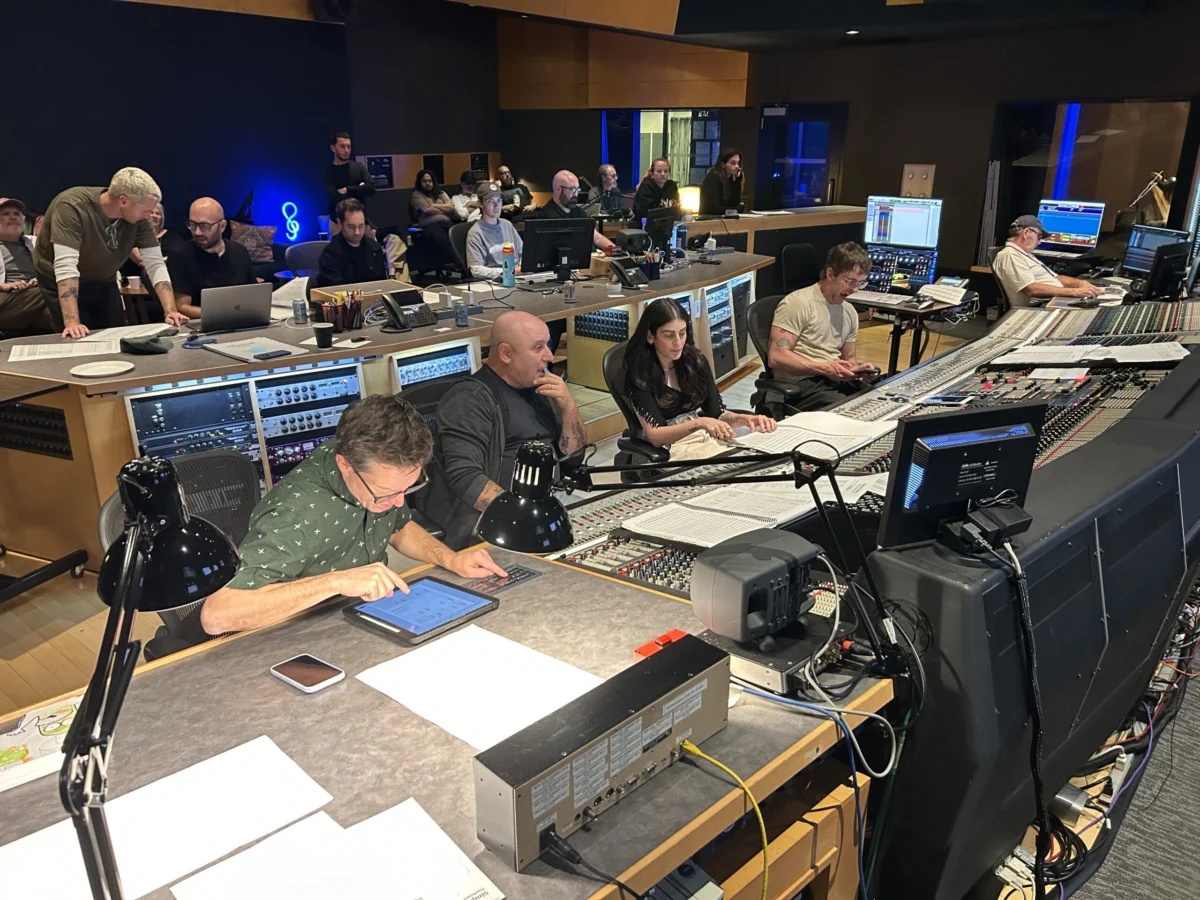
As the clock struck 7:00 p.m. on September 23, the Newman Scoring Stage on the 20th Century Fox lot transformed into a cauldron of sonic experimentation. Dozens of top-tier musicians filtered into the room, hauling double-basses, percussion rigs, and a rare, otherworldly instrument that has become the spiritual anchor of The Simpsons’ most iconic annual tradition: the theremin.
The atmosphere in the control room was a high-stakes blend of professional intensity and creative levity. This was the final hurdle for The Simpsons’ "Treehouse of Horror XXXVII," an episode that promises to be as musically complex as it is narratively twisted. Overseeing the chaos was six-time Emmy winner and series veteran Tim Long, acting as the episode’s steward. At the helm of the mixing board sat Russell Emanuel, the jovial co-founder of the Bleeding Fingers music collective, and at the center of the creative storm was the show’s composer, Kara Talve.
A Legacy of Sonic Horror: The Chronology of Change
The transition of the show’s musical identity has been a significant journey. Since 2017, when the legendary Alf Clausen concluded his 27-season tenure, the Bleeding Fingers collective has held the keys to the kingdom. Within that group, Kara Talve has emerged as the definitive voice for Springfield’s musical landscape.

Emanuel, reflecting on Talve’s trajectory, noted the transformation from a quiet protégé to a powerhouse composer. "She used to be a shy little assistant. She wouldn’t look up, she wouldn’t talk," Emanuel recalled. "Now, she’s an absolute rock star." Her work on the series has earned her five Emmy nominations and a Grammy nod, and her influence is expanding beyond the yellow walls of Springfield, as she now helms the score for HBO’s highly anticipated Harry Potter series.
Long, who has collaborated with Talve extensively, admitted to a sense of awe regarding her work ethic. "I don’t know when she sleeps," he joked. "She is so good and so fast." For her part, Talve remains humble, insisting that the collaborative spirit of Bleeding Fingers is the true engine behind the show’s success. "My job is to take the helicopter view and then take all the glory," Emanuel quipped. "I give 10%, she does 90%."
The Complexity of the Score: A 43-Piece Nightmare
"Treehouse of Horror XXXVII" is, by any metric, the most musically demanding episode of the season. The production required a 43-piece orchestra to execute nearly 50 distinct cues live to screen. The sonic palette is broad, ranging from a chaotic, operatic homage to The Nightmare Before Christmas to a tense, suspenseful score that mirrors the terrifying mundane reality of a DMV visit.

The recording session took place before the final animation was locked and before the guest cast—including Tiffany Haddish and Jeff Probst—had completed their voice work. This "temp" phase is a standard part of the Simpsons workflow, yet the music must be precise enough to dictate the pacing of the final animation.
Official Responses: Defining the ‘Treehouse’ Ethos
The Treehouse of Horror specials serve as a "show within a show." Because these segments are non-canon, the creative team has the freedom to push the boundaries of character behavior and violence. For the 2026 edition, the directive from series creator Matt Groening was singular: make it truly, genuinely frightening.
"Matt had brought it up a few times," Tim Long explained. "The spirit of it is that these should be genuinely frightening, or at least lean in that direction. I took that to heart."

Kara Talve, a self-confessed horror fanatic, found the challenge invigorating. "I just love horror movies—that’s my genre. Every Halloween, I stream a bunch of horror movies, and I love creepy music in general. I love dissonance."
The team treats the episode with a level of reverence that reflects its status as a fan-favorite. Long emphasized that the stakes must remain high, even in a parody. "We get to have the characters act even more abhorrently than they normally do and, more importantly, start killing them off. That’s what makes it fun."
The ‘Nightmare’ Homage: Skating a Fine Line
A major focus for this year’s installment is the opening sequence, a musical parody inspired by The Nightmare Before Christmas. The production team at Stoopid Buddy Stoodios, the creative house behind Robot Chicken, handled the stop-motion animation, creating a world where characters like Comic Book Guy assume the roles of the macabre figures from Tim Burton’s classic.

The parody of Danny Elfman’s "This Is Halloween" required a delicate touch. "I’m skating a fine line," Talve admitted. "It’s hard to parody stuff that’s so iconic. Obviously, you want [Elfman] to sing the original tune." While there were discussions about bringing Elfman in for a cameo, scheduling conflicts prevented it. Nevertheless, the creative team delivered a composition that stands on its own, providing a meta-commentary on the nature of the show itself.
Supporting Data: Audio Easter Eggs and Influences
Beyond the grand arrangements, the score is packed with subtle auditory nods for the observant viewer. Long, a student of classic film history, provided Talve with specific mandates for each segment.
"For the Bart Dog/Dog Bart one, I wanted to evoke the score from the original Carrie—the Brian De Palma film," Long noted. For the driving-centric segment of the episode, the team drew inspiration from Steven Spielberg’s Duel and the high-octane score of Speed.

Talve’s reverence for composer Bernard Herrmann also plays a central role. "You can hear it throughout," she said, referencing the legendary composer of Psycho and Taxi Driver. "There’s just so much menace in his work."
One of the most unexpected inclusions is a "scary" version of the children’s song "On Top of Spaghetti." The idea, pitched by assistant Alexa Patterson, demonstrates the collaborative, "anything-goes" environment of the Simpsons writing room. "Every once in a while, an assistant will pipe up with something and we go, ‘Damn, that’s a good idea,’" Long said.
The Theremin: The Secret Weapon
Perhaps the most crucial instrument in the recording room was the theremin, a device that produces sound through the manipulation of electromagnetic fields—no physical contact required. The show’s history with the instrument is cautionary.

"The very first ‘Treehouse’ season we were on, we used a sampled theremin," Russell Emanuel shared. "Matt Groening was there. He heard it right away. ‘That’s not a real theremin.’ Not only did he know what sound he wanted, he knew the level of distortion he wanted. We had to cancel the dub and go back."
Since that day, the show has relied on live performance for its theremin tracks. This year, musician Lara Wickes took the lead. The complexity of the instrument led to a humorous moment in the booth when Tim Long attempted to play it. "I asked if something I was doing had an effect, and she said, ‘No, that doesn’t do anything,’" Long laughed. "I realized I was ‘theremin-splaining’ her own instrument back to her. I had to back off."
Implications for the Future of the Franchise
The level of detail poured into "Treehouse of Horror XXXVII" underscores a broader trend for The Simpsons: a commitment to maintaining the show’s cultural relevance by honoring its history while embracing new, younger talent like Talve.

By blending high-concept parody with genuine, albeit darkly comedic, horror, the team ensures that the Treehouse franchise remains a cornerstone of the Halloween season. As the industry continues to evolve, the ability of The Simpsons to attract top-tier musical talent—and to keep that talent under the pressure of a 24-hour creative turnaround—suggests that Springfield has plenty of life left in it.
The episode stands as a testament to the fact that, even after 37 iterations, the Treehouse of Horror is not just about the jump-scares or the sight gags; it is about the meticulous, often obsessive craft of the people behind the curtain, ensuring that every note, every chord, and every theremin shriek hits exactly where it’s meant to.
 Nila Kartika Wati
 Nana Wu
 Neng Nana
